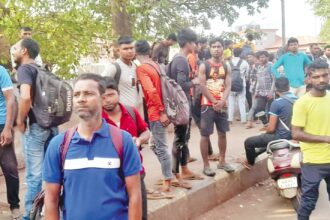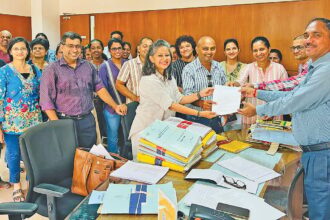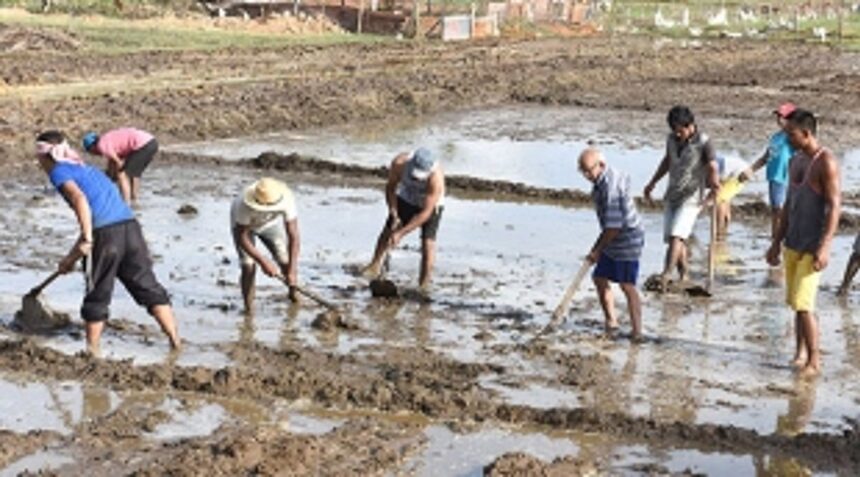
The COVID-19 lockdowns in the State and the country has actually become a game-changer for the agriculture sector, especially in Saligao village and many other areas of Goa. Farmers, who had given up cultivation for decades are moving back to the occupation.
Back in their villages due to lockdown, some youngsters from the coastal belt who had deserted farming in search of greener pastures in cities are now showing interest in returning to their roots.
No matter if they are engineers, post-graduates and so on, the educated youth across Goa, with a farming background, have decided to make agriculture their business.
Their farms were left barren for ages, only for the government and ministers to acquire them for road widening and other projects.
But the current food crisis and sackings in employment sector, seems to have pushed the youth to fall back on traditional farming.
Ramesh Ghadi, of Save Saligao front, himself a farmer and Gulf returnee, has started the revolution in the village after his group started protesting against alleged illegal conversions of agricultural land and also alleged illegal constructions.
Inquiries reveal that 90 per cent of the agricultural land in Saligao belongs to the Comunidade.
Ghadi says, “Saligao is a name derived from word Sal, which means paddy. So there has always been a farming culture here but in the past few decades, people saw greener pastures and quit the profession. However, this year, call it the COVID effect or Save Saligao impact, the area under paddy cultivation in village will go up by at least 20 acres in this monsoon. Many of the fields are ploughed and ready for sowing.”
He added that judging by the inquisitiveness of those who want to take up farming; an additional 10-20 acres are likely to come under paddy alone in Saligao this year.
He further says, “Our survival is dependant on agriculture and a good harvest depends on quality seeds delivered to farmers by the seed sector, both public and private. As we are in the midst the coronavirus crisis, it is imperative that good seeds and other farm inputs reach the farmers in time for the Kharif crop season”.
He adds, “These are frightful times, where we need courage and truth as the lodestar. We need to make informed decisions so COVID-19 doesn’t evolve to threaten our agriculture and food supply.”
Ghadi says that the govt needs to be very strict in this regard. “The permissions for pump houses should be small. Otherwise some take permission for pump house and build huge buildings,” he says, while adding the govt also has to be strict on conversion of agriculture land.
Ghadi rued the fact that there is dearth of labourers right now but mechanisation has helped us lot.
Yuvraj Toraskar, from Muddavadi, Saligao, a farmer started ploughing his field after 20 years, says, “COVID -19 was an eye opener for many of us.”
He added that he felt guilty for neglecting the paddy fields for two decades when there was shortage of vegetables and rice during the first lockdown.
“Everything was coming from neighbouring States and despite having our fields, we had nothing,” he said, while adding, “but not anymore; this year I am cultivating my field after 23 years. I will never ever keep the fields barren again”.
Another farmer, who is working as a government employee and didn’t want to be named says, “No more excuse of being busy with my job. I will make farming my priority and will teach my children too the importance of agriculture. We have suffered a lot during lockdown”.
Another farmer, Natha Omrajkar, a foreign returnee, who worked as a Chief Engineer in the Gulf and also worked in Taj Fort Aguada, has been a driving force for agricultural sector in the village.
Omrajkar is first person to have his own harvester and tractor and even today very few have their own in village. He, however, rues the fact that though the government makes several announcements, it has failed to deliver. “My subsidy has not been given for years and upon inquiry, I was told that the files have been eaten up by rats in Agriculture Department,” he says.
He further adds that the government must give a good support rate for the produce and across the counter and should not delay the subsidy.
“I have cultivated even basmati rice and steamed rice with good seedlings,” he says.
Community farming culture in Saligao
There is a group of farmers in Saligao, who help each other and do not depend largely on outside labour.
Farmers like Anand Kerkar, Sunil Parulekar, Pradeep Parulekar, Rangnath Gawade and Pundalik Pednekar amongst many others, have a group, which helps each other in sowing the seeding and also harvesting etc.
For those, whose fields are deep inside and do not have road access Sunil Parulekar helps with his bullock cart, which is the only one left in the entire constituency.
Mind you, despite the tractors availability; many farmers take up ploughing in the old traditional ways called as ‘Paddeanchim Zottam’ or ‘Nangor’.
“Farming is part of the culture in Saligao, but despite this, many had left their fields barren for decades. But now after many lost their jobs and realised that food has become a scarcity, they have taken back to the fields,” said Pradeep Parulekar.
Pednekar, a graduate who has been working in the service industry, says his family has been cultivating 20,000 sq metres or five acres for seven decades, and he takes leave whenever required.
“We keep 30% for our consumption while the rest is sold to the government,” he says.
He urges the youth to take up farming full time and reasons that if one has to take it up as a full time profession, there can be a lot of profits for them. Also, he adds, the farmer has to be involved himself and not depend on the labourers.
St Cruz family takes to field after 15 years
Even as the villages are is in the eye of the storm over alleged illegal land-fillings in agricultural zones, the villagers from St Cruz and Taleigao have taken up the responsibility of cultivating their fields after decades thanks to the COVID-19 as many have been left unemployed due to the pandemic. The fields along the Taleigao-St Cruz road at Bandar were left barren for decades now but this year is going to be different.
The Dias family has a catering business but now with no business due to the lockdown, they decided to fall back on their traditional business, for their livelihood.
Speaking to Herald, Anthony Dias, of Bandar, St Cruz, was sitting at home for the last three months as his business had shut down due to the lockdown.
Dias, who is a caterer, saw no help coming from government too and thus he decided to take the step.
“My father said instead of us sitting at home, lets cultivate our fields. My entire family, that is my father, five brothers and children started doing work in the fields,” Dias adds.
He further pointed out that now they are all very happy and there is also a special feeling that their family has started working in the fields after 15 years.
“Our father continued to cultivate but after that every brother started moving away with his own business or went abroad. At that point, he could not do it alone so he stopped. So when our father gave us this suggestion, we respected it and started working in the fields,” he says.
Dias also suggested that people should start cultivating their fields as otherwise the government tends to acquire it and builds huge buildings on it.
“If cultivated, ministers will stay back and not acquire your land,” he says, while adding that there also facilities available with the government like machines, fertilisers and seeds, which are given free of cost.
Farmers’ response to COVID-19 is encouraging: Agriculture Minister
Minister for Agriculture Chandrakant Kavlekar alias Babu says the farmers’ response has been encouraging and he wants the occupation to see a further growth.
“In the last one year we have been stressing on bringing back the barren lands into cultivation and we have been successful so far,” said Kavlekar.
The Deputy Chief Minister further added that every year around 300 kgs seeds are supplied to the farmers.
“But so far for the last 11 months the demand has increased by almost 5 times. Till now we have distributed around 900 kg and there is further demand for another 600 kg,” he said.
He added that the youth have to get back to the fields and take forward the traditional occupation of Goans.
“These are testing times and there is uncertainty in the employment sector, hence the youth must see this as a business and take it forward,” he says.
The minister opines that the farmers need to become self-sustaining and that the COVID pandemic has thought everyone to become ‘Atmanirbhar’ (self-reliant).
“Today we know the neighbouring States are in red zones but we still have to depend on them for essential supplies. If our farmers had produced the veggies, we would not have had to depend on red zones,” he said.
Kavlekar adds that the government – both Central and the State, provide tremendous support to the agriculture sector.
“There are several government schemes. Besides that, there are support prices and subsidies. The State gives subsidised seeds, subsidies for fencing of fields, seeds, manure, harvesting machines, tillers and tractors,” Kavlekar explains.
Detailing his government’s support to farming, he said the Zonal Agricultural Offices (ZAOs give farmers advice on the type of cultivation they can do on the land as well on the selection of seedlings and fertilisers.
“We have also made a WhatsApp group of farmers and ZAOs, wherein they can ask for advice or submit complaints. The ZAO immediately attends to these issues,” he said.
Kavlekar further says that the department has also increased procurement centres.
“I have directed the Horticulture Corporation to lift the produce from local farmers first and rest from Belgaum. I am also working on a strategy to see that the farmers get the money immediately,” he said.