The declaration and description of National Highways in India was first published in the National Highway Act 1956. In essence, the 1956 Highway Act lays down a schedule of multiple laws that empower Highway Authorities to declare acquisition of land for highway construction, the power to survey, to make rules, to maintain and develop national highways, to determine the amount payable for compensation and several other minor rules.
Of interest to us in Goa is the 1956 Act, which describes for the first time – the NH4A highway connecting Belgaum, Anmod, Ponda and Panaji (ref. pg.8 in 1956 Act) which presumably would have to pass through Bhoma and Corlim on its way to Panjim.
The NH4A was notified as a Standing Order (S.O 3344(E) dated July 21, 1971. This 52-year-old notification has been repeatedly touted by government authorities as justification for routing the highway through the villages of Corlim and Bhoma.
Three years later, the Goa Daman and Diu Highways Act 1974 came into force on June 27, 1974 with essentially the same set of laws as in Act 1956, but having extra rules, empowering NH authorities to fix boundaries for the highway and land the required to be marked and measured.
Nothing happened in these three years (1971-1974) , until a set of 16 notifications were issued in the official Gazette of India covering the period 1977,1989, 1985, 2012,2013 2014, 2015, and 2017. A quick look of these notifications and their
amendments pertain to name change of the Act, appointments of personnel and other
administrative matters.
However, the 2017 notification (5-1-PCE-PWD-EO/201-18/25) dated May 4, 2017), issued by the PWD Principal Chief Engineer, favoured a bypass due to traffic congestion on the highway.
What does this notification say? For the first time the word “bypass” was used in reference to the widening of sections of existing National Highway, which is not possible due to built-up sections over time, resulting in congested areas.
In such cases, sections of National Highway were bypassed and new bypasses were listed in the notification; examples being the Mapusa bypass, Santa Cruz bypass, Goa Velha bypass, Ribandar bypass closer to Old Goa-Corlim-Bhoma, Mardol bypass, Ponda bypass and the Usgaon Tisk bypass.
The notification further stated that the new bypass would be absorbed as part of the National Highway network. The existing discarded lengths reverted to the State of Goa, were then classified as District Roads with 20m Right of Way (ROW).
Village Opposition to the widening of Corlim-Bhoma Road
Since the declaration of the Goa Highways Act 1974, the NH4A highway (in what concerns us) passing through the villages of Bhoma-Corlim – Ella Old Goa remained largely unattended with lukewarm attempts to widen the highway in 1986-87, dropped by the PWD in 2016, and in 2010 when it was unanimously opposed in the Gram Sabha.
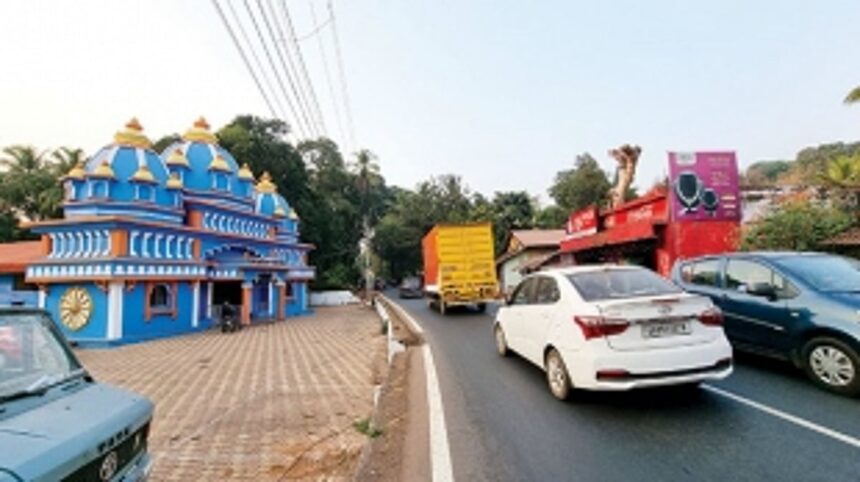
It is clear that villagers of Corlim-Bhoma have opposed in one voice the extension as it does not have community support. It was natural that over 52 years since its declaration as a Highway in 1971, the Corlim-Bhoma section began to have built-up sections, resulting in significant congestion at various sections along its length.
Finally on August 2 last year, the authorities came up with the suggestion of a 2 km elevated highway on stilts, which have numerous drawbacks (see box). As expected, this has been vigorously
opposed.
It is surprising that the highway authorities and Goa government have missed applying the 2017 notification (5-1-PCE-PWD-EO/201-18/25)- dated May 4, 2017), issued by the PWD Principal Chief Engineer, favouring a bypass as a solution for traffic congestion on the highway. The Corlim-Bhoma-Old Goa highway section satisfies all the criteria of the 2017 notification.
The villagers in an appeal to the NHAI and the Government of India authorities have suggested the construction of a modern green by-pass highway link from the Kadamba to the Kundaim highway along the fallow fields, avoiding human habitation.
Such a bypass will be broad enough to handle future traffic demands. The villagers want the by-pass link highway to be a showcase for ‘green development’ with solar power used for road illumination, signs, information panels, emergency EV charging stations and lay-bys.
This has whole hearted community support from the villagers of Corlim and Bhoma, as it will solve all current problems pertaining to road widening as well as the inevitable growth of traffic in future.