Two and a half years ago, locals of villages in the Mormugao coastal belt had braved the pandemic and submitted over 2,000 objections to land acquisition proceedings for the controversial railway double-tracking project.
But, their worst fears turned into a reality on December 3, when they read the award published in the local dailies.

The public notice specifying the brief description of the land to be acquired, with or without structure, falling within the proposed Special Railway Project, Hospet – Hubli – Tinaighat – Vasco-da-Gama doubling, in the State of Goa was issued by the Deputy Collector and Sub-Divisional Magistrate (SDM) of Mormugao, Ravishekhar Nipanikar, who is also the competent authority appointed for the land acquisition process for the railway double tracking project.
As per that notice, a total compensation of Rs 101.61 crore (Rs 1,016,125,163) is to be paid for the 46,498 sq mtr land that is to be acquired for the double tracking project from Collem to Vasco. The doubling work of the 352.58 Km Hospet to Vasco Railway line is to be done at an estimated cost of Rs 3,692.60 crore.
So far, 75.16 % ie 288.28 km, primarily in the Karnataka region, has been commissioned by Rail Vikas Nigam Limited (RVNL) which is executing the project.
It may be recalled that in the month of June 2020, notices were issued by the Mormugao Dy Collector and the Competent Authority stating that 103 survey numbers had been marked for the acquisition of a total area of 60,177 square meters.
From this, 51 survey numbers will come under acquisition from Kulem to Margao and the remaining 52 survey numbers will be acquired from Majorda through Vasco, through the villages of Cansaulim, Pale, Issorcim, Dabolim, Chicalim and Vasco.
“There have been three distinct land acquisition processes. The land acquisition award that was recently published in a local daily pertains to the very first land acquisition that was initiated on March 4, 2020. Since the double tracking project is notified as a ‘Special Project’, it should be time-bound and the land acquisition process should have been completed within a year,” said Orville Dourado Rodrigues, Goencho Ekvott (GE) Founder member.
“We understand that the Land Acquisition Authority was given time extensions on account of the Covid-19 pandemic. However, no such courtesy was extended to the numerous petitioners, most of whom were senior citizens who had filed objections to the land acquisition notification within the stipulated period,” Rodrigues said.
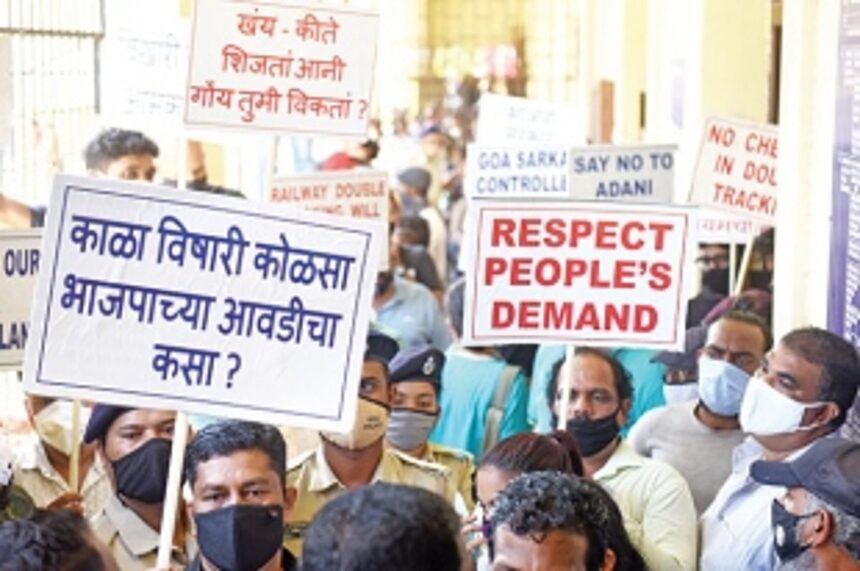
It may be recalled that on account of the major public demonstrations led by GE, Goyant Kollso Naka (GKN), other allied organisations as well as political leaders cutting across party lines, the then ‘competent authority’ had taken the decision to stall the Land Acquisition process for a brief period.
At that point of time, the villagers had thought this was a welcome relief but it turned out to be a short one at best.
However, the ‘competent authority’ recommenced the land acquisition process again thereby putting the senior citizens to great risk during the pandemic. Taking great risk to their lives to protect their inheritance, these senior citizens had to attend hearings in the deputy collector’s court initially at Vasco da Gama and thereafter at Baina.
One such family members is the 78-year-old Michael D’Souza who lives in his ancestral house Primero Vaddo, Velsao, with his 70-year-old wife Maria Olga D’Souza while his 73-year-old-brother Anthony lives next door.
There are visible cracks all over his house, right from the compound wall out front to the kitchen inside and the trio were in tears while talking about how their hearts are heavy as they can’t get sleep at night or have peaceful days due to the constant vibrations from the numerous coal-laden wagons that pass their houses and invariably drop coal pieces in their property on a regularly basis.
Their house faces the railway tracks and their public access has been blocked and they don’t even have enough space to walk, let alone allow vehicles like an ambulance to pass through.
This is just for perspective as there are hundreds of senior citizens who are dealing with a similar ordeal, and instead of the government or authorities attending to their grievances, they have been slapped with notices after notices for hearings.
“We have such a small space of land and they want to grab this too. We had to go for the hearings all the way to Vasco during the Covid pandemic. The matter is still not over and this troubles us greatly. It is heartbreaking to consider that this ancestral house of mine where my parents and others lived will have to be torn down,” Michael added.
“It looks like they will stop at nothing to take our houses. Even if we die here trying to protect our house, they will still go ahead. Our quality of life has already taken a beating. Our trees and plants are affected. But this is still our home. Where will we go and why should we leave?” said Anthony.
However, as per the Mormugao SDM, they have followed all due procedures and handled each case as per the law and have thus gone ahead with the public notice announcing the award.
It may be shocking to know that of the 2,719 objections received by the ‘competent authority’ from persons and institutions, only 66 of these were listed as valid interest in the land that was to be acquired.
So the remaining lot that had filed objections based on collateral damage to their existing heritage/traditional houses, environment, etc., were outright dismissed without giving them an opportunity to hear them out.
“That is why it was and it’s still necessary that a Public Hearing, coupled with a detailed Environment Impact Assessment (EIA) has to be conducted by the Government in all fairness to the residents residing alongside of the existing railway tracks whose residences and farmlands have been devastated by the fugitive coal dust,” Rodrigues added.
Two petitions are also being heard by the Goa Bench of the Bombay High Court against double tracking where these land acquisition related issues have been raised. Another couple of petitions are also in the process of being filed.
The gram sabha of Velsao village panchayat has also resolved to approach the Supreme Court.
Max De Souza, who is part of the Village Action Group against Double Tracking (VACAD) and Chairman of the Velsao’s Village Development Committee (VDC) chairman, elaborated about one such petition that has been filed by the panchayat in the High Court against the Railways.
When the track was first laid in the Portuguese era, it was a meter gauge track laid. The speed at which the trains were moving was 40 km/hr. Today they’re moving at 110 km/hr. Our ancestors had kept a patch of land on both sides of the track, around ten metres, which was very well thought of.
“It was intended for vibration dampers where trenches were built and that vibration was being absorbed by the trenches. So, it was not affecting the old houses as the vibrations were moving below. Today, the Railways claim it is their land. So, we have filed a petition in the High Court,” De Souza added.
GKN’s activists such as Abhijit Prabhudesai are of the opinion that the award pronounced by the Mormugao Deputy Collector and SDM has to be rejected as it is in violation of the laws in force.
“The land acquisition award will be challenged by the people since it has been pronounced in violation of the law. The officer has no jurisdiction to give the award,” said Prabhudesai.
“Also, even though hundreds of people had filed their objections, the deputy collector has only taken cognisance of the objections filed by the owners,” he added further.
Prabhudesai and several other activists are presently tied up with cases filed against them by the Railway Police Force, Vasco, and the Maina Curtorim Police for their role in the mega protests at Chandor in November 2020 and a smaller one in Arossim in the same year.
Elsewhere, a local resident from Cansaulim, who did not want to be targeted by the government, gave another example of how the entire land acquisition process appeared to be flawed.
He said there is a particular case in Cansaulim, whereby land,which is directly in line with other adjoining land to be acquired, belonging to Fabrica de Igreja de St Thome and gifted to the Holy Family Society was kept out of the land acquisition award, despite both parties being earlier notified and had filed objections to the land acquisition of their land which houses the St Anne’s convent.
He lamented that ‘this bits and parts land acquisition process’ has caused a fear psychosis among the residents, as who could be targeted next by the Railways.
There are also others in Majorda who have no faith in the land acquisition process given that the authorities have failed to do what is right by them for years now.
For example, in the Comunidade of Majorda, there is a portion of land that was used for the laying of the single track during the British times even though there is no evidence of acquisition in the first instance by the South Western Railways. J A Jacques, the President of the Comunidade had filed objections to the public notices that were issued for the land acquisition proceedings for the double tracking project.
“Twenty years ago, when the Railways wanted to use more land for the broadening of the road next to the tracks, this Communidade went to Court against it. But the Court ruled in their favour and gave them the added “benefit” on the assurance that compensation would be paid. The railways pleaded that they did not have the budget for it and would compensate when they had budgetary provisions. They still haven’t. For twenty-plus years,” he said.
There were another set of environment related objections that were filed by the villagers who felt that the competent authorities should have also considered the irreversible destruction of the human settlements due to coal transportation.
In that regard, apart from the loss of their inherited land, the affected villages had in their objections, given specific reasons like how coal dust from passing railroad rakes will cause them grave ill health, polluting their air, land and water resources. They had also cited the noise pollution caused by the passing rakes which violate noise pollution laws as they don’t stop the coal transportation even during the night. They pointed out that coal dust pollution is having a mega negative effect on the crop production and with increase in railroad traffic these once vibrant areas will represent ghost areas, free of human inhabitants.
However, none of this was considered by the ‘Competent Authority’ who merely stated that it was not in the ambit of its court, and that the objectors could readdress the same to the competent court or authority.
Against this backdrop what has upset the locals is that on top of the land acquisition proceedings, RVNL has continued to carry out works in what they say is private property or public land that has not been acquired by the Railways and by doing so they destroyed age-old storm water drains. The heritage St Lawrence Chapel at Arossim that was built in 1598 is also at risk with the area around the structure being dug up.
When the locals such as Camilo Souza tried to protest this, they were told by the Mormugao SDM that the land belongs to the Railways despite what the locals have claimed and that the owners of the land, if any, should bring proof and then only such works can be stopped.
“Why are the railway authorities not producing the title documents of the land that they claim to own. Usually in land encroachment cases, the encroacher is asked to prove he owns the land but it appears that those rules do not apply here,” said Souza.
Locals pointed out that the tributary of the River Sal which originates at Velsao has been backfilled with mud and other construction debris, forest cover has been totally denuded and an embankment/retaining wall is being constructed specifically for the proposed railway track. They added that this is in gross violation of the laws and lamented that repeated requests to RVNL to prove ownership of the area under construction have evoked a deaf response, and instead the villagers are threatened for trying to protect their inherited countryside.