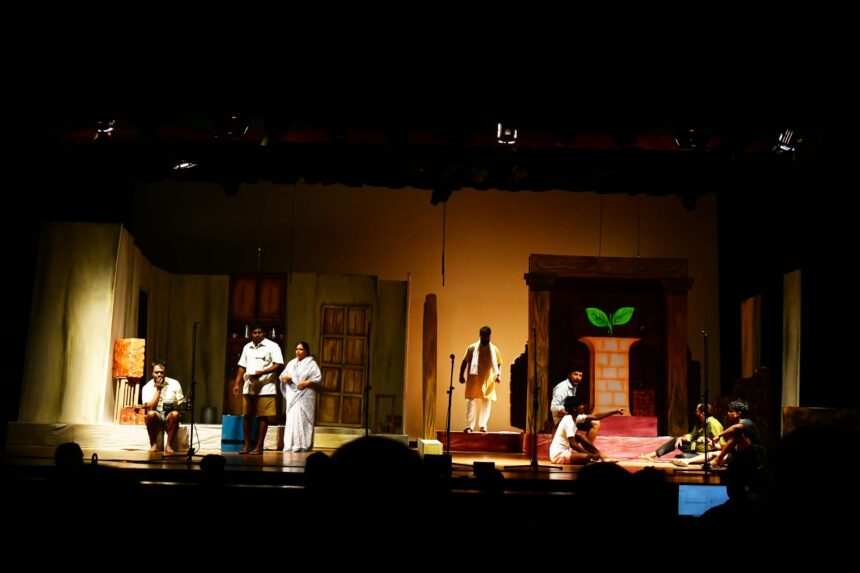
For generations, tiatr—Goa’s traditional theatre form—has been a mirror of society, a platform for debate, a keeper of the Konkani language, and a cultural thread connecting Goans at home and across the globe. Its inclusion as the 56th element in India’s National Inventory of Intangible Cultural Heritage strengthens the case for seeking inscription under UNESCO’s Intangible Cultural Heritage framework. This national recognition presents Goa with an opportunity much larger than a certificate or a prestigious title. The real question is not whether tiatr will one day receive a UNESCO tag, but what Goa can do with this recognition to ensure the art form survives, evolves, and flourishes for generations to come. MARCOS GONSALVES reports
From recognition to responsibility

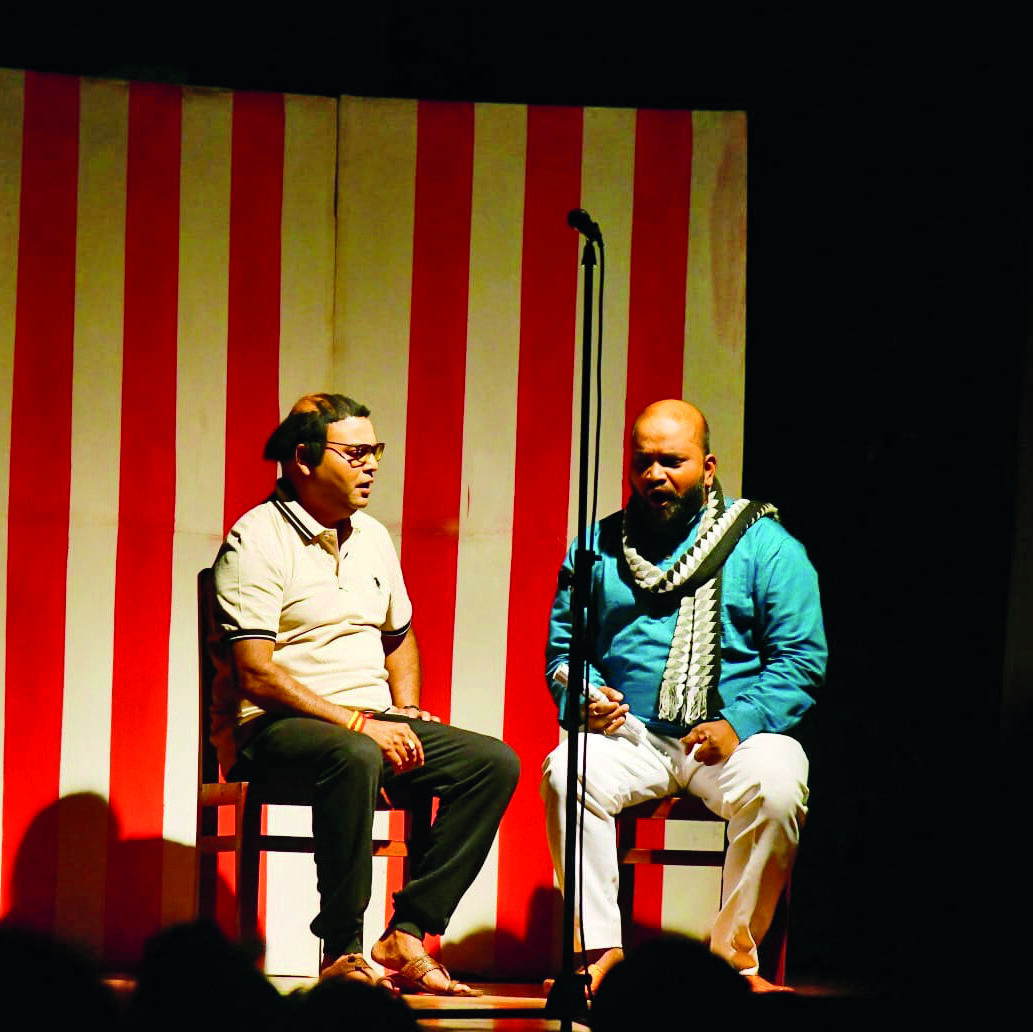
Recognition brings visibility, but it also carries responsibility. Tiatr depends on writers, directors, actors, musicians, singers, technicians, stage workers, producers, and audiences. A UNESCO-oriented approach could encourage the government to develop a policy for preserving and developing tiatr. This policy could encompass financial aid, infrastructure, training, documentation, research, education, and career opportunities for artistes.
For years, tiatrists and institutions have kept tiatr alive. Dedicated grants for original productions, support for performance spaces, scholarships for young artistes, and aid for traditional musical instruments, costumes, and stagecraft could become standard parts of such framework. Recognition should begin a process of long-term investment.
Passing tiatr to the next generation
Perhaps the greatest challenge is ensuring there will be future performers, writers, and musicians. Traditional knowledge can disappear if it is not consciously transmitted. Schools and colleges could play an important role with tiatr workshops introducing children to acting, singing, scriptwriting, stagecraft, and direction.
Colleges could organise inter-collegiate festivals and courses. Veteran tiatrists could be brought into formal mentorship programmes to allow young performers to learn from their expertise. An apprenticeship system could be developed, where a young artist works with an experienced writer, musician, director, or actor to learn skills that cannot be acquired from books. Youth festivals could become a platform, and young audiences should be encouraged to transition into creators. Tiatr should not be preserved for young people; they must become its future custodians.
Building a tiatr archive
Much of tiatr’s history exists in fragile, scattered forms. Old scripts, posters, photographs, programmes, recordings, newspaper reports, and personal collections are often sequestered in homes, trunks, and private archives and these may disappear.
A national tiatr digital archive could address this. The archive could contain digitised scripts, musical scores, photographs, posters, audio recordings, video performances, interviews, and biographies of key personalities.
It could document costumes, instruments, stage designs, and production techniques. The memories of veteran tiatrists are invaluable; oral-history projects could record their experiences—stories of travelling productions, legendary performances, changing audiences, and the social circumstances in which tiatrs were written. A young tiatrist accessing a century of Konkani theatre history via a digital platform could transform how the art form is studied and understood.
Recognition must reach the artistes
Another dimension to heritage recognition is livelihood. Tiatr cannot survive on nostalgia alone. Behind every performance are artistes and technicians who invest significant time, money, and energy. A safeguarding framework could introduce fellowships, production grants, residencies, professional training, and cultural exchange programmes. Young artistes could receive fellowships to write original scripts; musicians could be supported to preserve traditional practices while experimenting with contemporary forms. There should be programmes to enable tiatr groups to perform outside Goa and globally.
A bridge to the Goan diaspora
Goans in the Gulf, Britain, Europe, Canada, and elsewhere maintain an emotional connection with tiatr. Goan associations abroad could organise international festivals, workshops, and archival initiatives. Veteran artistes could conduct classes for younger members of the diaspora. Digital platforms could connect tiatr performers in Goa with audiences across continents, potentially creating an international tiatr network linking performers, writers, musicians, researchers, and cultural organisations.
Tiatr could become a component of cultural tourism programme. An “Experience Goan Tiatr” initiative could offer visitors an opportunity to attend performances, visit a tiatr museum, participate in workshops, and understand Konkani theatre’s history. This must be approached carefully. Tiatr should not be reduced to a performance packaged solely for tourists. Its authenticity and relationship with the community must remain central.
A new field for academic research
Universities could establish research programmes examining the history and evolution of tiatr. Researchers could study its music, stagecraft, language, and social commentary. The role of women in tiatr deserves attention, as does the development of comedy, political satire, and social criticism. Researchers could examine how tiatr has responded to changing Goan society—from migration and unemployment to family relationships, politics, social inequality, and shifting cultural values. Doctoral theses, books, conferences, and international academic collaborations could emerge from this research.
Taking tiatr to the world
International recognition could open new opportunities for cultural exchange. Tiatr could be presented alongside theatre forms from Asia, Africa, and Europe. This is vital because safeguarding does not mean freezing an art form in a specific historical period; tiatr must remain recognisably tiatr while responding to the realities of contemporary society.
What UNESCO recognition does—and does not—mean
There is a common misconception that UNESCO inscription brings large financial grants. That is not the case. UNESCO’s Intangible Cultural Heritage framework provides mechanisms for international cooperation and assistance, but inscription should not be presented as a guarantee of a permanent or substantial annual financial grant. The value lies in creating an international framework and strengthening the visibility and safeguarding of the tradition. For Goa, the emphasis should be on developing a credible and practical safeguarding plan.
A Tiatr Safeguarding Action Plan
If Goa wants to make the recognition meaningful, it could consider a long-term Tiatr Safeguarding Action Plan. The plan could begin with the establishment of a tiatr heritage centre and museum, providing a permanent home for historical materials. A National Digital Archive could preserve endangered material, and education could be integrated through schools and cultural institutions. A permanent safeguarding committee—involving the government, the Tiatr Academy of Goa, artistes, researchers, and community representatives—should oversee the process. The most important principle remains that tiatr belongs first to the community that creates and sustains it.
The bigger opportunity
The ultimate achievement would not be the words “UNESCO” attached to tiatr. The real achievement would be a stronger tiatr ecosystem: a veteran tiatrist’s knowledge recorded before it disappears; a young writer receiving encouragement; a child discovering the joy of performing in Konkani; an artist receiving a fair opportunity to earn from their talent; an old script preserved digitally; researchers studying a century of history; and a Goan living abroad maintaining a connection with home.
The ultimate goal should not simply be to get tiatr a UNESCO tag; it should be to ensure that tiatr continues to have a stage.
Academic opportunities
Dr (Fr) Luis Gomes said the significance of a possible UNESCO inscription would extend well beyond international prestige, particularly in the academic field.
“If tiatr is eventually inscribed by UNESCO as Intangible Cultural Heritage of Humanity, what would it actually mean for tiatr academically?” he asked, stressing that the significance could lie in creating opportunities for research, documentation, teaching, preservation and transmission.
Gomes pointed out that tiatr has an academic foundation, with the art form being taught at undergraduate and postgraduate levels. Four PhDs have also been completed on tiatr—one in English, two in Konkani and one in Marathi. He said UNESCO recognition could provide fresh impetus to the development of tiatr studies as an interdisciplinary field, covering areas such as tiatr history, literature, language, scriptwriting, kantaram, music, acting, direction, stagecraft, humour, satire and social commentary. He suggested that tiatr could be studied through disciplines including linguistics, theatre studies, sociology, anthropology, history, cultural studies, media and migration studies.
“Existing digital documentation can be developed into a comprehensive Tiatr Digital Archive containing scripts, recordings, photographs, posters, programmes, reviews, interviews, and other historical materials,” Gomes said. Such an archive, he noted, could become a research resource. Highlighting the importance of tiatr in the study and preservation of Romi Konkani, he pointed out that tiatr preserves idioms, humour, expressions and changing vocabulary.
Gomes said there was scope for editions of old scripts, annotated collections of kantaram, biographies of prominent tiatr personalities, bibliographies, encyclopaedic works and scholarly journals devoted to tiatr. He stressed that UNESCO recognition could strengthen the basis for developing projects under the existing intangible cultural heritage mechanisms.
According to Gomes, the ultimate academic benefit would be institutionalisation, including the possibility of a Tiatr Research Centre, research fellowships, academic conferences, digital archives and collaboration between universities and the tiatr community.
Protecting the original character
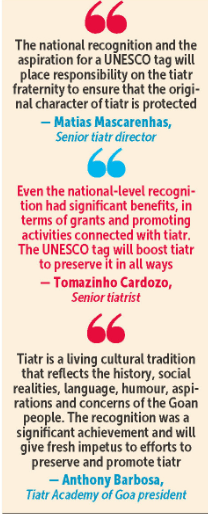
Senior tiatr director Matias Mascarenhas said the national recognition and the aspiration for a UNESCO tag would place responsibility on the tiatr fraternity to ensure that the original character of tiatr is protected. “Tiatr is known as a unique art form across the world and hence its originality needs to be protected,” Mascarenhas said.
He expressed concern over the changes taking place in professional tiatr, saying that several productions were failing to maintain the original format of the art form. “What we can see at the professional tiatr level is opposite to what we call as the unique form of art form, as maximum shows performed at the professional level failed to maintain its original format,” he said. Mascarenhas said the loss of originality was taking place at the ground level and called for serious discussions and studies to protect the traditional format without affecting the evolution of the art form. He said the national recognition could provide opportunities for grants and support for tiatr-related activities. “The Tiatr Academy of Goa can take the lead in this regard,” he said, adding that tiatr should be viewed as an art form with cultural importance.
Dr Carlos Fernandes said the next challenge was to pursue UNESCO recognition, despite the challenges. He said such recognition could help preserve and protect tiatr while also providing financial support to take the art form to the world while retaining its unique style and format. Fernandes highlighted the possibility of bringing the Goan diaspora together through tiatr. He said UNESCO recognition could also encourage greater research and in-depth studies on the art form, strengthening efforts to preserve tiatr.
Senior tiatrist Tomazinho Cardozo said even the national-level recognition had significant benefits, in terms of grants and promoting activities connected with tiatr. “The UNESCO tag will boost tiatr to preserve it in all ways,” Cardozo said. He said recognition could facilitate research on tiatr as well as systematic documentation in its original form. For Cardozo, documentation would be important as tiatr evolves and generations of artistes and their contributions risk being forgotten.
A proud moment
Tiatr Academy of Goa president Anthony Barbosa described the inclusion of tiatr in the National Inventory as a matter of pride. “Tiatr is a living cultural tradition that reflects the history, social realities, language, humour, aspirations and concerns of the Goan people,” Barbosa said. He said the recognition was a significant achievement and would give fresh impetus to efforts to preserve and promote tiatr.
Fr Doel Dias, tiatr director, described the inclusion of tiatr in the National Inventory as a proud moment. He said the recognition would provide a strong foundation for taking tiatr to the international stage. “The UNESCO tag, when achieved, will help in the upliftment of tiatr and tiatrists. The art form will be known to people across the world,” Dias said. He added that the recognition would also create opportunities for the preservation, promotion and development of tiatr, while bringing wider attention to the contribution of tiatrists to Goa’s cultural heritage.
The comments from artistes and academics point towards a common message: national recognition should become the beginning of a more organised effort to preserve tiatr’s originality, strengthen research and documentation, support artistes, and ensure that the art form continues to be transmitted to future generations. As tiatr moves towards the possibility of UNESCO recognition, the fraternity now faces the challenge of ensuring that greater visibility and institutional support go hand in hand with protection of the traditions that have made tiatr a distinctive expression of Goan culture.