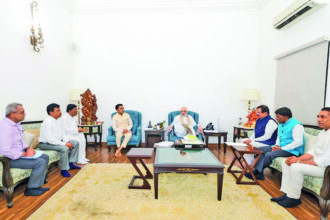
Is Goa for sale? This question is relevant, as evidenced by a recent real estate exhibition in Delhi that marks a jarring shift for the coastal State. While traditional local markets like Banastarim and Mapusa face extinction, Goan land has become the new commodity in the Delhi Bazaar. TOMAS AMANSIO RODRIGUES reports on how this aggressive commercialisation, backed by policy loopholes, is pushing fragile ecosystems like Divar Island to the brink
The threat of Section 39A

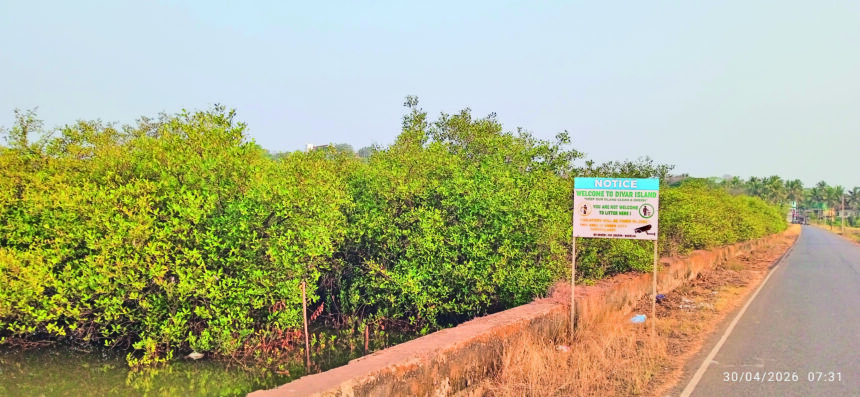
Section 39A of the Town and Country Planning (TCP) Act, which allows case-to-case conversion of land use, is facilitating the sale of Goan land. The implications of this section for ecologically sensitive and culturally significant areas are nowhere more visible than on the island of Divar whose identity is deeply tied to its landscape, environment and languid pace of change, as susegad as the ferries that take people from the mainland to the island. But that is changing and it is happening fast.
Divar island can be a case study for Section 39A, as its low-density settlements, traditional Goan homes and expansive stretches of paddy fields and wetlands coupled with agricultural systems including khazan lands reclaimed from estuaries, are not only economically important but also serve as ecological buffers that regulate flooding, maintain soil health and support biodiversity. The island ecology is fragile and Divar, in particular, is threatened by manmade issues that have already led to the water of the River Mandovi almost reaching the habitation area of the island.
Let me illustrate how this occurred: the incursion of mangroves onto the island. In the past, mangroves were always situated along the bunds or embankments on the riverside, never on the other side beyond the bunds towards the island. It’s only after breaches in the bunds that the mangroves surfaced in these areas and have even encroached onto paddy fields.
How this occurred is also a lesson to be learnt. The land on which Champion Yacht Club is situated in Divar has seen the destruction of lakhs of mangroves over a period of more than a decade, which can be particularly seen in survey number 118/1 of the panchayat of Goltim-Navelim on Divar island. This mangrove destruction has led to the bunds becoming vulnerable to the waves of the river. But these are not natural waves. Again, tourism-related high-speed boats speed past the island and the waves that hit the embankments are creating a broader impact on the island as they damage the bund, the mangroves grow on the other side of the bund and have come up to the habitation area leading also to flooding of agricultural land, making it unsuitable for farming.
The death of ‘Susegadponn’
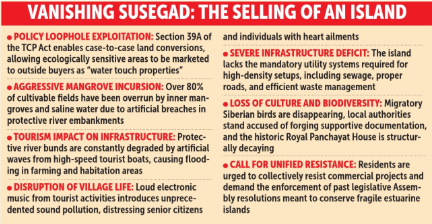
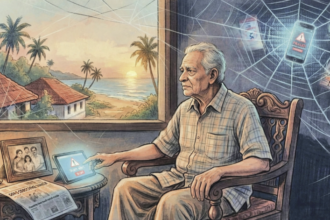
There is also sound pollution, as loud electronic music can be heard on the Divar side and surrounding areas, and senior citizens who enjoyed natural ambience and ‘Susegadponn’ are now suffering due to this unexpected nuisance. Those with heart ailments are unable to bear this sound.
Sadly, Divar is sinking and the fear that it could one day vanish from the map of Goa is real. This breaching of bunds, de-silting and deepening of the rivers will destroy the ecology of the island. Today, saline water and mangroves have ingressed upon almost 80 percent of the cultivable land. In addition, some rare species of flora and fauna exist on this island of Divar (inventory recorded by Goa State Biodiversity Board 2014 and the National Institute of Oceanography) that are on the road to becoming mass martyrs of ecological and agro-economic tragedy.
The changes began in the 1990s when the Konkan Railway blasted the river beds and Khazan land for two overhead bridges that destroyed small, beautiful landscape hillocks on the eastern side (Narva). The unfavorable site for the bridges and debris along the bridges in the river contributed to silting on one side and erosion on the other.
The ‘water touch’ trap
Unfortunately for Divar, some greedy people, including our own brokers, are making hay while the sun shines, promoting land as ‘water touch property’ and marketing it in the Delhi Bazaar. Land sales have increased so much that soon you won’t see any prominent islander on their own land. Our local authorities are equally responsible and supportive in ‘manipulating’, ‘forging’ and creating ‘fake’ supportive documentation.
We, villagers, have seen this happen even as the local governing bodies facilitate the conversion of paddy fields into mangroves, when they should be doing just the opposite. There is no reasonable or logical explanation for this conversion, except that mangroves are deemed forests and will add to the forest cover of Goa.
However, converting paddy fields to mangroves will have huge ecological impacts on the island as mangroves are known to degrade the land, grow quickly and congest the waterways. The residents of Divar have seen how quickly mangroves have encroached on paddy fields and can sense the disaster that could occur. Yet, to be clear, Divar needs the outer mangroves to act as a fortification along with the bund, what is not acceptable is the mangroves encroaching on agricultural land and reaching almost habitation areas. Besides, the stagnant waters have depleted the frog population and mosquitoes is the fresh concern of the villagers.
A call for collective resistance
If the island of Divar and the other river islands are to be saved from mangrove encroachment and destruction of the embankments, the villagers have to come together to resist projects that destroy the island’s biodiversity. In the past the Government of Goa passed a resolution in the Assembly to conserve such estuarine islands in the Rivers Zuari and Mandovi, which are fragile in nature, formed out of small silt deposits surrounded by the core land. This resolution has to be acted upon.
Against this background, we have to look at how Section 39A of the TCP Act can have far-reaching consequences on the island. Unlike rapidly urbanising parts of Goa, Divar has largely retained its rural character, making it both a cultural treasure and an environmental asset. But today there is fear that land use changes under Section 39A of the TCP Act, even a few of them, can lead to a cascade of transformation. A single paddy field converted into a residential plot may not seem significant in isolation, but when replicated across the island, it can disrupt ecological continuity.
The infrastructure deficit
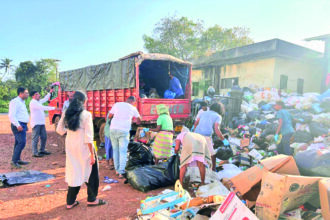
Divar is not equipped to handle high-density development. Roads are narrow, public transport is limited and essential services such as sewage and waste management are almost non-existent. It has been seen that zoning changes do not lead to proportional infrastructure upgrades, resulting in mismatches between land use and service capacity. As a result there is a strain on local resources and a reduced quality of life.
In the case of Divar, the stakes are particularly high. The island’s ecological systems and cultural landscape are finely balanced, and even small disruptions can have outsized effects. The question is not whether Divar should change, but how. Development that respects the island’s ecological limits and cultural heritage is possible and desirable. However, achieving this requires planning tools that are comprehensive, participatory and sensitive to local realities. Section 39A, in its current form, risks falling short of these requirements.
Termites, freeloaders and fading heritage
For Divar, the challenge lies in ensuring that the promise of flexibility does not come at the cost of its future. Sadly, while termites are eating away at the Divar panchayat ghar—called Royal Panchayat House due to its architecture being the only heritage panchayat ghar in Goa—the land is under attack by freeloaders seeking to destroy the village.
Unless urgent measures are taken, in the course of time Divarkars may be forced to leave their ancestral agricultural land, orchards and homes. Birds are already disappearing, as migrating Siberian birds, especially wild ducks and local birds are hardly seen. It will only be a matter of time before the original inhabitants of Divar will also not be seen on the island. Divar could one day be a fairy tale told to future generations about a beautiful island called Divar on which their ancestors used to live.