From questioning the basis of its noise pollution enforcement mechanism to easing regulatory procedures for businesses and tightening waste management oversight, a series of decisions taken at the Goa State Pollution Control Board’s latest Board meeting could reshape the way environmental regulation is enforced. KARSTEN MIRANDA examines what changed, why it matters and what it could mean
The Goa State Pollution Control Board (GSPCB) 165th meeting produced decisions that could reshape environmental regulation in Goa — from the way noise complaints are enforced to how businesses obtain clearances and manage waste. While most resolutions dealt with routine regulatory matters, one discussion stood apart: the decision to revisit the mechanism through which noise violations were monitored and environmental compensation imposed.

Why the noise framework was revisited
Unlike debates over permissible noise levels, the Board’s latest deliberations did not centre on changing the prescribed standards. Members examined whether the enforcement mechanism was capable of accurately identifying the source of excessive noise before regulatory action was initiated.
The issue has its origins in directions issued by the High Court of Bombay at Goa in the noise pollution matter. Acting on the Court’s directions and suggestions made by the Amicus Curiae, the Board made the installation of Real Time Online Noise Monitoring Systems (RTONMS) a mandatory Consent to Operate (CTO) condition. These systems transmit ambient noise data to the Board, enabling regulators to monitor compliance with prescribed limits.
According to the Board, 38 establishments were brought under the online monitoring framework. Based on data generated between June and September 2025, enforcement action was initiated against several establishments and environmental compensation was levied where noise levels exceeded the limits.
The monitoring system was brought under scrutiny, with questions raised over whether the data generated was sufficient to establish responsibility for a violation before penalties were imposed.
The minutes record that while the RTONMS accurately measures overall ambient sound pressure levels, it does not distinguish whether the recorded noise originated from amplified music, vehicular traffic, neighbouring establishments, construction activity or other sources. The system records the environmental noise at a location but cannot identify the contributor responsible for a particular exceedance.
That distinction becomes important in commercial and tourism belts, where hotels, restaurants, clubs, beach shacks and entertainment venues operate alongside busy roads and other businesses. Ambient noise recorded at a location may be influenced by several sources.
The Board revisited the methodology used for enforcement and environmental compensation. Members examined whether regulatory action based on monitoring data was sufficient and reviewed the technical basis on which environmental compensation had been calculated. The Board decided that physical verification should form part of the enforcement process.
The focus shifted to whether the enforcement mechanism is scientifically reliable, legally sustainable and capable of accurately attributing violations before penalties are imposed.
For businesses operating under the monitoring framework, the review could influence how future violations are assessed and environmental compensation determined. For residents and environmental groups, the question is whether the revised enforcement mechanism will continue to deliver effective action against genuine violations while addressing concerns over fairness and technical accuracy.
The discussion illustrates the challenges that accompany technology-driven regulation. Continuous monitoring provides regulators with far more data than periodic inspections, but enforcement depends on ensuring that the evidence collected can withstand technical and legal scrutiny. The Board’s review raises questions about how technology should be used in environmental enforcement.
The review of the noise enforcement framework is likely to influence Goa’s environmental regulatory landscape. Changes to consent procedures, a new approach for smaller restaurants, stricter compliance requirements for Bulk Waste Generators and greater reliance on monitoring point to a broader shift in how the Board approaches its responsibilities.
Changes to the consent process
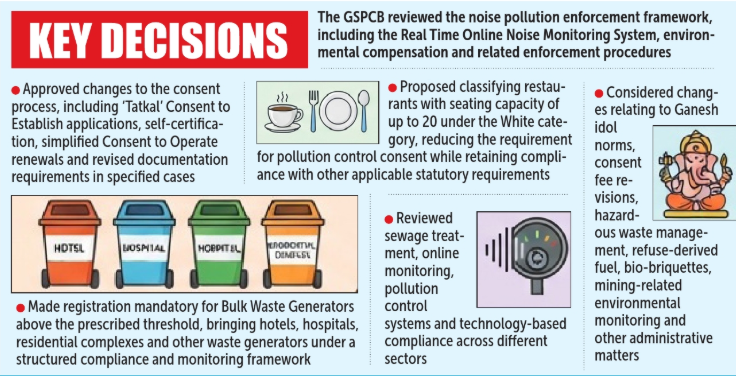
The Board approved changes to the consent process under pollution control laws, including provisions for ‘Tatkal’ Consent to Establish (CTE) applications, greater reliance on self-certification and affidavit-based declarations, revised inspection procedures, simplified Consent to Operate (CTO) renewals and relaxation of certain ownership-related documentation in specified cases. It reviewed the stage at which Goa Coastal Zone Management Authority (GCZMA) approvals are required, while retaining panchayat no-objection certificates wherever applicable.
The changes stem from a review of approval procedures that, according to the Board, had become documentation-heavy and time-consuming. The revised framework seeks to simplify procedural requirements without altering statutory obligations under pollution control laws.
One significant change was the greater reliance on self-certification. This shifts greater responsibility onto applicants. False declaration or subsequent violation would continue to attract regulatory action, making post-approval monitoring as important as the approval process.
The reforms indicate a shift from pre-approval scrutiny towards stronger post-approval compliance. Whether that balance succeeds will depend on how effectively the revised system is monitored and enforced after permissions are granted.
Why smaller restaurants are being treated differently
Small businesses are likely to welcome the proposal to classify restaurants with a seating capacity of up to 20 under the White category, which, if implemented, would reduce the requirement for pollution control consent.
The proposal recognises that neighbourhood eateries do not generate the same environmental impact as larger restaurants, hotels, banquet facilities or commercial kitchens. Applying the regulatory framework to both is viewed by operators as disproportionate to the scale of their operations.
If implemented, the proposal could simplify the process of starting and operating small restaurants by reducing compliance requirements and approval timelines. It does not exempt them from complying with laws relating to sanitation, waste disposal, food safety or other statutory requirements. It changes the pollution control consent process rather than the broader regulatory obligations applicable to such businesses.
New compliance rules for Bulk Waste Generators
While smaller establishments stand to benefit, the Board adopted a stricter approach towards entities generating larger environmental impacts.
It approved mandatory registration for Bulk Waste Generators (BWGs) above the prescribed threshold, bringing hotels, hospitals, residential complexes, educational institutions, commercial establishments and other large waste generators under a structured compliance framework.
The move intends to strengthen implementation of the Solid Waste Management Rules by making major waste generators responsible for segregation, processing and scientific waste disposal, instead of depending on municipal collection systems. Registration will provide regulators with a mechanism to identify waste generators, monitor compliance and initiate enforcement action where obligations are not met.
The decisions reflect a risk-based approach to environmental regulation. While activities with low pollution potential are proposed for simplified procedures, sectors capable of generating greater environmental impacts are being brought under closer regulatory oversight and stronger compliance requirements.
Greater reliance on monitoring
The Board reviewed a series of matters aimed at strengthening environmental monitoring, pollution control infrastructure and regulatory compliance across sectors.
The agenda covered sewage treatment plants, effluent treatment systems, online monitoring, environmental compensation, river water quality, pollution control infrastructure and compliance mechanisms. They indicate an emphasis on continuous monitoring and environmental oversight.
The Board reviewed issues relating to the functioning of sewage treatment facilities and associated pollution control systems, reflecting the challenge of preventing untreated sewage from entering rivers, estuaries and coastal waters. As urbanisation, tourism and industrial activity place pressure on infrastructure, effective sewage management remains central to protecting Goa’s water resources and public health.
The Board examined online monitoring systems and environmental compensation across sectors, signalling an increasing reliance on technology to support regulatory enforcement. While continuous monitoring can provide regulators with frequent and objective information than conventional inspections alone, its effectiveness depends on verification and enforcement whenever violations are detected.
Other important decisions
The Board considered several proposals affecting specific sectors. Among them was the decision relating to Ganesh idols, approving idols containing up to 20 per cent Plaster of Paris (PoP) mixed with clay, while reviewing the registration of idol makers and monitoring arrangements during the festival.
The meeting examined revisions to consent fees, hazardous waste management, the use of refuse-derived fuel and bio-briquettes, mining-related environmental monitoring and administrative matters connected with the functioning of the pollution control regime. The decisions underline the breadth of the Board’s responsibilities, extending beyond the issues that dominate public attention.
Who is affected and how?
Some decisions reduce regulatory requirements for lower-risk activities, while others increase compliance obligations for sectors with a greater environmental footprint.
How the reforms are judged will depend less on the resolutions than on how they play out on the ground.
For neighbourhood restaurants, the proposed easing of consent requirements represents a long-awaited simplification of procedures that many considered disproportionate to the scale of their operations. Businesses seeking environmental clearances will watch closely to see whether the revised consent process delivers quicker approvals.
The review of the noise enforcement framework may address concerns over how violations were identified and environmental compensation imposed, but for those affected by noise pollution the real test remains unchanged — whether complaints result in prompt, fair and effective enforcement against violators.
For large hotels, hospitals, residential complexes and other Bulk Waste Generators, the direction is different. Mandatory registration, stronger compliance requirements and closer monitoring reflect a clear expectation that larger generators must assume greater responsibility for managing their environmental impact instead of relying on civic authorities.
The effectiveness of the reforms will depend on whether simpler procedures are matched by equally strong enforcement. Faster approvals will carry credibility only if regulators act consistently against violations.
The Board’s decisions will be determined by whether they produce visible improvements on the ground. For businesses, that means a regulatory system that is faster and proportionate. For residents, it means quieter neighbourhoods, cleaner rivers and coastal waters, better waste management — and confidence that environmental laws are being enforced without compromise.