Even after retiring from their jobs after working for over three decades, senior citizens in Goa continue to remain active by alleviating the lives of people in their second innings. SHASHWAT GUPTA RAY highlights such seniors who are proving to be the silver lining for those in despair
They may have ended their active working careers, their hair turned grey, but many of Goa’s senior citizens are showing no signs of slowing down. Instead, they are more active than before, dedicating their lives to serving people facing several social issues ranging from mental health, acute illnesses, elder abuse to substance addiction. Following are some of those seniors who are defying age and helping others.

Teacher turns mental healthcare giver
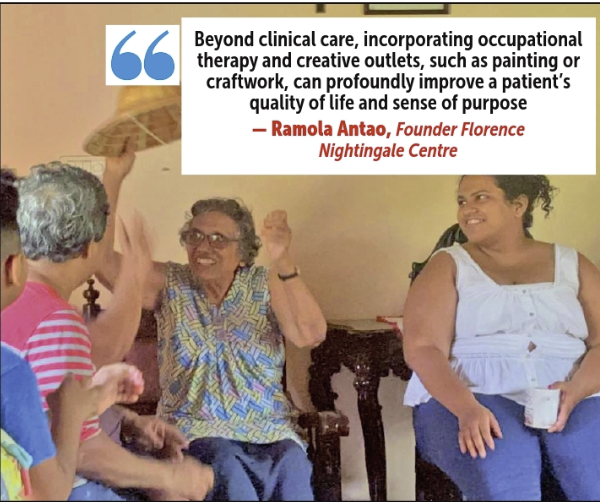
Despite losing her husband Frank Antao to Parkin-son’s disease in 2018, retired English Professor Ramola Antao did not break down. Instead, she decided to dedicate her life to serving people with men-tal and other health challenges.
She had founded the Florence Nightingale Centre in January 2014 through the Florence Nightingale Trust, at her residence in Sucaldem, Chinchinim-Salcete. The initiative was inspired by Professor Ramola’s long-standing vision, dating back to the 1990s, to support individuals struggling with depression and allied illnesses.
“To prepare for this endeavour, I studied the operations of institutions such as COOJ and the Chaitanya Institute. Consequently, the Centre specialises in oc-cupational therapy and counselling within a day-care setting. The facility’s activities are managed by Tecla Fransco, who has been with the Centre since its inception, supported by our initial team of counsellors,” Prof Antao says.
Years of effort are now showing results. The young women who joined as the centre’s first clients have successfully developed various skills, including cross-stitch, quilling for jewellery, and the production of jute doormats, seasonal decorations, and artisanal food items.
“These products were subsequently offered for sale. Notably, the participants requested that the proceeds be used to organise a group picnic and a restaurant lunch rather than receiving direct payments,” she says.
Furthermore, Prof Antao continues to conduct holiday camps for children aged 6 to 14. Despite a hiatus following her husband’s passing in 2018 and the subsequent pandemic years, these camps have resumed their biannual schedule.
These sessions frequently culminate in theatrical productions on the Sucaldem stage. Most recently, a dramatic performance featuring three scenes in Shadow was hosted at her residence for an audience of approximately 40 people.
“I also share my insights regarding care giving for those with Parkinson’s disease, drawing from my ex-perience of providing care for my husband and other elderly neighbours. As Assistant Secretary in the Forum for Senior Citizens, I do get contacts,” she adds.
Based on these experiences, Prof Antao emphasised several critical aspects for caregivers and relatives to consider.
“Regarding medication management, precise timing is essential, particularly with dopamine-related treatments. Administering the first dose as early as 5:30 am significantly improves morning mobility and overall daily function. Additionally, vigilant observation is vital as Parkinson’s can diminish physical sensation,” she says.
It is important to regularly check for injuries or underlying health issues such as burns or internal pain-that a patient may not be able to feel or communicate effectively.
“Furthermore, I have found that physical activity and holistic engagement are crucial for managing symptoms. Participation in support groups provides both the necessary structure for exercise and a vital sense of community. Beyond clinical care, incorporating occupational therapy and creative outlets, such as painting or craftwork, can profoundly improve a patient’s quality of life and sense of purpose,” the octogenarian says.
While she has transitioned her primary focus toward the Florence Nightingale Trust-where her team provides counselling and occupational therapy for various mental health conditions and senior citizens-she remains a firm advocate for the specialised work being done within the Parkinson’s community.
Providing palliative care to terminally ill patients
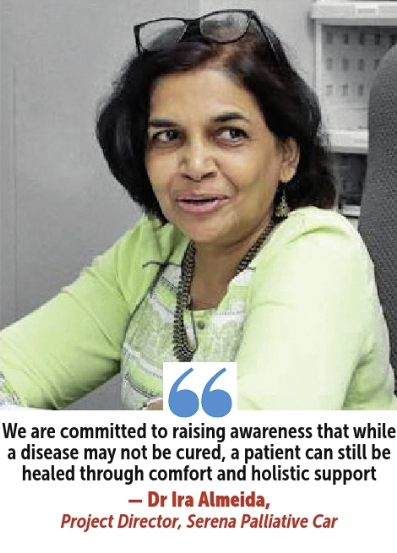
Following her retirement, Dr Ira Almeida, former Director of Health Services undertook a new role as Project Director, Serena Palliative Care. Working in palliative gave her tremendous fulfillment and joy as it provides specialised medical care for anyone living with a serious illness.
This integrated project, sup-ported by a dedicated NGO HelpAge India, the State government provides essential physical, emotional and social support to patients facing chronic and life-limiting conditions.
“Our objective is to improve the quality of life for these individuals from the point of diagnosis through to end-of-life care. We provide comprehensive sup-port at every stage of the illness, ensuring that patients facing significant health challenges receive the necessary care and attention,” Dr Almeida says.
My mission is to prevent others from wasting crucial years of their lives as I once did. I intend to continue this work indefinitely to reach as many individuals as possible. This palliative care centre gives comprehensive Outpatient Department (OPD) and inpatient care, with a primary focus on home-based services.
“Our mission is to ensure access to palliative care for patients who face significant barriers, including physical mobility limitations and financial constraints. We specifically address the needs of those who cannot easily access traditional facilities-such as stroke patients-due to the lack of disabled-friendly transport or other logistical challenges,” she says. By bringing specialised care directly into the patient’s home, the aim is to bridge the current gap in service delivery.
“Our unique community programme collaborates with local panchayats to utilise volunteers who identify patients within their villages. This allows us to conduct approximately 800 home care visits per month, ensuring that care reaches those who need it most rather than waiting for them to seek us out,” Dr Almeida says. The services are available free of charge at District Hospitals in both North and South Goa.
“In South Goa, we offer comprehensive outpatient (OPD), inpatient (IPD), and home care services, alongside various support groups for breast cancer, dementia caregivers and bereavement. While our North Goa operations currently focus on OPD services, this month we have started home care. Our goal remains consistent: to relieve all forms of suffering by connecting patients with government schemes and donors,” the veteran healthcare professional says.
However, a critical challenge she faces is the misconception that palliative care is only for the end of life. In reality, support should begin at the time of diagnosis.
“We are committed to raising awareness that while a disease may not be cured, a patient can still be healed through comfort and holistic support,” she adds.
Resolving disputes between elderly parents and their children
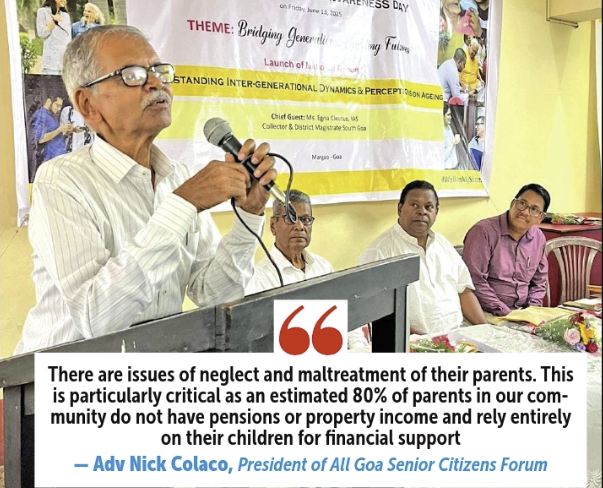
Adv Nick Colaco, President of All Goa Senior Citizens Forum, has been a law practitioner for 49 years, handling a diverse range of legal concerns including civil and revenue matters. Now, he helps in settling disputes between elderly parents and children regarding maintenance of the senior citizens through conciliation.
“In addition to my legal practice, I am heavily involved with the senior citizens’ federation. This organisation was originally known as the Forum for Senior Citizens of India and is recognised by the Government of India. It has since been renamed the All Goa Senior Citizens’ Federation. I am its current president,” Adv Colaco says.
While parents work tirelessly to provide for their children’s future, there is a growing issue where chil-dren, upon gaining independence especially after marrying — neglect and maltreat their parents. This is particularly critical as an estimated 80% of parents in our community do not have pensions or property in-come and rely entirely on their children for financial support,” the veteran advocate says. Unlike the 20% who are self-sufficient, remaining 80% of senior citizens require their children’s financial contributions for their basic needs and well-being.
“I believe we need to address this shift in family dynamics to ensure that elderly parents are treated with the respect and financial care they deserve,” he says.
According to him, even though the Maintenance and Welfare of Parents and Senior Citizens Act, 2007 is meant to ensure their welfare, there are a lot of practical challenges regarding the implementation. “While the legislation is well-intentioned, there appears to be a significant gap between the law and its practical application. Although the Act provides a 90-day mandate to settle cases, the process is often slowed by material considerations and procedural delays. This lack of proper implementation often diminishes the legal protections intended for senior citizens once family dynamics change,” Adv Colaco says.
As the President of the All Goa Senior Citizens Federation, he is also now serving as the Conciliation Officer.
“In my capacity as Conciliation Officer, I am ded-icated to mediating family disputes with empathy and objectivity. Our objective is to foster mutual understanding between parents and children, helping parties navigate resource limitations and recognise diverse perspectives,” he says.
According to him, there is a concerning trend of children failing to provide basic necessities, food, and medical care for their elderly parents.
“Our process typically involves initial mediation; if that fails, we assist in filing formal representations with the Deputy Collector: Handling these sensitive family disputes remains complex, especially when both parties are adamant or when new family dynamics create additional friction. Despite the emotional toll of these cases, I remain committed to leveraging my experience to navigate these situations tactfully and ensure the protection of senior citizens’ rights,” he adds.
Crusading against liquor addiction
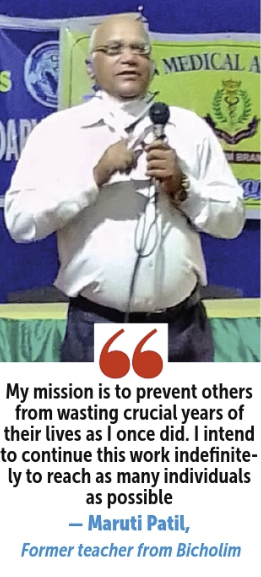
Maruti Patil, a former teacher from Bicholim, has dedicated his life to de-addiction advocacy. Patil’s commitment to this cause stems from his personal four-year struggle with alcohol addiction.
“During that period, I faced significant socioeconomic challenges, including strained family relationships and a debt of over Rs 4 lakh. I had also made up my mind to commit suicide. I had left my family at my hometown in Kolhapur and was ready to take the extreme step,” he says.
But before taking the extreme step, Patil met a spiritual guru, whose words transformed his life. His words motivated him to quit liquor permanently and reclaim his life. Soon after, his recovery began.
“To stabilise my finances, I eventually secured a personal loan of Rs 7 lakh from a local cooperative bank to repay the bar owners where I used to drink and settle with my creditors. Then, when I realised that many others were facing similar destruction, I launched a de-addiction campaign. My efforts have since helped at least 3,000 families successfully over-come alcoholism,” he says. Today, Patil frequently engages with educational institutions to mentor youth.
He emphasises the importance of choosing a positive social circle and warns against the physical and mental degeneration caused by addiction.
“My mission is to prevent others from wasting crucial years of their lives as I once did. I intend to continue this work indefinitely to reach as many individuals as possible,” Patil says.