BASURI DESAI
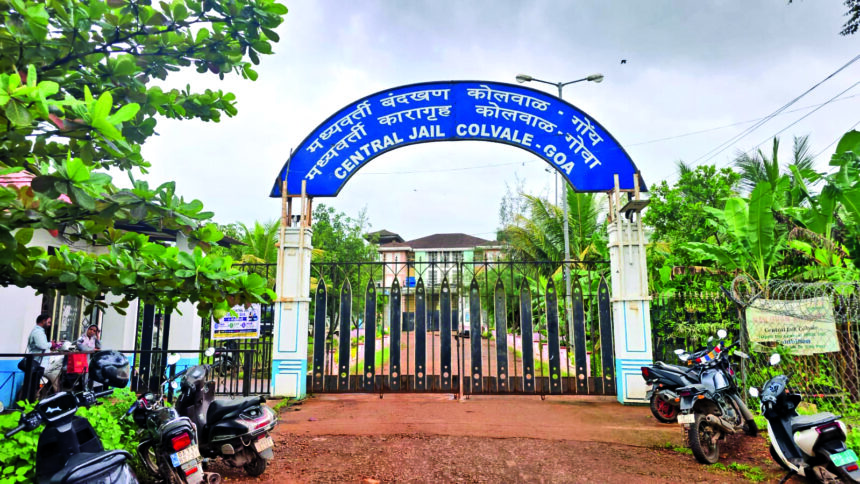
PANJIM: The ongoing investigation into a prison smuggling attempt has taken a high-profile turn following the arrest of Colvale Central Jail inmate Rovina Pereira Lobo, exposing an alleged network operating comfortably behind prison walls. Lobo, an undertrial who has not been convicted in the double-murder case of Martha and Vera Lobo, was arrested after police established a direct link between her and a compromised security staffer.

The plot unraveled when a Goa Human Resource Development Corporation (GHRDC) security staffer, Asha Chodankar, was caught red-handed attempting to enter the high-security facility. Contraband consisting of around 236 grams of suspected ganja and two grams of suspected charas was found concealed inside a steel thermos flask in her possession. A subsequent search of Chodankar’s locker yielded three mobile phones and three ATM cards, bringing the internal security breach into sharp focus.
The institutional response, however, follows a familiar pattern. Speaking to O Heraldo, Superintendent of Police (SP) Vishwesh Karpe stated that the identity of the external source who handed over the thermos flask to Chodankar remains unknown. He added that a detailed investigation will be conducted to cross-verify statements from the accused.
This latest incident is far from an isolated security breach; rather, it underscores a persistent, long-term breakdown of authority inside Colvale Central Jail. Data tabled in the Goa Assembly reveals a staggering history of illicit activity, noting that 161 mobile phones were confiscated from prisoners between 2017 and May 2025. During that exact same period, 171 prisoners were caught possessing prohibited articles, and 11 jail staffers were suspended for facilitating the smuggling of contraband.
Major historical breaches paint a picture of an uninhibited supply line.
In January 2026, a massive internal raid recovered 48 mobile phones alongside illicit drugs and electronic accessories from various cells. Another recent raid also reportedly resulted in the recovery of additional mobile phones from inmates.
In 2025, outside accomplices successfully hurled a massive consignment of 1.4 kilograms of ganja directly over the prison walls, triggering an investigation into the intended inmate recipient as police arrested several persons in connection with the incident.
Two separate security guards were arrested in the span of a single month—one carrying 208 grams of ganja and seven grams of cocaine, and another attempting to supply cocaine to an undertrial in June 2022.
In 2019, a sweeping raid resulted in the single largest haul at the facility, uncovering 80 mobile phones and nearly two kilograms of ganja.
The regular discovery of support accessories—including chargers, power banks, and headphones—confirms that prisoners have maintained active, long-term communication facilities without meaningful disruption.
These recurring discoveries have shifted the investigation’s focus from petty smuggling to a far more dangerous possibility: that Goa’s wider narcotics trade is being actively managed from inside the prison blocks.
Sources familiar with the jail’s internal dynamics allege that repeat offenders and high-profile undertrials are using these smuggled mobile phones to maintain seamless contact with external operators. From their cells, these inmates allegedly dictate terms, handle logistics, and issue precise instructions regarding the supply and distribution of narcotics across prime coastal tourist belts and local villages in both North and South Goa.
Furthermore, the financial infrastructure behind this network appears highly organized. External operatives allegedly collect lucrative commissions and protection money from ground-level drug dealers, funneling a portion of those illicit funds straight back to the mastermind inmates controlling the syndicate from the inside.
With a definitive pattern of security personnel acting as internal mules, authorities are now facing intense pressure to look beyond isolated cases. Moving forward, investigators must establish whether these are detached criminal acts or part of a heavily structured, organized syndicate requiring deep-rooted internal facilitation from within the prison apparatus.
Retired Superintendent of Police Bossuet Silva, who served in various positions in the Goa Police, including the Anti-Narcotics Cell, said the repeated recovery of drugs and mobile phones from Colvale Central Jail should not be viewed as isolated incidents, but should be investigated as a possible organised narcotics network.
“From my experience in the Anti-Narcotics Cell, I can say that a drug network cannot function for long without communication, money and protection. If inmates are able to obtain mobile phones, communicate with people outside and continue receiving drugs and money inside the prison, then the authorities have to look beyond the individual who is caught carrying the contraband. They have to identify who is actually controlling the network,” Silva said.
He said the alleged involvement of politically well-connected individuals in the narcotics trade operating around the prison is an aspect that should be thoroughly investigated.
“There are allegations that politically well-connected persons are involved in this network and that their people are collecting money from the drug trade outside and sending it inside the prison. If this is true, it means the issue is much bigger than prison security. It points towards an organised network with people operating both inside and outside the jail,” he said.
Sub Divisional Police Officer of Mapusa, Vishwesh Karpe (SP) said that the investigation in the present case of the security guard is underway to find out the source and end of the narcotics.
“We have taken remand only on Saturday of the main suspect from Colvale jail; we are investigating the case in detail,” Karpe said.