At a time when the state government is spending crores of rupees on some ambitious water-oriented projects like marinas, floating hotels etc., the question about the conditions of water bodies – rivers, lakes and creeks – stands neglected. This, despite the fact that authorities like the Goa State Pollution Control Board (GSPCB) and National Institute of Oceanography (NIO) have, at various times exposed the pathetic conditions of these water bodies.
At a time when the state government is spending crores of rupees on some ambitious water-oriented projects like marinas, floating hotels etc., the question about the conditions of water bodies – rivers, lakes and creeks – stands neglected. This, despite the fact that authorities like the Goa State Pollution Control Board (GSPCB) and National Institute of Oceanography (NIO) have, at various times exposed the pathetic conditions of these water bodies.
Undoubtedly, Goa has the best water treating facilities making it the second-best state in the country as far as treated water is concerned. But unfortunately, all the river water does not get treated.
Water bodies that attract tourists – Mayem Lake in Bicholim and Harvalem waterfall in Sattari – are highly contaminated by untreated sewage discharge. The water is unsafe for human consumption and bathing. Unaware about this, thousands of tourists enjoy in these waters every season.
Goa has over 35 major rivers, lakes and creeks (as per a GSPCB survey). But unfortunately it is just Rivers Mhadei and Khandepar that are least polluted with River Sal, once the lifeline of South Goa, and River Bicholim being the most contaminated.
River Mandovi that houses four off shore casino vessels, various cruise boats and other vessels is among the most polluted rivers along with River Zuari.
Fresh water is a precious resource and the increasing pollution of our rivers and lakes is a cause for alarm. The largest source of water pollution in Goa is untreated sewage discharge. Other sources of pollution include agricultural runoff and unregulated small scale industrial waste. “Discharge of untreated sewage is the single-most important source of pollution of surface and ground water in Goa,” GSPCB chairman Jose Manuel Noronha said.
The faecal coliform count, which needs to be zero, was found to be between 1300 to 7900 MPN (Most probable number) per 100 ml water. Faecal coliform, caused as a result of sewage discharge needs to be absent for water to be considered safe for general human use.
The majority of the government-owned sewage treatment plants (STP) remain closed most of the time due to improper design or poor maintenance or in many places they just don’t exist. GSPCB recommends that only proper STPs in the vicinity of water bodies can help reduce water contamination to a large extent. “Every household sewage pipeline needs to be connected to a STP. The discharge of sewage in the water bodies leads to destruction of aquatic life,” Noronha said, appealing to builders and construction agencies not to release the waste into water bodies and also not to allow their labourers to build hutments.
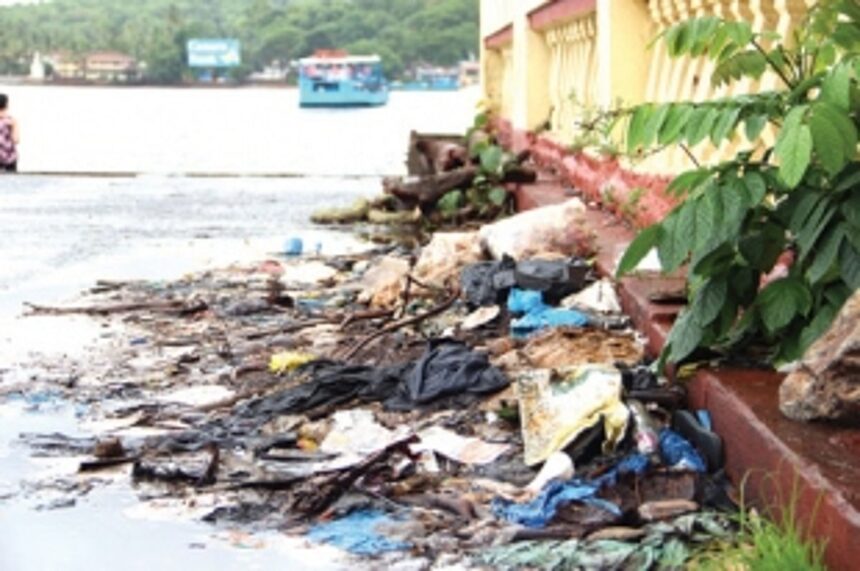
The monsoons worsen Goa’s water pollution problem, as it washes and moves solid waste and contaminated soils into rivers and wetlands. As per the report, the faecal coliform count is highest during the monsoon – May to October.
A physician, refusing to be named said that the consumption of water containing raw sewage can lead to heart and kidney diseases. “The water is poison. Bathing and personal consumption should be avoided in these waters,” he said.
The waste water generated in these areas normally percolates into the soil or evaporates. The uncollected waste accumulates in urban areas causing unhygienic conditions and releases pollutants that leach into surface and ground water.
Dr Antonio Mascarenhas, former NIO scientist, pointing to the contamination of River Mandovi said that the cause and effect of contamination is indiscriminate release of raw sewage and related waste. “St Inez creek is one of the conduits through which city waste finds its way into the river. If the issue is sorted out, I feel Mandovi will be clean,” he said.
Also to be noted is the incessant river traffic – casino vessels, boats, trawlers, barges and ferryboats – which could be looked at as one of the reasons for river pollution. “Also the role played by river side (and hinterland) hotels and restaurants is another issue that has been rarely tackled,” Mascarenhas said. He added, “As far as River Zuari is concerned, MPT has its own share of polluting this river.”
On the River Sal, GSPCB has already signed a Memorandum of Understanding (MoU) with Asahi Geo Survey Company Ltd Japan for ‘Pilot Survey for Disseminating SME’s Technologies for Groundwater Remediation by Bioremediation of Sal River in Goa’ under the governmental commission on the projects for ODA Overseas Economic Co-operation by the Government of Japan.
Mascarenhas, a member of the Goa Coastal Zone Management Authority, feels that it is human nature that leads to pollution of water bodies, accompanied by other factors. “The moment a water body is detected, we don’t hesitate to incessantly dump garbage into it whether it is a lake, river or a pond. From bridges, we can see a lot of garbage being flung out of cars and into rivers,” he said.
“We need to realize that water bodies are assets and unless and until modern societies, as well as government agencies see a reason, nothing much can be expected,” he lamented.
The issue of polluting water bodies was also raised in the Parliament by Congress Rajya Sabha MP Shantaram Naik, with the centre assuring proper remedy.