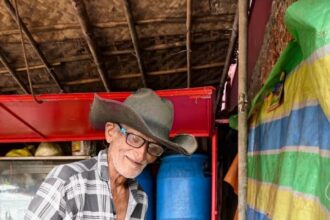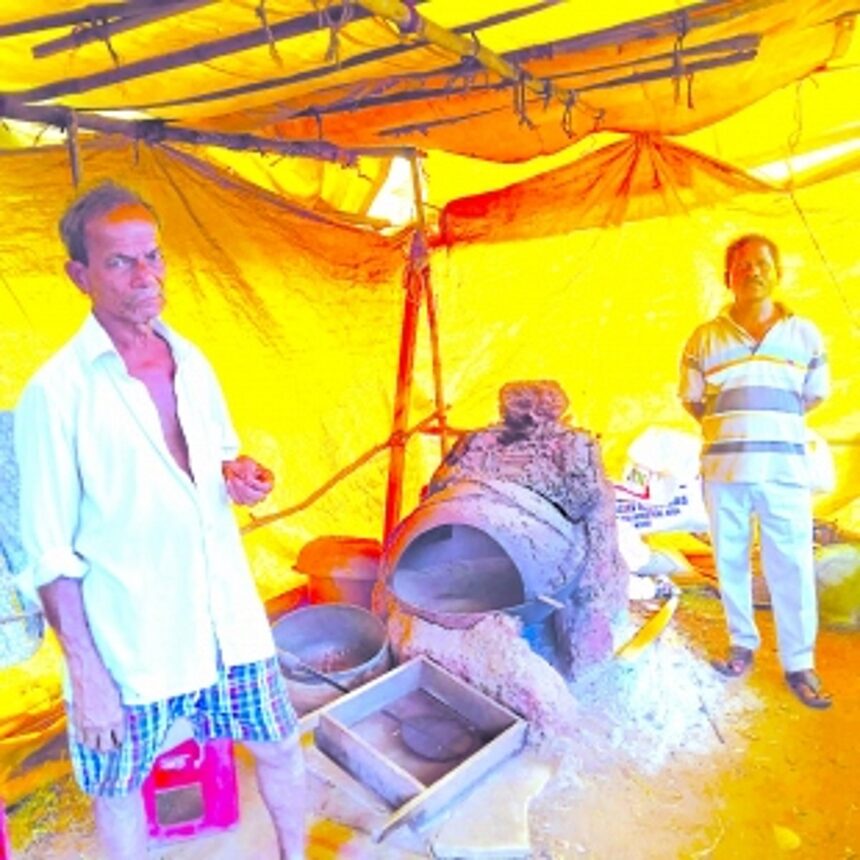
MARGAO: In the bustling atmosphere of the Holy Spirit Church feast in Margao, one familiar face has been a constant for over five decades. Damodar Anant Naik, a 65-year-old from Pairaband, Cuncolim, sets up his stall here every year, roasting gram and groundnuts in the traditional Goan style. Damodar reveals the rich history behind his family’s business, tracing it back to his maternal grandfather, Shankar Naik, who initiated the enterprise around 51 years ago. Joining in at the age of twenty, Damodar has carried forward the legacy with pride.
The traditional roasting techniques used by Damodar are a testament to the authenticity of his craft. The vessel used for roasting, now made of steel and strengthened with clay, was traditionally crafted from fragile terracotta. Firewood, specifically sourced from jackfruit and mango trees, adds a unique flavour to the gram and groundnuts. The gram is roasted with turmeric and salt, while the groundnuts are only seasoned with salt, for taste and longevity. The entire setup, known as the ‘bhatti’, is a nod to time-honoured methods of culinary craftsmanship.

However, with immense sorrow in his voice, Damodar laments that none of his children are interested in continuing this third-generation business. “After me, this business will vanish into thin air in my family. Sourcing jackfruit and mango wood from sawmills is also getting difficult,” he says. For bigger feasts that last eight days or more, Damodar sets up the furnace on-site, roasting gram and groundnuts at the stall itself. Big feasts would include feasts at Chinchinim, Cansaulim and Varca, and the Colva fáma. For smaller feasts, where the fair lasts for only about a day, I carry pre-roasted gram and groundnuts from home.
However, modern times have brought challenges, with the availability of roasted gram throughout the year affecting the demand during traditional festivals. Increased competition and fewer buyers have impacted Damodar’s business, leading to losses.
“Earlier, we had four labourers who assisted us, but now we manage ourselves since we do not do as well as before and paying labourers becomes an additional burden,” he says. With a faint smile on his face, Naik compares the prices of gram in his childhood and in today’s times: “One podd (unit measure) would cost around Rs five around 35 years ago, while the same amount costs Rs 160 today,” he says.