Team Herald
MARGAO: In a thought-provoking editorial titled ‘Bring Back Jesus for Christmas’, the Archdiocese of Goa and Daman’s magazine ‘Renovacao’ has raised serious concerns about the growing commercialization of Christmas and “the gradual erosion of its spiritual essence”.

Fr Aleixo Menezes, the editor of Renovacao, points out that Christmas has transcended its religious boundaries and become deeply entrenched in the commercial world. “Whether one has faith in Jesus Christ or not, business is conducted in his name,” he writes.
The editorial observes a “paradigm shift” in how Christmas is understood and celebrated today. “The market economy has captured Christmas from the religious-spiritual realm and placed it on the racks of the shopping malls and centres,” the editorial states. “Everyone seems to make best use of Christmas: cultural activities are sponsored by politicians (as a means of canvassing), by corporates (as a means of advertisement).”
Even more concerning, according to Fr Menezes, is how church institutions and parishes themselves have sometimes fallen prey to this commercialised approach to Christmas. He cites the Archbishop-Patriarch of Goa, Rev Filipe Neri Cardinal Ferrao, who has been consistently calling for bringing Jesus back into Christmas, noting that “Santa Claus (not Saint Nicholas) has usurped the place of Jesus Christ.”
The editorial points to a concerning trend even within church compounds, where “most of the Cribs, even in the Church Compounds and Somudai corners, as well as Christmas Week Programmes are spiced with the competitive spirit, the egoistic mentality, where the joy of communion, participation and mission seems to be visibly absent.”
“It is not only Christmas that has lost Christ or has been replaced, but many of our devotions and novenas of popular piety have no Christ in them,” Fr Menezes writes, highlighting how this shift away from Christ-centered worship is a broader phenomenon affecting various aspects of religious practice.
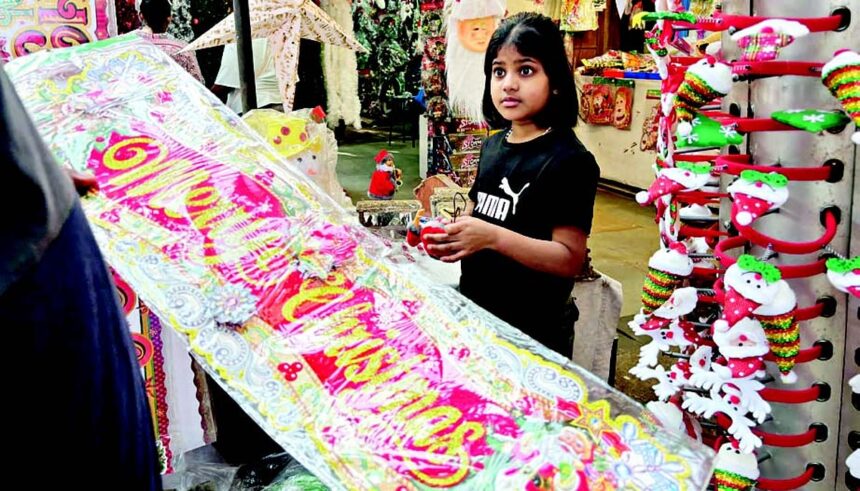
The commercialisation extends beyond just the celebrations, according to Fr Menezes. The editorial raises ethical questions about the production and sale of Christmas decorations, buntings, and electrical fittings. “Nobody questions ‘how are the decorations made or who makes them?’ or Nobody questions ‘how much profit does the street-vendors make, when we bargain with them’,” Fr Menezes notes, asking, “In the name of the Birth of the Saviour/Liberator, are the marginalised still being abused, manipulated,
exploited?”
Drawing parallels with the first Christmas, the editorial reminds readers that the birth of Jesus was first announced to shepherds – “the most marginalised section of the society. They were considered to be the dirty, filthy, illiterate, uncultured, etc. people, who had no place in the society of the rich, literate, clean, etc.”
The editorial delves deeper into the theological understanding through the Gospel of John’s perspective on the Incarnation, distinguishing it from the narrative accounts in Matthew and Luke. It emphasizes that while homilies during Christmas attempt to cover the deeper meaning of Incarnation, “unfortunately, the best prepared and proclaimed homilies get lost in the hub and dub of Christmas activities and celebrations.”
The editorial also examines the story of the Magi as another crucial human-centric event. Fr Menezes notes how Herod and his coterie, despite being ‘in town’, saw the newborn king as a threat rather than accepting the good news. This leads to his reflection on whether “those who propose renewal and growth (in an environment of Churchy ‘tradition’ and ‘orthodoxy’) [are] ostracised inside and outside the Church?”
Using the Exposition of the Relics of St Francis Xavier (2024) as an example, Fr Menezes illustrates how religious practices can sometimes deviate from their intended purpose. While the Church organises this event to help the faithful grow in their faith in God, he observes that people primarily come to “kiss the relics, in order to demonstrate faith in Gôycho Saib.”
The editorial concludes by emphasising that while theologically and liturgically, devotions to Mary and the saints should lead people to Christ, “Popular Piety, most of the time, makes one stop with Mary and the Saints.” Fr Menezes calls for reflection on whether the Christocentric dimension of faith can be better integrated into popular religious practices, devotions, and novenas.