BASURI DESAI
The historic centuries old Ribandar causeway is waiting for the attention of the heritage conservation institutes for its preservation and survival.
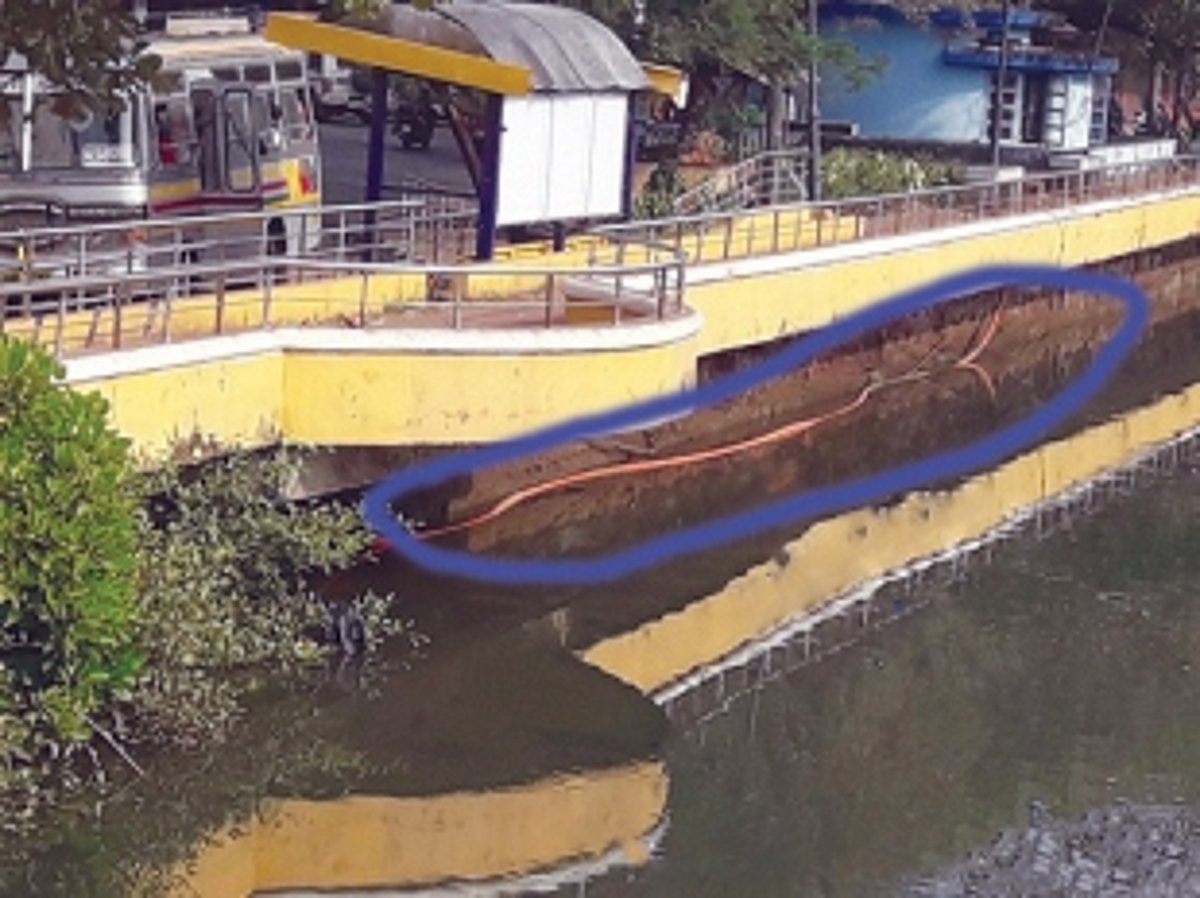
Public Works Department (PWD) of Government of Goa is in complete darkness over the maintenance of this Goa’s longest bridge as it is sinking year by year. The temporary patch work being done by the department does not provide a permanent solution, said a source.
PWD officials said that there is no plan and or any other proposal to maintain, preserve or repair the said stretch, which is now in the list of other district roads of the State.
The plans are only talked out in the meeting of the city planning and tourism but so far nothing has been reflected on the papers on the Government.
On other hand the Goa Heritage Action Group (GHAG) has been pursuing the case of Ribandar causeway with the Archaeological Survey of India (ASI) to recognise the bridge as the world heritage site under UNESCO.
“In 2010 we have even made the presentation before the committee of the UNESCO in Mumbai through ASI and Union Government, but it did not turn out positively”, said Historian Professor Prajal Sakhardande, who is also President of GHAG.
He said that GHAG will be pressing ASI to list the monument under them as heritage monument.
“It is sad that such historic monument is being just neglected has been allowed to sink for several years. Once upon a time it was the longest bridge in Asia and remained for almost four centuries”, Sakhardande said.
He said that GHAG will be representing Government of Goa to at least notify the bridge as State heritage under State Archaeological department.
PWD officials, on the condition of anonymity, said that the entire stretch is in very bad condition and it is sinking.
The causeway, earlier called the Ponte Conde de Linhares when it was built in 1633-34, was believed to be a longest bridge of the world of having a length of 3.2 kms connecting Ribandar village with Panjim.
The causeway was built to handle horse drawn carriages of its time but has handled the load of heavy motor vehicles since then.
The bridge was built on alluvial soil and stabilised with the trunk of the iliadola briformis, a tree called Benth, locally known as Zambo. Laterite stone was used in the construction of the bridge superstructure.
The causeway is supported by three arches on the eastern side, while thirty-eight arches support it on the western side.