In the New Year, the hunt is always on for an interesting calendar to be put up in the house. There
are many which portray flora and fauna, festivals and different places. But
there are rarely calendars that make us think and wonder about the future of
our state. St Xavier’s College, Mapusa, recently launched its second edition of
its annual calendar. The 2018 calendar is based on the theme, ‘Goa Then &
Now’, with over 15 photographs of five cities and heritage sites. After
focusing on the occupations in Goa for their first edition, this year, the
college wanted to give a reality check of how development has taken over. The
photographs speak for themselves.
Fr Ramiro Luis, assistant professor, Psychology, St Xavier’s
College, headed the project and was assisted by Anzil Fernandes, assistant
professor, mass communication, St Xavier’s College, Mapusa, who carefully
selected the photographs that could really start a conversation about the
current state of affairs. Fr (Dr) Jeronimo D’Silva supported their initiative.
Each page of the calendar is divided into two months and showcasing the then
and now photographs.

Fr Ramiro is on the lookout for new ideas and he was happy when
this concept came to light through Anzil. “Our motive was to subtly ask the
question of where we are heading to. We came up with the idea nearly six months
back in June and within a month, we were looking out for people who would have
these photos. Lynn Barretto and Willy Goes were very helpful and we could
source many photos from the Internet. However, the next challenge was to click
the same photos in the same angle. Some structures are the same in both the
photos but it’s the surroundings that have changed, and are destroying the
beauty of the buildings,” says Fr Ramiro.
“We were thinking of doing something different this year
specially focusing on the turmoil that Goa is undergoing today — the good and
the bad. This calendar is an introspective about Goa and we hope that it can at
least ignite a thought in the mind of the onlooker,” says Anzil. The calendar
is available at the college and only a thousand copies are left from the 5000
printed.
The well thought initiative is not being judgemental about the
current times. The cities in focus include Panjim, Mapusa, Old Goa, Vasco and
Margao. The months of January and February highlight the city of Margao where
the commercial street in the photo is still the same, the 2017 photo shows the
chaos. “The structures are the same but there is a lot of visual pollution. The
traffic and parking was more orderly compared to the current photo,” explains
Anzil.
The photograph of Panjim was more challenging. All the
photographs used in the calendar are from the 50s, 60s, 70s and 80s and the
shot of Panjim of the yesteryears was aerial.
“The photo must have been taken either from a helicopter or a
plane and there are no buildings in sight. History describes Panjim as a marshy
land which has been reclaimed and this picture is self explanatory. For the
current photo, the students used a drone to get the same angle and it’s easy to
spot the difference,” adds Anzil. Each photo has been well researched as it
comes with a brief about the place.
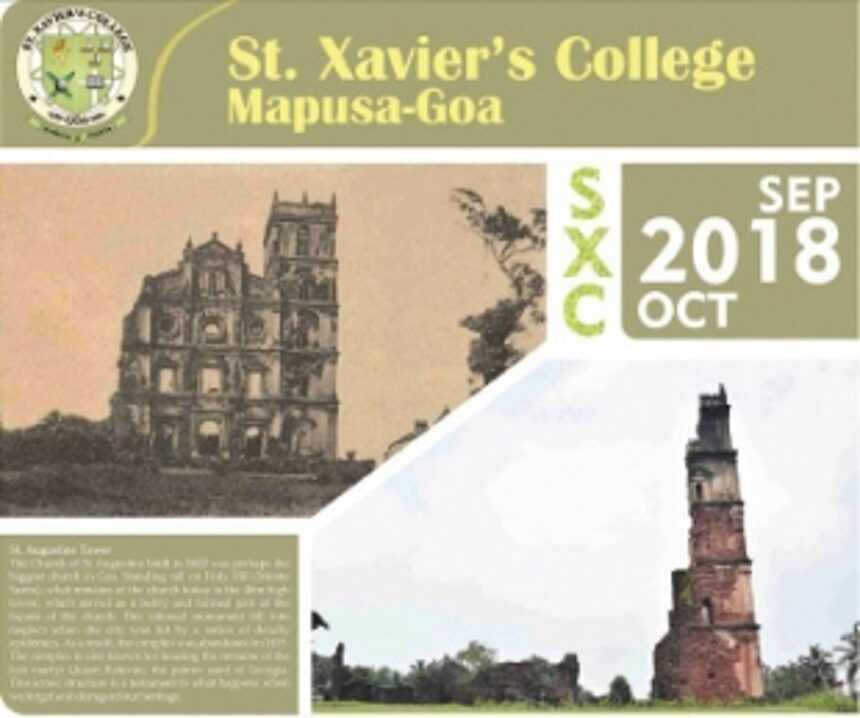
The calendar goes on to feature the iconic Vasco clock tower,
the market entrance of the historic Mapusa Friday market and St Augustine
tower. “Mapusa is the home to St Xavier’s College and through our research we
realised that it is one of the least developed cities in Goa,” says Anzil.
November
and December offers a collage of heritage sites of Old Goa. “We wanted to
highlight these sites as many Goans are not aware of them as heritage sites.
Also, though the structures are of Christian faith and the engineers may have
been foreigners, the artisans were of Islamic and Hindu religions. Instead of
fighting over religious differences, we wanted to celebrate it,” concludes
Anzil.