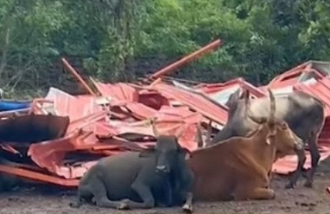
It’s a Rs Ten crore spent on a wall, with a hope that it will help break all walls of resistance to get more hands on the deck on Kavlems farms. The Kavlem panchayat decided to revive farming by adopting a resolution to construct a protection wall along the
Nullah to prevent waste and garbage from entering into 1.3 lakh square meters of paddy land belonging to 150 farmers in Kavlem.
“The proposal was sent to Marcaim MLA and PWD Minister Sudin Dhavalikar, who got the irrigation department to sanction the work at around Rs 3.5 crore in the first phase, while the second phase of the project will cost Rs 3 crore.”
“So far, 70 percent of the work on the protection wall is complete and the remaining work will continue after monsoon.” “The main purpose of the protection wall is to prevent garbage from entering the village fields. The Nullah is around 12 km long and merges into the Zuari
River at Bandora. About 2 kms of this 10-12 metre wide Nullah falls in Kavlem panchayat. About Rs 3.5 crore will be spent on phase three of the project,” said sarpanch Rajesh Kavlekar.
Speaking to Herald, Kavlem Sarpanch Rajesh Kavlekar
claimed that paddy farming had been a traditional
occupation in most parts of Ponda taluka. “But
increasing cost, shortage of manpower and subsidized
rice made available by the government pushed people
away from farming activity about 20 years ago. As a
result, most youth switched to government and other
jobs,” said Kavlekar.What made matters worse was the
dumping of waste, sewage, garbage and plastic into
main drain which provided water supply to the paddy
fields in Kavlem. As a result, the drain would get flooded
during the monsoon and all garbage, including medical
waste and broken bottles, would flow into the fields,
making it difficult and hazardous for the few farmers
who continued their traditional activity.
Kavlekar admitted that project should have commenced
a long time ago, but work had been delayed
due to ground realities.
“Work could not commence because of encroachments
along the Nullah. Temporary mud bhandaras
were constructed and many coconut trees were grown,
narrowing the width of the Nullah. To build a protection
wall, we were forced to cut around 300 coconut trees
along the encroached stretch of the
Nullah,” said Kavlekar.
Farmers in the village have, however,
felt that additional incentives are
needed if agriculture has to be revived
in the village.
“The government should encourage farmers to
undertake farming in fields which are barren all over
Ponda taluka. As an incentive, farmers should be provided
with power tillers, fencing and information on
agricultural techniques. If the government takes this
initiative, several hundred hectares of barren land will
flourish with cultivation,” said Damu Naik, a farmer
from Kavlem.
“Farming will also compel authorities to stop
dumping of waste, including medical waste into the
Nullah. After all, one cannot grow paddy or other crop
in highly polluted water flowing from the nearby Nul-
SANTOSH NAIK [email protected]
ANIL SHANKHWALKER [email protected]
Kavlem Sarpanch
leads the hunt for
new sons for the soil
Kavlem, or for that matter Goa has many
sons of the soil. But this panchayat is
looking for sons for the soil, mainly
younger generation locals who will
take over farming from their fathers and
uncles.
The sarpanch, Rajesh Kavlekar has hoped
that steps by the panchayat would attract
youth to return to traditional farming
activity on the fertile land.
“The few existing farmers
are ageing and tired. We
want youth to take up
their ancestral occupation.
Besides paddy, various agricultural crops,
vegetables and fruits can be grown and
sold in the local market, where there is
huge demand.”
“If agriculture has to be restored to its
former glory in the village, our youth
should change their mindset. Even if our
youth pursue government jobs, they have
ample spare time to pursue agricultural
activity. With government schemes and
subsidies on machinery to reduce the
expenses, the only requirement is that our
youth should get into the fields.”
“The present attitude is that agriculture is
a demeaning occupation not suitable for
educated youth. This mindset needs to
change, not only to save our land but also
to ensure self-sufficiency, as we need not
depend on import of vegetables and fruits
from other states,” says Kavlekar.