FRAZER ANDRADE

OLD GOA: Relics of the saints are precious heirlooms of the Church. They are not simply historical mementos, but are considered as physical connections to the divine and are a sign of hope.
All relics bestow honour and privileges upon the possessor; monasteries and cathedrals and even individuals sought to obtain the prestigious relics, and when they succeeded, their proud accomplishment would often be celebrated in the decoration of their sanctuaries or homes.
Reliquaries are the containers that store and display relics. Thus, several churches, chapels and homes in Goa and outside own relics of St Francis Xavier.
A significant number of relics associated with the body of St Francis Xavier are distributed across the globe. Currently, a substantial portion of these relics, referred to as the ‘sacred relics of St Francis Xavier’, is housed in a crystal urn, which is encased in a silver casket positioned atop a marble mausoleum within a chapel dedicated to the saint at the Basilica of Bom Jesus in Old Goa.
Until approximately sixty years ago, these relics were commonly referred to as the incorrupt body of St Francis Xavier. The shift in terminology to ‘sacred relics’ occurred because the contents of the urn in Goa consist of ‘a shriveled skull, two legs, the left arm and hand, along with numerous bones, loose vertebrae, ribs or rib fragments, and pieces of skin’, as determined by Dr Wolfango da Silva and Dr Pacheco de Figueiredo, who conducted an examination of the body in 1951.
Down the ages, various parts of the body have been removed as relics by religious figures and others.The lower part of the right arm was transported to Rome in 1614, while in 1619, the upper portion of the same arm was divided into three portions and sent to Jesuit colleges of Malacca, Cochin and Macau. The Holy Spirit Church in Margão, a Jesuit construction, has a first-class relic of the saint.
A notable relic can be found at the St Francis Xavier Church in Bhatpal, Karnataka, which attracts Catholics from Canacona and the nearby region of Karwar during the feast day.
Within a small glass casket, a fragment of the saint’s bone is preserved, with the Latin term ‘ossibus’ (meaning bone) inscribed upon it.
Historical accounts indicate that one of the first individuals to remove a piece of the saint’s body was a sailor from the ship Santa Maria, who was sent ashore to retrieve the remains of Francis Xavier.
Astonished by the preservation of the body, he cut off a piece of flesh the size of a finger from below the left knee to demonstrate this phenomenon. Additionally, a Portuguese individual named Jose Bravo is credited with severing a larger piece of flesh, which is now housed in a reliquary at the Basilica.
Furthermore, a toe of the saint is preserved in another reliquary located in the sacristy of the Basilica in Goa. The shoulder blade was transported to Macau. Subsequently, another Jesuit superior general requested additional relics, leading to the removal of all internal organs from the chest and abdomen, which were then distributed across various nations including Japan.
The Pereira Bragança House in Chandor owns a finger nail of the saint which is said to have been gifted to a Jesuit priest from the family. Here the relic is placed into a gilt silver monstrance reliquary studded with diamonds, which is placed into an elaborate wooden oratory.
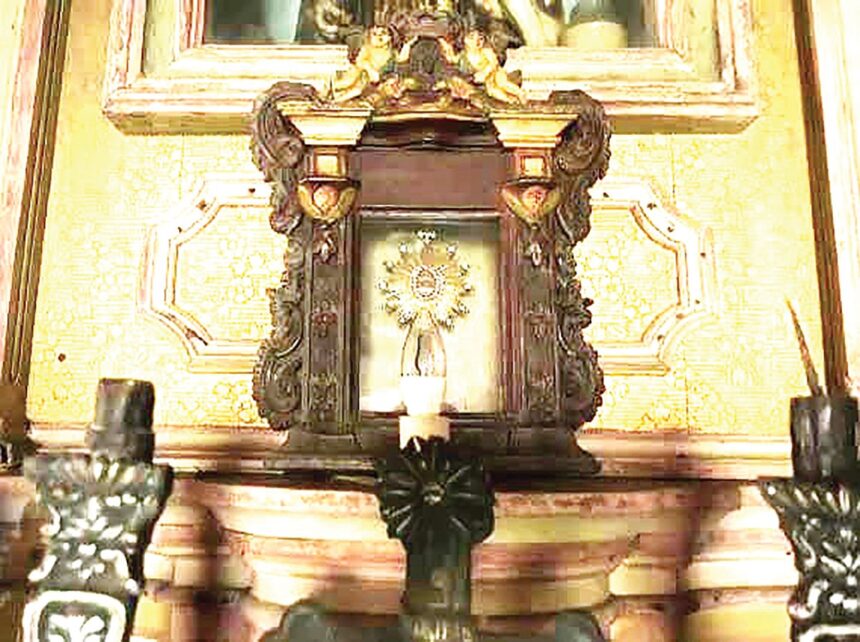
One can say with confidence that almost every devout follower of St Francis, both from Goa and outside would definitely possess ‘class III’ relics of the saint. One such family is the Andrades from Ambajim in Margão. A few fragments of the old cloth, lining the casket of St Francis Xavier, are visible in a reliquary placed onto their family oratory table.
The reliquary seen at the Casa Andrade has been crafted from rosewood following a Baroque theme and is inspired by Ramalhetes crafted in the 18th century.
The niche contains class III relics of Saint Francis Xavier along with a paper strip bearing an inscription in Portuguese as follows: ‘FRAGMENTOS DA URNA DE SÃO FRANCISCO XAVIER’ which translates to ‘Fragments of the casket of Saint Francis Xavier’.