Herald: Hello and welcome. We are here to discuss yet another issue concerning our environment and our futures. This is a debate that we’ve had once too often and will continue to have. This is on the infamous Mopa project, which is going to spell doom for Goa, and there will be many on the other side who do not agree. I understand that the proponents of development will say that the new airport is extremely important for the futures of Goa and progress. That still does not offset the fact that development has to be done on the bedrock of environment. It has to completely pass the touchstone of environment, which Mopa has unfortunately not done. The environment clearance (EC) for Mopa has been given in a predetermined manner. The Union Environment Minister came and gave the EC even before the matter came to his table. What we are discussing is not whether Mopa should come or not. We are saying that even if Mopa does come it has to come keeping all environment concerns in mind. If that is not being done, then no airport anywhere in India can come up until basic environment concerns are meted out. And the government cannot bulldoze these concerns and have Mopa only for Mopa’s sake. Attempts were made to reach out to members of the government who are crusading for Mopa airport and the answer, as always, was negative. Our panelists for this discussion include Rajendra Kakodkar, Fr Eremito Rebello, and Joao Philip Pereira.
Herald: Rajendra, let us first talk about the EC. How do you assess the granting of the EC? Does it mean that everything is clear?
Kakodkar: It was obvious that the EC would be granted because the Environment Minister, before the matter was put before him, said it would be granted. Similarly, the EC that was being submitted was completely fraudulent and baseless. The baseline data should normally be of four seasons. This EC was done for only one season, which is three months. More important is that Goa is very susceptible to the monsoons. Those three months, from July to September, are very important for Goa, but were not included in the baseline data. Secondly, the baseline data readings were all wrong. Even during the season in which the baseline data was taken, the flora and fauna and water resources were not mentioned in the report.
Herald: You’re referring to the baseline data in the Environment Impact Assessment (EIA).
Kakodkar: Baseline data is data on which basis the EIA is made, and EIA is the basis on which the EC is granted. The baseline data was created over three years ago. The Terms of Reference (ToR) had also expired even after a two-year extension. Since the ToR expired on May 31, there could not have been any application for EC after that day. The EC was granted when the ToR was non-existant. Another thing is that when the project comes, there is nothing called Goa or Maharashtra. It is a five or ten kilometer periphery which is as per an MoEF notification. Whether it comes in Maharashtra or Karnataka is immaterial. The Goa government did not include the Maharashtra portion which comes under the periphery of the project for the baseline data. These are the points on which the EC actually falls apart.
Herald: Fr Rebello, don’t you agree that any EC has to be taken before the project is envisaged and not after everything is laid on the ground.
Rebello: Sure. Even before acquiring the land, they should have gone for an EIA, which they have not done. If they do it after acquiring the land, naturally, this shows that they want to push in the project and get it done. Secondly, i would like to what Kakodkar was saying The appraisal committee had only recommended that the EC be granted. Before it is granted, the Chief Minister says that they already received it. The Union Environment Minister, whose duty is to protect the environment, is saying that when proposals come to us, they will be granted. This is all done in a very fraudulent way.
Herald: What are you views on the manner in which the EC was granted?
Pereira: I think it is something to do with politics. Since the elections are around the corner, you cannot afford to displease the people. And the ruling party has taken advantage of the fact that they are ruling in the State and the Centre. The game plan is “whether anybody wants it or not, we will see that Mopa goes through because otherwise we will not get votes”. Otherwise the Union Environment Minister, without checking the facts or without the application for the EC coming to his table, could have not made that statement to the press. The whole process is illegal, and hence, they cannot go forward with tendering the airport.
Herald: So where do we go from here?
Pereira: People should know the facts. Because they are misguided. Whoever wants to bring Mopa to Goa should go to the people’s court and put the real facts before it; how the farmers will be affected, how the groundwater will be affected, how many houses will go when the approach roads are built from Canacona to Mopa. These are the facts that have been told to the people before they even think of tendering the airport.
Herald: Fr Rebello, what Joao is saying is ideal, but practically the chances of that happening are very low, though one must fight for it. What are the legal options?
Rebello: Legal options are many. From today, we have around 27 days or so, and there are a number of people preparing their files to go to the court. That much I can say, nothing more than that.
Herald: What will be the fundamental legal ground of challenge?
Rebello: They are going to challenge the whole process; acquiring of the land and the investigation which has been done about the biodiversity, social impact, groundwater, displacement of people, ozone layer. When there are many airports in the neighbourhood, it seriously affects the ozone layer.
Herald: Rajendra, what are the serious environment issues with regard to Mopa that have not yet been addressed?
Kakodkar: Our water reservoirs. Any plateau is like a sponge. It absorbs water and stores it. This water is available for the locals when the monsoons are over. Once concretization takes place, the sponginess is lost, which leads to less water being stored. The water will just go back into the sea. Once we waste this water, from where will our water resources be replenished? Secondly, the Mopa project is going to use water from elsewhere. Not only will the existing water be wasted, the project will borrow water and burden the rest of Goa. There is also the soil requirements. The land there is undulated. There is a valley where the airport is supposed to come up. To fill this valley, a lot of earth has to be removed from elsewhere and dumped there. From where will that earth come? And which is the road that will be used to transport it? The study conducted by the Goa government says that huge amounts of mud have to be moved out or moved in. That has an environmental impact and will also cause a nuisance to the people staying there. Bardez residents have to be told that they will have so many roads and houses will be going and so any hills will be cut.
Herald: Fr Rebello, in the replies to queries raised by the shortlisted bidders and during the EIA, the government has taken a stand that the runway is on barren land and there are no home or vegetation, and at the end of the day, the project will not affect the people. How do you react to this since you’ve been to the area and studied it?
Rebello: This is a lie. When they showed the land on TV, they showed a small portion of the plateau, and that also in the dry season. Never have they showed it during the monsoons. We approached the Biodiversity Board and asked them whether they have prepared a biodiversity report on this platuea. They said no. We questioned them on what the biodiversity of Goan plateaus is like, and they said, “highly sensitive”. Goa’s plateaus are not just plateaus like others., There is a lot of activity going on even at night. Many animals from the hills come down for grazing. We have also approached the Goa State
Pollution Control Board (GSPCB) to do a study on this and they said they couldn’t find anything. The Biodiversity Board and GSPCB have not done any study and are still saying that this plateau is a barren land.
Herald: Philip, your response to this.
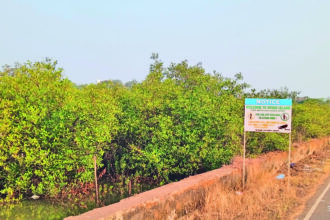
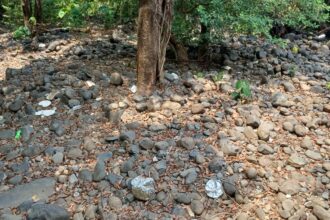
Pereira: I walked on the Mopa land for about eight hours during the monsoons three years ago. It was not just me, but a group of people who were interested in finding out the facts. The first thing we noticed was perfect greenery. We counted about 16 springs. During the rains, there was clean water gushing out. We also noticed that around 2,000 trees were marked for cutting. When I touched the soil, I found it was fertile and black. It retains moisture for a long time. We saw shepherds with their herds of goats. We saw many animals like hares, rabbits, fowls, and deer roaming freely. It is the best place in Goa to see nature. If we are losing our best natural beauty, what it the point of bringing such a project? It could have been done on any other area.
Herald: The fundamental topic as far as this discussion goes is that the spot on which the Mopa airport is coming up is highly debatable. That is why the EC for this spot needs to be challenged.
Kakodkar: Another thing is that they call this plateau ‘barren’. Barren also has some value or advantages of its own. It’s a sponge; it retains a lot of water. It is lateritic barren land. Some portion is basaltic, but most of it is lateritic. It’s a water reservoir of Goa. I don’t think the BDB, GSPCB or Water department has done any study on that.
Rebello: The stand of Goans For Dabolim Only (GFDO) is that we don’t need any airport anywhere in Goa. One airport is sufficient. It’s not a question of an airport only at Mopa. Besides that, the Mopa airport is very close to the Western Ghats. And UNESCO has already called it a world heritage zone.
Herald: The different bodies that are earmarked to protect the environment have not done their job. It’s been a unilateral decision where the MoEF and other environment bodies have been silent spectators to this debacle. That’s an important point. We need your comments on this, Philip.
Pereira: What are we leaving for the next generation? Are we leaving concrete jungles or are we leaving nature? We see concretization wherever we go. Dona Paula is an example. Will our future generations get a beautiful view from up the hill? Dona Paula today is finished. If we have nature, our future generations will thank us for fighting to preserve whatever is left to preserve. We should preserve nature as far as possible. Why do tourists come here? To see concrete jungles? They can see concrete jungles in their country. They come here to see our culture and the natural beauty of Goa. The Goa government today is saying hinterland tourism. What are the tourists going to see if you are going to convert everything that is natural into concrete. Like I said earlier, it is a political gimmick to gain votes.
Herald: Let us look at an issue that has not yet been touched upon. It is not just the airport. A lot of land still needs to be acquired for approach roads, buildings, shops, etc. When you talk of approach roads, you also need to talk about the expressway connecting Canacona to Pernem. When land for the approach roads is to be acquired or when the expressway needs to be constructed, what happens at that point of time and what are the challenges there?
Kakodkar: Firstly, nobody is aware about how many houses will go. Some study was conducted from Canacona to Cortalim. In that section, more than 3,000 – 4,000 houses were falling under the widening of the road. Just widening, not six-laning or four-laning. Some 3-4,000 houses were going from Pollem to Cortalim Bridge. We did not know how much would go from Agacaim to Pernem. It could be much more in Bardez and Tiswadi. The government is quiet on this issue. It’s not telling the locals how many of their houses will be going.
Rebello: At Tuem, around 6 lakh square metres of agriculture land has been taken over. Then, Tiracol. Every panchayat through which the six-lane road is going to pass is in the dark. Where is the transparency of the government? Once they got the power, they think they can do whatever they want. They don’t care for the people. This government is a completely irresponsible government. Till date they have not informed any panchayat about what is going to happen in that particular place.
Pereira: We had corner meetings from Cortalim bridge to Canacona to create awareness when they wanted to do the six-lane highway. When we started creating awareness, politicians were worried that we were trying to poison the people’s minds. We were trying to enlighten the people on the ill-effects of this highway. A Cortalim politician assured to build a flyover from Zuari bridge to the Toyota showroom in Kesarval at a cost of Rs 100 crore if a highway was being constructed in the area. This is the way they are going to push the project and force it on the people by fooling them. I have seen how people can be bought in such easy ways.
Herald: The biggest underlying story here is that while the EC has been given, the environment of Goa is in danger as far as the Mopa airport is concerned. This needs to be challenged and objected to. What is most important, as Fr Rebello rightly said, is that people are being kept in the dark. The problem is far beyond just Mopa. The problem is in the periphery of Mopa and it affects a much large region. Obviously the EC needs to be looked at seriously. The next battle will be fought in the National Green Tribunal (NGT). We wish the people who are fighting this battle all the very best.