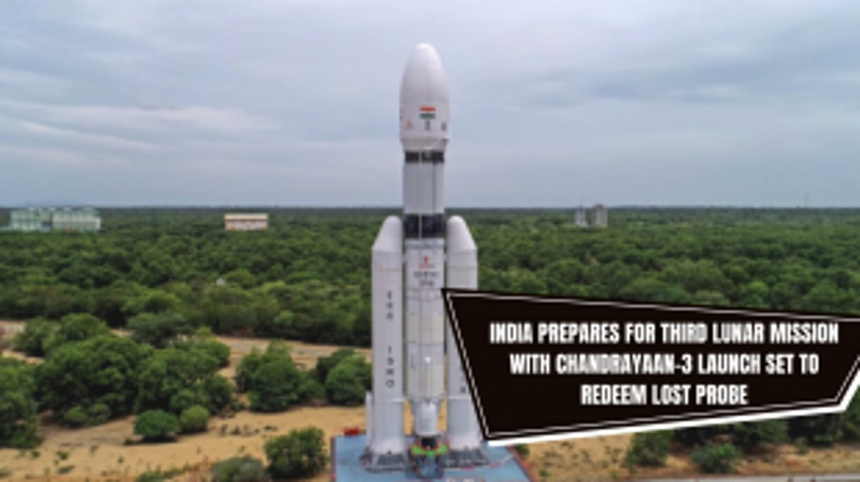
On Friday, the Indian Space Research Organisation (ISRO) will launch Chandrayaan-3 mission from the Satish Dhawan Space Centre in Sriharikota. The spacecraft, which is enclosed in the fairing of the Launch Vehicle Mark-III (LVM3), will be placed on a path that will lead it into orbit around the moon. On September 6, 2019, India was eagerly anticipating the successful landing of Chandrayaan-2 on the Moon’s surface. However, the mission ended in disappointment as the probe was lost. Now, four years later, the Indian Space Research Organisation (ISRO) is preparing to redeem itself with a new lunar mission. Chandrayaan-3 is set to launch and take on the challenge. India is preparing for its third lunar mission, Chandrayaan-3, following the loss of Chandrayaan-2. The mission aims to showcase India’s ability to perform a soft landing and rove on the Moon’s surface. The spacecraft consists of a propulsion module, a lander module, and a rover, which will carry out in-situ chemical analysis of the lunar surface. The mission’s primary goal, which is estimated to cost Rs 615 crore, is to successfully land the spacecraft near the Moon’s south pole and deploy the rover for scientific research for a period of one lunar day or 14 Earth days. The mission’s main aim is to successfully perform a soft landing. The spacecraft is made up of a propulsion module, a lander module, and a rover. Chandrayaan-3 has the potential to attract significant investment to India. The Goa Board of Secondary and Higher Secondary Education and Directorate of Education have circulated notices to educational institutions under their jurisdiction, requesting that schools educate their students about India’s lunar mission. Director of Education, Shailesh Zingade, has requested that all institute heads and teachers raise awareness among students about the mission’s objective and generate enthusiasm for space exploration advancements.