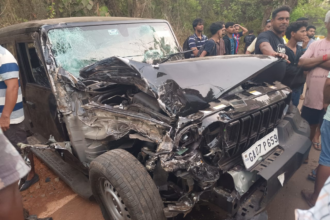
When an accident occurs, the onus is projected instantly on the driver or the vehicle but no one blames the road or the curves or the potholes. Nothing is more severe than the fact that the asphalting of the road works in Goa lacks finesse and even if it marginally does, the heavy traffic flow on the highways and our suburbs or inner roads makes road to develop cracks which are invisible to the human eye.
The spillage of oil and other substances by vehicles on the roads make them slippery, specially in the monsoons. Lack of sacrifice where people refuse to co-operate and allow the expansion of road is also a setback to better roads infra-structure of our cities. Buses plying constantly on all the roads leads to more punishment to those roads who cannot speak or yell to avoid an accident when it is head-on collision or swerving from impacting each other in the face, therefore landing in the field or in a hospital or even in the morgue.
Look at the broad roads at Bambolim uphill climb towards GMC from Panjim or at the Dona Paula stretch near Manipal Hospital. It is rewarding that Goan minds work to develop roads for our citizens so that they drive safely and without collision. But no one is serious about maintaining speed limit on these broadened roads. It is therefore necessary to install sign boards of speed limit along the expanded roads and Traffic police must supervise the flow of traffic and obedience to the rules of care and caution while driving by the citizens.
Traffic is like a team game and the road is the playground. It is vital that as one drives, one must observe the condition of the road and control the urge of pressing on the accelerator. Like the road traffic at Merces, Santa Cruz, Cuncolim, Zambaulim Junctions is always the same old story on the same old narrow roads. Our govt authorities have not been able to expand these narrow roads. Every time an accident occurs in these villages, the local crowd gets frantic and a mob-attack arises when the victim succumbs. It is highly essential that the quality of roads should be checked time to time by road transport authorities and whatever improvement or expansion of road is necessary should be imposed on our state funds rather than let precious lives get lost in accidents that occur due to negligence and bad quality of roads in Goa which is the top tourist destination for people from all over the world.
Though accidents may be inevitable, road improvisation and supervision of speed limit by road traffic officers can bring down fatalities. Heavy traffic, such as traffic loaded with huge containers, should be posted to a time sequel/schedule as they must be allowed to ply only after 9 pm. The over-filled lorries also pose a threat to human lives and endanger the safety of other cars and two-wheelers.
Presently the heavy monsoons have eroded the asphalt and created potholes which make the drivers of the vehicles feel like they are on a horseback. The most pitiful site is after the Mandovi Bridge towards Porvorim which has turned a threat to human safety as one keeps driving in and out of the potholes or maneuvering their vehicles in a zig zag fashion to avoid colliding with other vehicles that roll along side by side. A similar occurrence is on the Borim Bridge highway road where the road texture has been totally thrown out of gear that there is no way out for a driver to take another road over to Borim from Margao to reach Ponda.
The solution to resolving road asphalting quality lies in developing and bench marking an ISI quality grading system for Goa’s roads after taking into consideration the terrain, type of soil and rocks, average annual rainfall received, potential gradient, incline, road traffic density, tectonic shift and rate of growth of flora such as moss and algae on the road surface.
In the meantime, however, the ad hoc solution lies in adopting concrete roads where the conditions are uncertain and the road asphalt tends to wear out rather quickly.