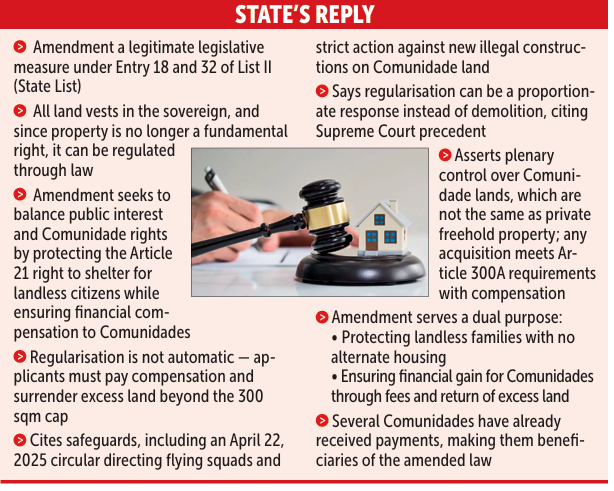
The legal confron tation between the State government and several Comunidades has entered a decisive phase, with the gov ernment filing its reply to the writ petition submitted by the Comunidade of Na goa and seven others before the High Court of Bombay at Goa. The amendment to Goa Legislative Diploma No. 2070, introduced as part of the Mhaje Ghar scheme to regularise unauthorised residential structures on Co munidade land, has drawn significant opposition. Advo cate Sahil Sardesai criticised the move, stating that the amendment is arbitrary be cause it benefits encroach ers who have violated the law. In its detailed 27-page response, the State govern ment described the amend ment as a valid exercise of legislative power under En try 18 and Entry 32 of List II of the Seventh Schedule of the Constitution. It ar gued that all land ultimate ly belongs to the sovereign and that property rights, no longer classified as fun damental rights, may be al tered through legislation. The reply, filed by Under Secretary (Revenue) Vru shika Kauthankar, states that the amendment seeks to balance public interest with the rights of the Co munidades. It argues that the measure aims to protect the right to shelter under Article 21 for landless cit izens while ensuring that Comunidades receive finan cial compensation through regularisation fees and the surrender of excess en croached land. The government clarified that regularisation is re stricted to dwelling houses built before February 28, 2014, and only up to an area of 300 square metres. It stressed that regularisation is not automatic, and appli cants must first compensate the respective Comunidade to prevent any unjust gain. The reply also cited addi tional safeguards. A circular issued by the Chief Secre tary on April 22, 2025, di rects authorities to protect Comunidade lands, form flying squads, and take im mediate action against new illegal constructions. Relying on a Supreme Court judgment, the State noted that the right to shel ter is recognised as part of Article 21, and that pro portionate responses such as regularisation may be appropriate in place of im mediate demolition of resi dential structures. The government further stated that it has plenary legislative and regulatory authority over Comunidade lands, which are not equiv alent to private freehold property and remain sub ject to State control. Under Article 300A, it pointed out, property can be taken only in accordance with law, and the amendment satisfies this requirement by providing for reasonable compensa tion. According to the government, the amendment serves a dual purpose: protecting landless citizens with no alter native housing and safeguarding the financial interests of Comunidades through the regularisation fee and the re turn of land exceeding 300 square metres. It added that several Comunidades have already received payments under the amended provisions, making them direct ben eficiaries. In three similar PILs filed by Diksha Vaigankar and Kash inath Shetye challenging Section 38A of the Goa Land Rev enue Code, the High Court has also issued notices to the State government. All these matters have been listed for further hearing on February 3, 2026. Reacting to the developments, John Philip Pereira, At torney of the Comunidade of Nagoa, said they expect relief against the MhajeGhar initiative. He expressed disappoint ment that the matter has been posted for hearing only after two months, noting that petitioners had sought an earlier date in view of the upcoming ZP elections. However, he added that the Court appears to have scheduled the matter for February 2026 anticipating more writ petitions so that all related cases can be heard together.
State Defends Mhaje Ghar Amendment in High Court as Comunidades Challenge Regularisation Move