Nuvem, similar to its northern counterpart, previously functioned as a ward of Margão in the south but never established its own comunidade, remaining under the jurisdiction of the Margão gãocari. Navelim, likewise, always formed a part of Margão, despite being made a distinct parish in the early Portuguese rule in Salçéte. All lands designated as community property in Navelim continue to be held by the Comunidade de Margão. Historically, Margão was the center of the only deanery in south Goa, encompassing 37 parishes, including Navelim. The formation of Navelim as a new village likely occurred later, with its name possibly derived from ‘nov’ (new) and ‘hal’li’ (village). South Goa is known for three consecutive feasts: the Infant Jesus feast in Colvá, the Mother of the Poor feast in Nuvem, and the Our Lady of the Rosary feast in Navelim.
Igreja de Nossa Senhora do Rosário de Navelim

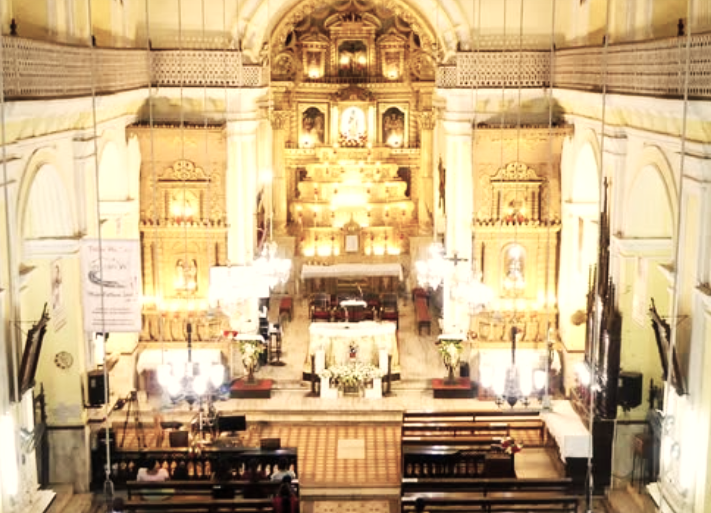
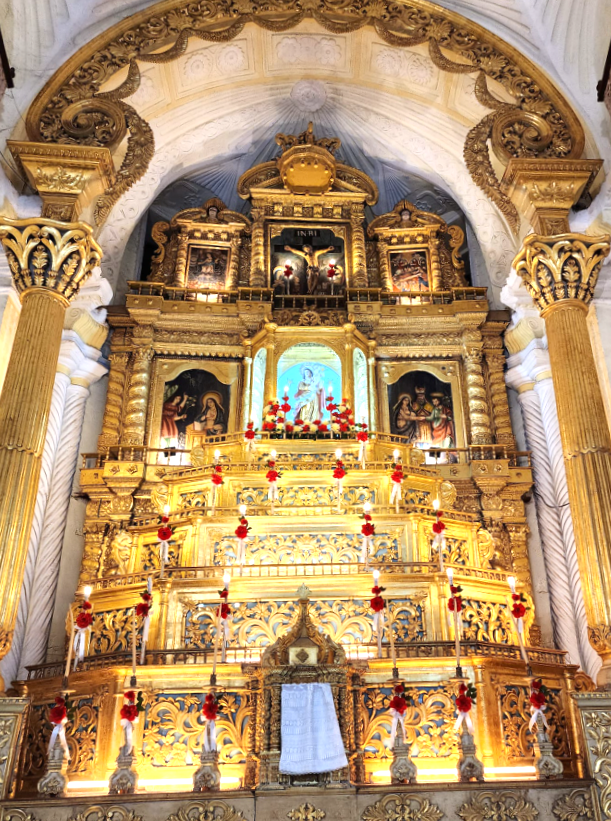
The Igreja de Nossa Senhora do Rosário de Navelim was founded in 1567 during the late 16th century by French Jesuit Pe. Jean de Sena, with financial support from local residents. On 23 May 1606, the gãoncars of Margão donated land in Návelim for expanding the church premises, and on 11 October 1606, Maria de Águiar contributed a plot called ‘Tontem Cumbar-batta’. According to tradition, a merchant whose business was seeing bad days, entered the church as he passed by the church one day. He pledged to Our Lady that if his business flourished, he would make sure that the church was enlarged. His business did flourish and so he kept his word. He not only enlarged the church but also enshrined a new statue of Our Lady. He also had the feast shifted from being celebrated on the first Sunday of October to being celebrated on the 3rd Wednesday of November. He was the one also responsible for encouraging vendors to set up a fair on the occasion of the feast of Our Lady in Navelim.
The Feast and Fair Traditions
Initially, the fair during the feast consisted of just three or four stalls and was a one-day event. Vendors were reluctant to stay overnight, attributed to beliefs about spirits in the area. The fair’s duration was gradually extended to three days by Dr. Francisco Salvador Gomes, who encouraged more vendors to participate.
Church Raids and Restoration
Maratha troops raided and looted the church in 1717 and 1739. During these raids, the statue of Our Lady was secured in the Carmel Convent in the city of Goa, only to be restored to Návelim after the expulsion of religious orders in 1835. Pe. Jean de Sena S.J. served as the church’s first vicar, while Pe. Diego de Amaral, in 1759, was the last Jesuit vicar among 22 Jesuit Vicars serving the parish. The church underwent renovation in 1941, when a new bell was installed in the original northern tower. A matching southern tower was added in the 1980s by vicar Pe. Robert Váz. In Navelim, the feast of Our Lady of the Rosary is observed on the third Wednesday of November, distinct from the global celebration on October 7.
Novena Procession and Agricultural Connections
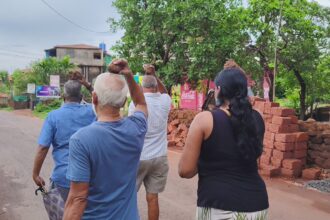
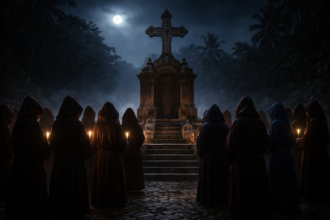
For about fifty years, the ‘Vatinchem Pursanv’ or ‘Procissão de velas’, a candlelit procession has begun the feast season. Starting at 3:30 am, on the first day of the novenas this procession goes from Capela de Nossa Senhora do Carmo in Teláulim to the Navelim Church, culminating in a mass at 5:00 am.
Traditionally, the male gãocars from Teláulim would go to the ghats (Belgão), a day before the novenas to source cattle to be sold during the feast fair. Just like the feast in Nuvem was known for cattle trade, so was the feast in Návelim. Villagers would also get sack loads of other agricultural produce from the ghats to be sold at the fair and on their return back would carry along goods like salt, dried fish and coconuts from Goa. Originally in the procession the statue of Our Lady of Mount Carmel was brought to the church, which remained there until the feast of Our Lady of the Rosary and was taken back to the chapel after the feast. This was done for safety reasons, to ensure that the statue from the chapel was safe at the church in the absence of the men of the village who went to the ghats for sourcing cattle which were traded at the church fair. It was recently that late Pe. José Roque Caetano Pires substituted the statue of Our Lady of Mount Carmel with that of an image of Our Lady of Fátima, with help of the rejidor (notary) of Teláulim, José Minguel Pires de Menezes.
Practical Reasons for the November Feast Date
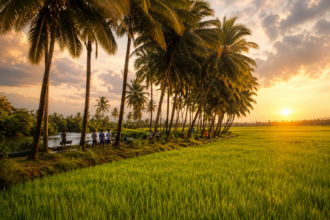
Residents like Mr. Cresçençio Pereira say the feast date moved to the third Wednesday of November because most Navelim villagers were paddy farmers. October, being the harvest period, kept them busy, unable to host guests. After harvest, they had the resources to celebrate the feast.
Every detail of the traditions and history surrounding Navelim, its church, and its feast reveal both the religious and agricultural rhythms that shape the community’s practices to this day.