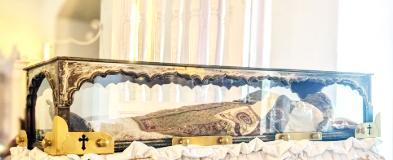
Within the Mastrillian silver casket that rests atop the Florentine mausoleum now lies a crystal urn safeguarding the sacred relics once forming the incorrupt body of St. Francis Xavier. This urn replaced the centuries-old wooden coffin after the 1952 Exposition, when Patriarch of Goa D. José da Costa Nunes determined that the fragile relic could no longer be directly touched or handled by pilgrims. In order to better protect the remains, he commissioned Casa Brandizzi of Rome to create a crystal or highly transparent glass urn specifically designed for the saint’s relics.
The task was entrusted to engineer Ettore Brandizzi, who arrived in Mormugão via Lisbon on January 30, 1955, aboard the ship India. He brought with him the newly crafted crystal urn fitted within a silver frame, which reportedly cost Rs 60,000, a significant investment at the time, underscoring the importance placed on the relic’s preservation.

Just a few days later, on February 2, the wooden coffin that had housed the relic since 1744 within the Mastrillian casket was transferred to the upper hall above the portico of the Professed House of Bom Jesus. This coffin could only be opened using three keys held by the highest authorities in Goa: the Patriarch of the East Indies, the Governor-General of Portuguese India, and the Administrator of the Basilica. Once opened, the relic’s transfer process began under Brandizzi’s supervision. For the next ten days, he meticulously worked to place the sacred remains into the new crystal urn.
In keeping with strict guidelines issued for the preservation of the relic, no wax or plastic substances, sometimes used elsewhere in the display of saints’ remains were allowed. These instructions were meant to uphold complete authenticity and avoid artificial enhancements. Brandizzi’s involvement represented yet another instance of Italian participation in the major milestones surrounding St. Francis Xavier’s Shrine, further highlighting the international significance of the saint and the reverence accorded to his remains.
By February 13, 1955, the delicate task of transferring the relic into the crystal urn was complete. The lid of the urn was then placed and officially sealed with the wax seals of Patriarch D. José Vieira Alvernaz and Governor-General Paulo Bernard Guedes. These seals were positioned on each side of the urn, as well as at the head and foot, ensuring that the relic remained secure, tamper-proof, and ceremonially sanctified. Once sealed, the urn, still positioned inside its silver frame, was moved back to the Florentine Mausoleum, where the wooden coffin had earlier been placed.
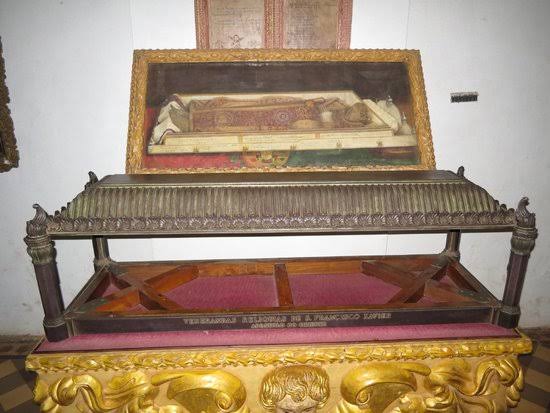
The silver frame, which originally held the glass urn
However, an unforeseen complication arose. The silver frame that accompanied the crystal urn proved too large to fit inside the Mastrillian silver casket. As a result, it had to be removed entirely. Only the crystal urn itself was placed inside the Mastrillian casket, onto a stretcher with wheels made of ivory. The stretcher had originally been placed below the old wooden coffin. Now, the elaborate silver frame which came along with the new urn was set aside. Today, this discarded yet historically significant frame is displayed outside the entrance to the Sacristy, where visitors can view it as part of the Basilica’s heritage.
The old wooden coffin, along with the three keys used to open it, has also been preserved. It is now kept within a glass enclosure outside the Sacristy, serving as an enduring reminder of earlier custodial traditions surrounding the relic. The official seals affixed to the crystal urn in 1955 remained intact until after the Exposition of 1964–65. At that point, they were broken to permit the inner surfaces of the urn to be cleaned. Owing to the high transparency of the glass casing surrounding the crystal urn, pilgrims have since been able to view the relic clearly, even as physical contact, whether by lips, hands, or devotional objects continues to be prevented for its protection.
Since the installation of the crystal urn, the sacred relic of St. Francis Xavier has been displayed within it during every subsequent decennial exposition. These expositions occurred in 1964, 1974, 1984, 1994, 2004, 2014, and most recently in 2024. This method of display has allowed millions of pilgrims to venerate the saint in safety while ensuring that the delicate relic remains protected for future generations.
The transition from the wooden coffin to the transparent crystal urn marks one of the most carefully planned and symbolic chapters in the conservation of the saint’s remains.
The presence of notable figures such as Patriarch José da Costa Nunes, Patriarch José Vieira Alvernaz, Governor-General Paulo Bernard Guedes, and engineer Ettore Brandizzi reinforces the sense of ceremony and solemn responsibility that accompanies stewardship of the shrine. Every action, from the handling of keys to the sealing of the urn, was performed with deep respect and historical awareness. The crystal urn remains both a protective vessel and a symbol of continuity, ensuring that the saint’s earthly remains continue to be venerated with the dignity, security, and sanctity they deserve.