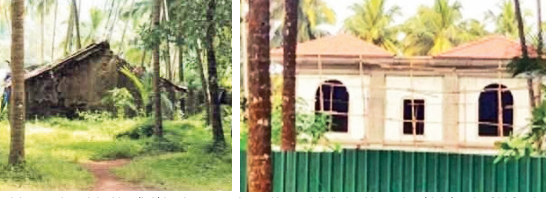
The Supreme Court’s move to appoint a committee headed by a Dis trict Court Judge to inspect the site of the controversial bungalow allegedly built within the UNESCO world heritage zone at Old Goa has sparked renewed discus sion and cautious optimism among so cial activists. For many, the inspection is a long-awaited opportunity to settle a basic but crucial question: was the original structure merely a small store house or has it been transformed into a full-fledged bungalow? Former bureaucrat Elvis Gomes welcomed the decision, noting that a fact-finding committee would bring “true facts out loud and clear.” He argued that while permissions had been obtained “through suppression of facts,” the larger issue was how such irregularities were allowed to continue unchecked. Pointing to what he described as a pattern of indul gence, Gomes remarked that “Delhi-based parties have been liberally allowed to in dulge in illegal activities,” even question ing how taxes were collected for “20-odd non-existent structures” for a decade without scrutiny. Echoing these concerns, activist John Baptista Mascarenhas of Ponda stressed that the structure stood within the pro tected area demarcated by the Archaeo logical Survey of India (ASI). According to him, the official site plan clearly showed only a loja — a small storeroom once used by the previous owner to store coconuts.
“The ASI report also mentions that it was a small size structure and not a bungalow now built there. It has to be razed,” he asserted. For the Save Old Goa Action Committee, the order marks a significant step in a long struggle. Coordinator Peter Vie gas said the group welcomed the formation of the commit tee, recalling their protests and satyagraha held over the years. Their demand, he emphasised, has always been the preparation and implementation of a comprehensive Mas ter Plan for Old Goa to end illegal construction in the her itage precinct. “We are confident that St Francis Xavier will give us justice,” he added. Historian Prajal Sakhardande, who has long document ed alleged violations in the heritage zone, expressed frustration that despite “several reports and umpteen inspections,” no action had followed. He reiterated that what once stood as a small store room was allowed to grow into a bungalow within the ASI-notified area. “We don’t know how the construction… was permitted. The then ASI Goa Circle had objected to it but he was trans ferred,” he said, adding that the Supreme Court’s inter vention offered a long-overdue chance to address “vio lations galore.” Committee president Fatima Pereira shared similar sen timents, recounting the group’s many democratic efforts — including satyagraha and protest meetings—to seek demo lition of the building. “We are now happy with the Supreme Court decision to form a committee to inspect the site. We are confident that truth will prevail,” she said. Old Goa resident Glean Cabral, who has been part of the agitation from the outset, also endorsed the court’s move. He pointed out that in the absence of heritage by-laws, constructions taller than national monuments had been al lowed in the area. “The committee will now find out what had happened there and will set the issue at rest,” he said, hoping the inquiry would finally bring clarity and closure. Taken together, the views of activists, residents, histori ans and former officials reflect a shared expectation: that this on-ground inspection will finally establish the facts— and perhaps reinforce the protection of the heritage zone.