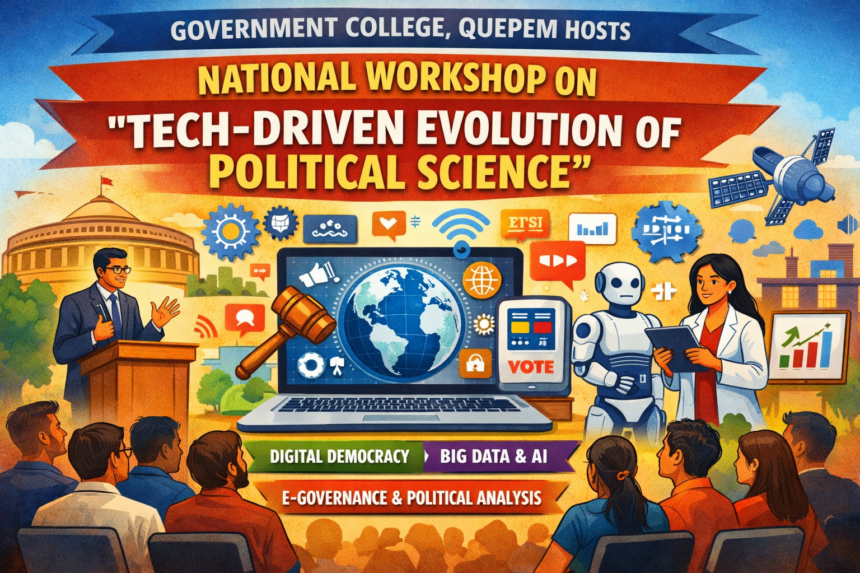
The Department of Political Science at the Government College of Arts, Science and Commerce, Quepem, in collaboration with the Directorate of Higher Education, successfully organised a two-day National Workshop titled “From Algorithms to Policy: The Tech-Driven Evolution of Political Science” on January 27 and 28, 2026.
The inaugural session was attended by Dr Maria Goretti Simoes, Principal of G.R. Kare College of Law, along with senior faculty members and dignitaries from the host institution. The workshop aimed to explore the growing intersection between technology and political science in an era of digital governance and data-driven policymaking.

Participants were exposed to a range of technical and academic sessions covering policy analysis, digital governance, cybersecurity, and the use of advanced statistical tools such as SPSS and SmartPLS. The sessions were led by noted resource persons, including Dr Alaknanda Shringare, Dr Seema Fernandes, and Dr Raghavendra, who shared insights on integrating technology into political research and public policy studies.
Adding a cultural touch to the academic programme, the Politisia Club of the college presented Goan folklore, enriching the learning environment and highlighting local cultural heritage.
The valedictory session was presided over by Prof. F. M. Nadaf, Principal of the Government of Goa’s Autonomous College of Multidisciplinary Studies and Research, Borda–Margao, and Deputy Director of Higher Education. He underlined the growing importance of technological tools in academic research and governance, particularly in strengthening democratic accountability.
Certificates were distributed to participants at the conclusion of the workshop, marking its successful completion. The event was coordinated by Ms Vrushali Joshi and conducted under the guidance of Dr Pravina Kerkar, Officiating Principal of the college.
The workshop brought together scholars, faculty members, and students from Goa at the national and state levels, fostering interdisciplinary dialogue and equipping participants with digital competencies essential for governance and policy research in the 21st century.