KARSTEN MIRANDA
A growing cho rus of concern is emerging in Goa over the proposed amendments to the Foreign Contribution (Regulation) Act (FCRA), with Catholic organisations, civil society groups and independent voices warning that the changes could fundamen tally alter the functioning of minority institutions and community-led service net works. At the centre of the anx iety are provisions that would allow the govern ment to assume control over assets of organisations whose FCRA licences are cancelled, lapse, or are not renewed — through a ‘des ignated authority’ empow ered to manage, dispose of, or repurpose such as sets. Critics argue that this marks a shift from regulato ry oversight to direct state control.

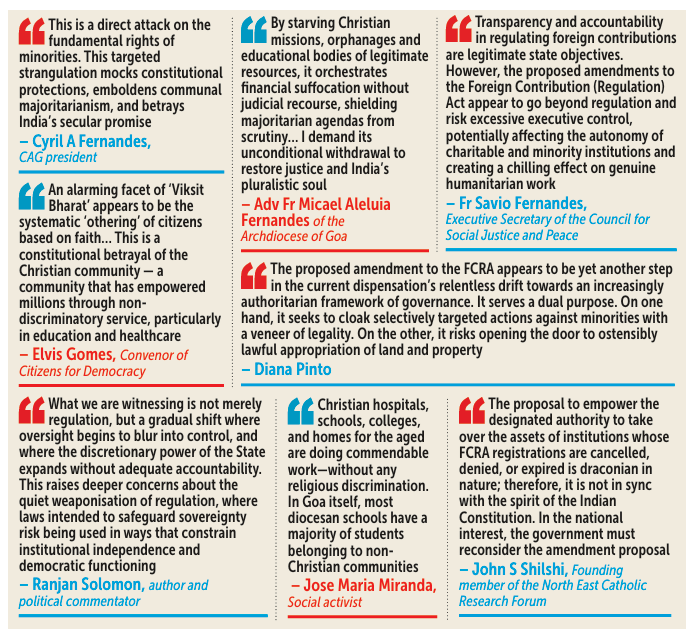
Leading the pushback, the Catholic Association of Goa has issued a strong condemnation, framing the amendments as an existen tial threat to minority-led service institutions. “The Catholic Associa tion of Goa (CAG) strongly condemns the controver sial FCRA Amendment Bill, which threatens the lifeline of minority welfare, edu cation and humanitarian work. By imposing sweep ing government controls on foreign funding for NGOs such as Christian charities, hospitals and schools, it violates the constitutional rights enshrined in Articles 14, 21, and 25-30 — equali ty, dignity, religious freedom and minority institutional autonomy,” said Cyril A Fer nandes, CAG president.
“This is a direct attack on the fundamental rightsof minorities. This target ed strangulation mocks constitutional protections, emboldens communal ma joritarianism, and betrays India’s secular promise,” Fernandes said. CAG further warned that the amendments go beyond financial regulation and could disrupt legitimate service delivery on the ground. “These amend ments empower arbitrary bank account freezes and donor restrictions, stran gling legitimate service without due process, as flagged by affected mis sions across Goa and India.
This is not regulation but targeted suffocation of minor ity voices, eroding Goa’s plu ralistic ethos amid rising com munal tensions,” Fernandes added. “We demand immediate withdrawal or judicial scru tiny to protect India’s secular fabric. Faith-based service is a constitutional duty, not a state licence. CAG stands with all minorities for justice. CAG demands an immediate halt to this erosion of minority au tonomy and justice.” Echoing these concerns, Adv Fr Micael Aleluia Fer nandes of the Archdiocese of Goa described the proposed law as a direct assault on con stitutional guarantees. “The FCRA Amendment Bill is a blatant violation of mi norities’ fundamental rights under Articles 14 (Right to Equality), 21 (right to natural justice under the right to life and liberty), and 25-30 (rights of minorities), systematical ly dismantling the autonomy of faith-based institutions through draconian funding controls and arbitrary state overreach,” he said. “By starving Christian mis sions, orphanages, and edu cational bodies of legitimate resources, it orchestrates fi nancial suffocation without judicial recourse, shielding majoritarian agendas from scrutiny,” Fr Micael added. “This legislative weaponi sation crushes the constitu tional guarantee of equal pro tection and religious liberty. I demand its unconditional withdrawal to restore justice and India’s pluralistic soul.” While sharply critical, some voices within the Church have also called for balance, cau tioning against the dilution of regulatory intent while warning of excess. Fr Savio Fernandes, Executive Secre tary of the Council for Social Justice and Peace (CSJP), said oversight must not translate into control. “Transparency and account ability in regulating foreign contributions are legitimate state objectives. However, the proposed amendments to the Foreign Contribution (Regula tion) Act appear to go beyond regulation and risk excessive executive control, potential ly affecting the autonomy of charitable and minority insti tutions and creating a chilling effect on genuine humanitari an work,” he said. “We respectfully urge the Government of India to with draw the overbroad provi sions and refer the Bill for wider consultation and care ful scrutiny,” Fr Savi o added. Beyond Church circles, civ il society voices in Goa have framed the issue as part of a broader political and ideologi cal shift. Elvis Gomes, conven or of Citizens for Democracy, said the amendments reflect a deeper pattern of exclusion. “An alarming facet of ‘Viksit Bharat’ appears to be the sys tematic ‘othering’ of citizens based on faith. The proposed FCRA amendments threaten to establish a ‘designated au thority’ with draconian pow ers to seize assets on flimsy pretexts. This is a constitu tional betrayal of the Christian community—a community that has empowered millions through non-discriminatory service, particularly in educa tion and healthcare,” he said. “Ideological factions cannot bear to see the upliftment of marginalised sections facil itated by these institutions. While the Bill’s deferment may be a tactical move ahead of the Kerala elections, its eventual return is inevitable,” Gomes added. Turning his criticism in ward, Gomes also called out Goa’s political leadership. “Those who defected to the BJP in Goa must stop enjoy ing the comforts of power and stand for the community that has contributed so much to Indian nation-building. Peo ple in Goa must rise up and be prepared to fight.” On the ground, the poten tial impact on long-stand ing service institutions has sharpened concern. Social activist and columnist Jose Maria Miranda pointed to the cross-community role played by Christian-run institutions in the State. “The proposed amendment to the FCRA is nothing but a draconian attempt at taking control of our Christian insti tutions, which are doing yeo man work for all communities. Christian hospitals, schools, colleges, and homes for the aged are doing commendable work — without any religious discrimination,” he said. “In Goa itself, most diocesan schools have a majority of stu dents belonging to non-Chris tian communities,” Miranda pointed out. He warned that the pro posed framework could en able sweeping state inter vention. “This amendment enables the appointment of an authority which can not only stop foreign contributions but also confiscate the assets of institutions and hand them over to the Central or State governments, or any other agency, or even sell them as it pleases — and this is beyond judicial review,” he said. “So can we call this a de mocracy, where such sweep ing powers are given to a compromised authority?” Miranda asked. “The Christian community and its hierarchy have rea sonable grounds to be ap prehensive of such decisions from a government whose credentials are, unfortunately, suspect when it comes to mi norities,” he added. Offering a broader structur al critique, author and politi cal commentator Ranjan Solo mon said the trajectory of the law itself is cause for concern. “The Foreign Contribution (Regulation) Act (FCRA) was conceived as a defensive in strument—an effort to shield India’s sovereignty from cov ert foreign influence. On pa per, its logic is unassailable: a nation has every right to regulate external funding that might distort its political or social fabric.” “In practice, however, the FCRA has increasingly mor phed from a regulatory frame work into a discretionary lever of control, raising un comfortable questions about its use—and misuse—in a democratic society.” “What we are witnessing is not merely regulation, but a gradual shift where oversight begins to blur into control, and where the discretionary power of the State expands without adequate account ability.” “This raises deep er concerns about the quiet weaponisation of regulation, where laws intended to safe guard sovereignty risk being used in ways that constrain institutional independence and democratic functioning.” Adding to the widening un ease, Diana Pinto warned that the implications go beyond immediate institutional im pact. “The proposed amend ment to the FCRA appears to be yet another step in the cur rent dispensation’s relentless drift towards an increasingly authoritarian framework of governance. It serves a dual purpose. On one hand, it seeks to cloak selectively targeted actions against minorities with a veneer of legality. On the other, it risks opening the door to ostensibly lawful ap propriation of land and prop erty,” she said. “The signal this sends is deeply troubling. It further constricts the already shrink ing space for minorities in India and risks compounding the damage to the nation’s standing as a pluralistic so ciety committed to religious freedom and the protection of all communities,” Pinto added. She also questioned the long-term consequences of state control over such in stitutions. “Moreover, given the government’s track re cord, there is little reason for confidence that institutions brought under its control will retain their defining ethos. Efficiency, compassion, and the spirit of selfless service — hallmarks of many such bod ies — may well give way to bu reaucratic inertia and erosion of purpose. In any eventuality, it is the nation and its people who stand to lose.” Concerns are not limited to Goa. Voices from the Northeast have raised similar objections, pointing to the wider national implications of the proposed law. John S Shilshi, founding member of the North East Catholic Research Forum (NE CARF), flagged constitutional concerns around the powers of the proposed authority. “The Bill says the desig nated authority shall have access to accounts, records, and properties for inspection; no transfer of assets without approval; and all activities shall be carried out under the supervision of the designated authority. This is dangerous because it directly violates Ar ticle 26 of the Indian Constitu tion,” he said. “Also, the proposal to em power the designated au thority to take over the assets of institutions whose FCRA registrations are cancelled, denied, or expired is draco nian in nature; therefore, it is not in sync with the spirit of the Indian Constitution. In the national interest, the government must reconsider the amendment proposal,” he added