SHASHWAT GUPTA RAY
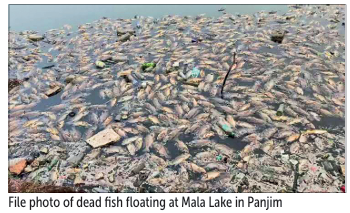
Goa’s water bod ies are choking — and the State knows it. From mass fish deaths in Mala Lake in Panjim to the worsening sewage cri sis in the Sal river, and the government’s own admis sion in the Assembly that several rivers and beaches are unfit even for bathing, a disturbing pattern has emerged — contamina tion is rising.

What was once dis missed as isolated in cidents has now snow balled into a full-blown environmental crisis. Environmental experts have raised questions about regulatory failure, unchecked urbanisation, and the State’s reluc tance to act, saying the warning signs have been visible for years — but ignored. They have called for immediate interventions, such as decentralised wastewater management to prevent sew age from entering water bodies, along with improved civic sense among citizens and restrictions on human settle ments along riverbanks. Water conservationist Tallulah D’Silva said unchecked settlements along riverbanks and streams need to be stopped. “In the case of Mala Lake, 75 per cent of the surrounding land is covered with buildings that discharge waste into it. As a child, I remember Mala Lake being a hotspot for birds. It was entirely freshwater. Today, due to human activity, not only is the lake shrinking, but there is also salinity in it,” D’Silva lamented. She said all stakeholders — local residents, the govern ment, and experts — must collaborate on solutions.
She also called for adopting newer technologies to deal with human waste. “We need more efficient technologies to dispose of hu man waste. Systems like septic tanks and soak pits are among the worst options because they are outdated. Un treated waste is directly released into the soil, polluting groundwater,” she said. Calling for nature-based solutions, D’Silva said that in the past, people maintained kitchen yards with banana trees, where wastewater was released as it was considered suitable for fruit-bearing plants, which in turn helped clean the water. “Banana plants effectively act as living filters, breaking down organic contaminants and absorbing nutrients, mak ing them a sustainable solution for treating domestic and light industrial wastewater. This is known as a root zone system. We should also adopt bio-digester-based toilet sys tems,” she said. A bio-digester toilet system uses anaerobic bacteria to decompose human waste into odourless, pathogen-free water and gas within a sealed, multi-chambered tank. It serves as a compact, eco-friendly alternative to septic tanks, requiring no manual emptying, reducing solids by over 90 per cent, and allowing treated water to be reused for irrigation.
Speaking on resistance to the installation of sewage treatment plants (STPs) in Goa, the water conservationist said the solution lies in decentralisation. “We cannot expect all our waste to go into a ‘magic ma chine’ that will automatically treat it. We need facilities that treat sewage close to its source, rather than pumping it to a central plant,” she said. Hyacinth Pinto, an architect and sustainable development expert, said the Goa State Wetland Authority is mandated to protect water bodies, but faces jurisdictional challenges. Wetlands in Goa are protected under the Wetlands (Con servation and Management) Rules, 2017, implemented by the Goa State Wetland Authority. These rules prohibit industrial expansion, waste dumping, and permanent con struction within notified wetlands and their buffer zones (Zone of Influence) to prevent ecological damage. “Although wetlands have been marked out, my studies show that the zone of influence has not been properly de marcated. Authorities have not adequately verified what falls within these zones on the ground.
Without this clarity, regulations cannot be effectively enforced. That said, peo ple must also behave responsibly,” Pinto said. She also criticised revellers for littering along lakes and riverbanks, contributing to pollution. “People come for picnics with food and beverages, and af ter consuming them, they leave behind litter such as pack ets and cans, which are lightweight and easily scattered. If people do not act responsibly, how can the government be expected to clean rivers and valleys every time?” she asked. Speaking specifically about the Mala Lake fish deaths, she said oxygen levels in the lake had depleted due to sew age inflow. “There are migrant labourers living in informal settle ments near rivers and streams. The government must provide proper accommodation with adequate sanitation facilities away from water bodies. It has to step in and take corrective measures,” she said. Former Acting Director of the National Institute of Oceanography, Dr S Prasanna Kumar, said the recent fish mortality in Mala Lake could be attributed to untreated sewage inflow from households and colonies. “In my view, to prevent such occurrences in the future — not only in Mala Lake but in any lake or enclosed wa ter body in Goa — several steps must be taken. First and foremost, stop the source of pollution. Divert and treat sewage and wastewater using STPs. Enforce strict effluent standards and implement stringent industrial discharge controls,” he said.
The second step, he said, is to remove sediments from the bottom through dredging and to clear invasive aquat ic plants such as water hyacinth. Removing floating debris through skimmers and periodic manual clean-up drives is equally important. “Restore natural hydrology by reconnecting feeder chan nels and inflows, ensure proper outlets to prevent stag nation, and protect catchment areas from encroachment. Many lakes die due to disruption of their natural water flow,” he said. He added that stabilising lake banks and restoring hab itats is crucial. “Plant native vegetation along the banks and create buff er zones to filter runoff. Restore habitats for fish, birds, and microorganisms,” he said. Pradip Sarmokadam, Member Secretary of the Goa Biodi versity Board and Head of the Nodal Agency of the Goa State Wetland Authority, said wetland pollution is a serious concern. “It is the collective responsibility of everyone to stop pol luting.
Community participation is critical for maintaining and sustaining water bodies. We are preparing an integrat ed management plan for notified wetlands. Protection will be effective only when local communities are connected to these ecosystems through their livelihoods and culture,” Sarmokadam said. He added that Lake Management Committees have been notified — specialised bodies established by the GSWA to ensure the protection, conservation, and management of identified wetlands and lakes in the State. “They will work with local communities, who will keep vigil over water bodies. A decentralised approach is the best model for protecting our natural resources,” he said.