SHASHWAT GUPTA RAY
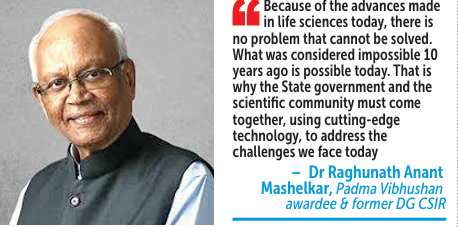
In the face of growing environmental and health challenges af fecting Goa, eminent sci entist and ‘son of the soil’ Raghunath Mashelkar on Friday exhorted the State government and the scien tific community to collabo rate in finding solutions to issues impacting Goenkars. “There is great scope for cutting-edge science and breakthrough research in finding solutions to our challenges. Because of the advances made in life sciences today, there is no problem that cannot be solved. What was consid ered impossible 10 years ago is possible today. That is why the State govern ment and the scientific community must come together, using cut ting-edge technology, to address the chal lenges we face today,” Dr Mashelkar told O Heraldo. The former Di rector General of the Council of Scientific and Industrial Research (CSIR) and Padma Vibhu shan awardee was in the capital city to receive the TECHNOLOGY prestigious Gomant Gaurav Sanman (Lifetime Achieve ment Award) on April 16, 2026. The honour was con ferred by the Goa Chamber of Commerce and Indus try along with MIT World Peace University, Goa. Speaking on the role of scientific institutions in solving social problems, Dr Mashelkar said that during his tenure as DG of CSIR, he ensured that sis ter laboratories — such as the National Institute of Oceanography — prioritised local issues and chal lenges. “Providing solutions has always been my mantra. Solution-based tech nology for societal transformation is a necessity. It cannot be restricted to laboratories but must be applied in the field to make a difference. People don’t want to be part of a problem; they want to be part of the solution. Therefore, even in Goa, the State gov ernment, which has a Science and Technology department, should make full use of its resources,” he said. He added that the amount of fund ing for research is less important than the power of ideas. “Basically, our emphasis has to be on young people who can think of breakthrough ideas that bring change. The Anjani Mashelkar Foundation that I founded does not recognise best practices, but ‘next practices’. For the last 15 years, we have given awards only to ‘next practices’ — solutions based on cutting-edge technology,” Dr Mashelkar said, adding that all awar dees have been from start-ups. He further noted that the advent of newer technologies such as Artificial Intelligence has made research faster and more effective. “For example, if you want to design a new molecule, it previously took years. Today, with AI, it can be done in months. We also have ‘CRISPR-Cas9’, a revolutionary, precise and cost-effec tive gene-editing technology adapted from bacterial immune systems. The speed of doing things faster and bet ter has increased immensely because of such cutting-edge solutions,” he added