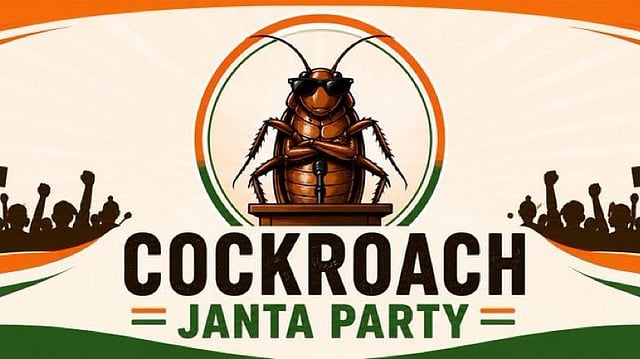
The Cockroach Janta Party (CJP), a satirical political movement born from online outrage and biting humour, has rapidly become a force in India’s social-media politics. What began as a reaction to remarks by Chief Justice of India Surya Kant about certain youth—comments that many saw as dismissive—has ballooned into a viral digital phenomenon that amassed over 10 million Instagram followers in just five days. The account behind the movement, @cockroachjantaparty, achieved this milestone faster than some established political accounts, surpassing the BJP’s Instagram following, which stands at about 8.7 million. Congress remains ahead with roughly 13.2 million followers, while AAP sits at about 1.9 million.
The CJP’s rise illustrates how sarcasm, short-form reels, and shared indignation can translate into massive online mobilization. It started on May 16 after the CJI’s comments on May 15—during a hearing—where he compared some youngsters to “cockroaches,” saying certain individuals who fail to find employment turn to activism, media, or RTI work and “start attacking everyone.” That line ignited anger across social platforms, and within days Abhijeet Dipke, who is identified as the party’s founder, transformed the outrage into an organized satirical campaign.

Although the CJI later issued a clarification saying he was misquoted and that his criticism targeted people who enter professions through fake degrees—not young people in general—the damage was done. The perceived insult from a constitutional guardian pushed many young users to rally under a banner that mixed humour with grievance. The movement tapped into broader frustrations: unemployment, exam paper leaks such as NEET, and a sense among Gen Z that institutions are out of step with their concerns.
High-profile voices amplified the trend. Influencers and public figures including Dhruv Rathee and activist-lawyer Prashant Bhushan publicly supported the CJP’s potential. Bhushan urged the movement to channel its momentum into concrete demands, such as calling for accountability over the NEET paper leak and advocating for a “right to employment” guaranteeing minimum-wage work or unemployment allowances. Political figures like Mahua Moitra and Kirti Azad have also signalled openness to the cause.
Despite the dizzying follower counts, analysts warn that online followings are not equivalent to on-the-ground party membership or organizational capacity. Building real political power requires grassroots structures, volunteers, and sustained local presence—things a viral page does not automatically create. Still, the CJP’s meteoric ascent underscores a new reality in Indian politics: meme-driven, youth-led movements can reshape digital conversations and outstrip traditional parties in the online arena, at least for a time.