SHASHWAT GUPTA RAY
A concerning trend is being observed by neurologists in Goa re garding the increasing in cidence of strokes among younger demographics. Traditionally known as older patients’ health con dition, there has been a significant rise in stroke cases affecting adults in their 40s, mainly due to the poor lifestyle being followed. “The trend regarding brain stroke in Goa is that it is setting in early amongst the younger lot, especially those in their 40s. I see at least four to five acute stroke cases in a week. Earlier it used to happen in people above 60s. The risk factors are smoking, high blood pressure and dia betes. Smoking is the biggest risk factor,” Dr Charudutt Jayant Sambhaji, Consultant – Neuro & Vascular Inter ventional Radiology, Manipal Hospital Goa, said.

According to Dr Sambha ji, stroke remains one of the leading causes of death and long-term disability in In dia, and Goa is no exception. However, advancements in neuro-interventional treat ment are now helping many patients recover successfully if they reach the hospital in time. “There is a misconception that stroke affects only the elderly. We are increasingly seeing younger patients with uncontrolled lifestyle-related risk factors. Awareness and preventive health checks are extremely important,” he said. “Time is Brain,” said Dr Sambhaji, explaining that nearly 1.9 million brain cells are lost every minute during a major stroke. Many patients lose precious time because symptoms are ignored or mistaken for fatigue, weakness, vertigo, or low blood pressure. Immediate medical attention can save not only life but also prevent permanent disability,” he said. He highlighted that Mechanical Thrombectomy has emerged as a game-changing treatment for severe strokes caused by blocked brain arteries. The minimally invasive procedure involves navigat ing a catheter through the blood vessels to remove the clot from the brain using advanced devices such as stent retrievers or aspiration catheters. “Unlike traditional surgery, thrombectomy does not require open ing the skull.
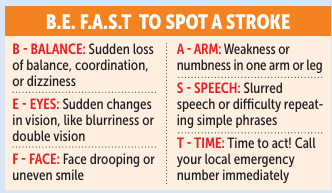
If performed within the critical time window, many patients can recover dramatically and regain normal speech, move ment, and independence,” he explained. Veteran neurosurgeon, Dr Audumbar Netalkar also emphasised the importance of early diagnosis and coordinated stroke care to prevent permanent paralysis of the patient. “Modern stroke management requires rapid teamwork between emergency physicians, neurologists, neurosurgeons, neuro-inter ventional specialists, intensivists, and rehabilitation teams to achieve the best outcomes for patients,” he said. According to Dr Omkar Churi, a consulting neurosurgeon, early identification of a stroke is critical due to the “golden hour,” the limit ed timeframe in which medical intervention is most effective. Unlike other conditions that may develop gradually, a stroke occurs rapidly. “Every second counts, as thousands of brain cells die for every minute a stroke goes untreated. To identify a stroke, we utilise the “BE FAST” acronym. B is Balance. One should look out for sudden loss of balance or coordination, even without limb weakness. E is Eyes, indicating sudden blurred vision or loss of sight in one eye. Then is F – Face. Sudden facial drooping or asymmetry on one side is an indi cator of stroke,” Dr Churi said.
Also watch out for weakness in the arms, which is often more pronounced than in the legs. S stands for Speech, meaning sudden difficulty speaking or slurred speech. Finally there is T or Time. It is vital to record the exact time the symptoms began,” Dr Churi said. Documenting the time of onset is essential for healthcare provid ers to determine the most appropriate course of treatment. “Then the most critical aspect is transportation of the patient. The sooner a patient reaches a tertiary care facility, the better the poten tial clinical outcome,” he said.