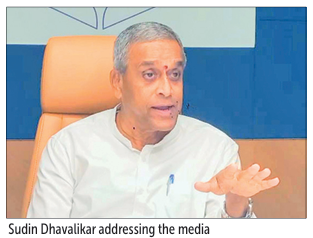
The Goa government on Tuesday acknowledged that near ly 70,000 electricity consumers — around 10 per cent of the State’s 7.5 lakh power users — were saddled with excess demand, ex cess energy and delayed payment charges, announcing a one-time rollback of the penal levies even as Power Minister Sudin Dhavalikar hinted that administrative lapses dating back to 2005 were respon sible for the situation. Addressing a press conference, Dhavalikar said revised electrici ty bills have begun reaching con sumers from June 29, with the additional penal components re moved.
Consumers will now pay only the normal tariff applicable to the electricity actually con sumed, while delayed payment charges on the revised bills have also been waived. The move amounts to an offi cial admission that thousands of consumers had been billed penal charges after being found to have exceeded their sanctioned elec tricity load, a controversy that had triggered widespread public outrage in recent weeks.

Seeking to explain how the issue arose, Dhavalikar pointed to lapses within the Electricity Department more than two decades ago, suggesting that sanctioned loads were not revised despite consumers obtaining enhanced Low Tension (LT) electricity connections. “The department engineers faltered. The two-point pro gramme was stopped in 2005. Consumers took connec tions, but failed to enhance the load,” the minister said. Asked whether he was holding the then Power Minister Digambar Kamat responsible, Dhavalikar stopped short of naming him directly, saying, “I am not talking about the then minister, but the department engineers faltered.” His remarks nevertheless appeared to indirectly point the finger at Kamat, who handled the Power portfolio dur ing that period, exposing apparent differences within the ruling dispensation over responsibility for the controversy.
Electricity Department Chief Engineer Stephen Fer nandes said penalties totalling Rs 43.51 crore, already recovered from the approximately 70,000 consumers be tween November 2025 and June 23, 2026, would be ad justed against their future electricity bills. Fernandes, however, defended the department’s actions, saying the penalties were imposed in compliance with di rectives issued by the Joint Electricity Regulatory Commis sion (JERC). While announcing relief, the government also unveiled a series of measures aimed at preventing similar disputes and reducing compliance requirements for consumers.
The Electricity Department will automatically revise sanctioned loads based on the highest load recorded by consumers’ meters. Single-phase connections will be au tomatically upgraded up to 5 kW, while three-phase con nections will be enhanced up to 10 kW. Consumers whose revised sanctioned load falls within these limits will not be required to submit applications, with the enhancement deemed regularised for billing purposes. Those requiring higher sanctioned loads or shifting from single-phase to three-phase supply will have three months to apply online and complete the regularisation process. In another consumer-friendly measure under the gov ernment’s Ease of Doing Business initiative, the depart ment has simplified the process for obtaining new sin gle-phase LT electricity connections up to 5 kW.
Applicants will now only need to furnish proof of iden tity and proof of ownership or occupancy of the premises. The earlier requirement of submitting a wiring completion and test report from a licensed electrical contractor, along with the mandatory joint inspection by a junior engineer, has been dispensed with. Dhavalikar said the department would instead conduct field-level verification before energising the connection to ensure safety and reliability. Connections failing to meet the prescribed safety checklist will be withheld until defi ciencies are rectified. Consumers seeking clarification on revised bills or load regularisation have been asked to contact the department’s helpline or visit their respective sub-divisional offices.