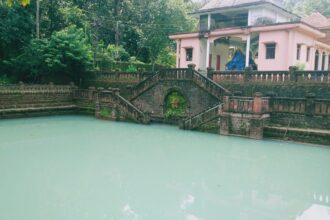
During the rainy season, when sea fishing comes to a standstill, Goans have long turned to inventive ways of satisfying their craving for fish without compromising on their fish quota during the monsoon months. Traditional monsoon fishing practices across Goa show how communities continue to harvest fish, frogs, crabs, clams, and oysters from ponds, streams, fields, rivers, and riverbanks.
Freshwater harvests
Agnelo Andrade of Ambagim, Margão, recalls that in May, when local freshwater ponds and lakes were harvested, children and adults alike would rush to watch and buy loads of fish. Some of the fish were eaten the same day, some were kept aside to make Molho, and some live fish were stored in large copper pots called Bhann(am) with water and taken out later for consumption as needed.
He also remembers that as a child in the 1970s, he would go to the old market in Margão to buy bull frogs sold in jute sacks by local youth who had caught them the previous night. When the first rains arrived, children would head to fields being ploughed for paddy in search of kongé, or field snails, and crabs, which were cooked that day or stored in covered copper pots or bamboo baskets if there was extra.
Night fishing methods
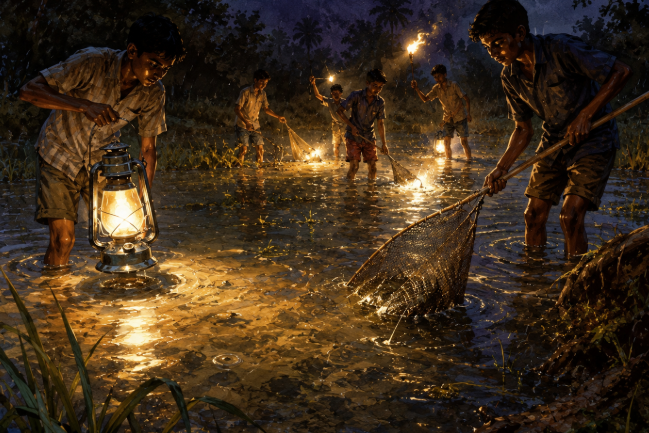
Late nights and early mornings during the first monsoon rains were often spent by village boys moving in groups to fields, forests, and riverbanks with kerosene lamps such as those made by the Petromax company, or with fire torches, to catch fish, frogs, and crabs. This light-based fishing technique is called Dhipkavnni/dhumpavnni a method that relies on the light sensitivity of fish and frogs.

Traps and baskets
Piedade Miranda of Fatorda describes several other traditional techniques used in Goa. For small flowing streams known as vall or voll, locals used a bamboo trap called kudd, which has one conical closed end and a wide opening. The trap is placed in the narrowest part of a running stream, with the sides blocked by twigs or mud, so fish enter through the open end but cannot escape.
In paddy fields, locals also throw fish food to gather fish and then catch them by covering them with bamboo traps. Wide-mouthed bamboo baskets were likewise plunged quickly into field ponds and lifted up, sometimes yielding a good catch.
Hook fishing
Poller, or line-fishing, and Gorovop, or rod-fishing, both use metal hooks. In Poller, a nylon string instead of a rod is used with multiple hooks and attractive bait, such as a big prawn, to catch a larger variety of fish. In Gorovop, a nylon string with a hook is tied to a wooden or bamboo stick.
The bait and hooks used depend on the type of fish being targeted, with small prawns, earthworms, and rice dough among the common choices. Today, bamboo rods have in most cases been replaced by more advanced fishing rods.
Stake and net fishing
Khutavanni is a local stake-fishing technique practiced in Goa. It uses wooden poles staked into the river along the edges, with a net tied across them to trap fish, which are then harvested at low tide. This method is commonly used during the monsoon to catch fish such as chonak, or sea bass, and dodiyare, or croaker.
Agostinho Coelho of Cortalim says that during the first rain, fish from field ponds come up swimming against the flow of running water and reach land surfaces where water has gushed by. He and others would go out in heavy rain to catch this Choddnechem nuste using a sharp knife, koito, or balho, a spear, striking the catfish on the head. He says the last catfish was always the first target, because starting from the front would make the fish disperse and make catching them harder.
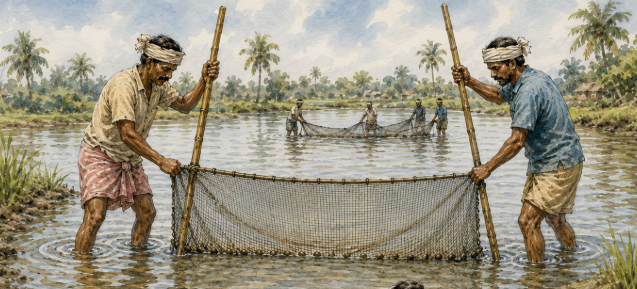
Kanni, or zalli marop, is another fishing method that uses a rectangular barrier net held by two bamboo sticks and carried by two men through shallow waters. For deeper bodies like ponds, more men may be used to trawl a larger net over the waterbed. When the net is semi-circular and fixed to a bamboo framework, it is called zalli, and it is commonly used to catch prawns in muddy shallow water.
Cast nets and crab gear
Kaanthalli, also known as cast net fishing, uses a net about 300 metres long. Small floats traditionally made of mango wood run along one side so the net falls over the water like a vertical curtain. A smaller net thrown by a single person is called paguer or paguel.
Catching crabs for curry or Xec-xec requires a device called Cobulem or coblem, made of a net woven against a circular metal frame placed along the river or stream edge. A string attached to the Cobulem is left on the riverbank, and when movement is felt in the string, the net is pulled up. Bamboo kudd traps are also used for crab catching, with cattle waste from butcheries commonly used as bait.