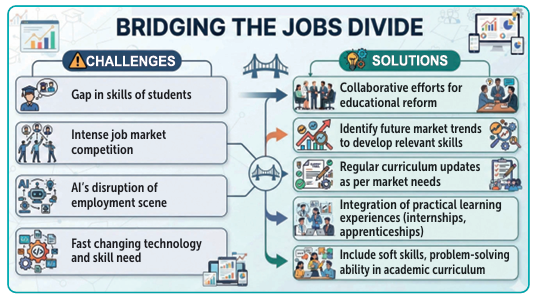
Goa’s unemploy ment rate for 2025 was recorded at 8.3 per cent, against the national aver age of around 3.1 per cent, according to the annual Periodic Labour Force Survey (PLFS) released by the Ministry of Statistics and Programme Imple mentation (MoSPI). This is not the first time Goa has recorded an un employment rate above the national average. But the bigger question is: Why is the rate so high, and what should be done to bring it down? Principal Software Engi neer at IT firm Webware. io, Asim Ahmed Shaikh, said there appears to be a significant gap between traditional higher educa tion and the practical skills required by employers. “There appears to be a significant gap be tween traditional higher education and the prac tical skills required by employers,” said Shaikh.
“Many three-year degree programmes focus primarily on theoretical knowledge, leaving graduates underprepared for immediate employment,” he added. Consequently, those who seek supplemental training face intense competition, with thousands of candidates often applying for a single position. This large volume of appli cants heavily impacts entry-level compensation, frequently resulting in lower starting salaries. “With AI taking over repetitive tasks, the number of available roles has decreased significantly. The remaining positions require high-level skills and experience. Howev er, professionals are trapped in a vicious cycle: they need a job to gain experience, but those entry-level opportunities are no longer available,” Shaikh said. The young techie said that over the past two to three years, many individuals have struggled to secure employment. “Even as they attempt to upskill, the rapid pace of tech nological change often renders those new skills obsolete by the time they acquire them. I believe young profession als today should focus on entrepreneurship and building businesses rather than relying solely on the job market. The current job market is highly saturated, and employers’ demands have become increasingly niche and difficult to meet,” he said. Founder and CEO of IT services organisation SoFueled, Prajyot Mainkar, said Goa possesses immense talent and strong communication skills. “However, to fully unlock this potential, our education and skilling initiatives must align more closely with current industry demands. This transformation cannot be achieved by any single entity; it requires a coordinated effort involv ing the government, industry leaders and academic institu tions,” Mainkar said.

However, he said that rather than assigning responsibil ity to a single sector, the most effective way forward would be to establish a core directive framework. “I propose organising a roundtable discussion or form ing a dedicated core committee comprising representatives from the Department of Technical Education, Goa Universi ty, relevant industry associations and government bodies. By creating a structured dialogue among the government, industry and academia — with a focus on student outcomes — we can successfully implement the necessary education al reforms,” he said. Principal Founder of GDP School for Social Entrepre neurship, Skill Building & Applied Social Research, Kishore Shah, said the current focus is not on identifying latent and emerging market demands, resulting in significant gaps. “The success of the GDP School can be attributed to the substantial time invested in understanding emerging mar ket demand trends. Skill development must be aligned ac cordingly and applied in the right areas,” Shah said. Citing an example, he said that having a skill such as cro cheting is only effective if it is aligned with market demand. “If we produce large tablecloths when the market wants something else, the effort becomes misaligned.
Therefore, we need to ensure that the skills we develop and apply are directly relevant to what consumers actually want,” he said. He also stressed the need to monitor evolving social trends to anticipate demand and create the right products or services. Principal of the Government of Goa’s Autonomous College of Multidisciplinary Studies and Research (formerly Govern ment College, Borda-Margao), Prof N F Nadaf, highlighted the need to transition the education system from merely award ing degrees to producing employable graduates. “The National Education Policy (NEP) 2020 is playing a significant role in bridging the gap between education and employment by promoting multidisciplinary education, skill development, experiential learning and stronger in dustry-academia collaboration. To support this momen tum, curricula must be regularly updated in consultation with industry experts and aligned with emerging technol ogies,” Prof Nadaf said.
Furthermore, he said greater emphasis should be placed on practical learning through internships, apprenticeships and skill-based certifications. “Core competencies such as soft skills, problem-solving, digital literacy and professional ethics must also become integral components of every academic programme. Ulti mately, an employment-oriented education system will ad dress the current skill gap and empower young people to become innovators and job creators,” he said. According to him, the ideal framework for modern em ployability can be summarised as: Knowledge + Skills + Values + Experience + Innovation + Industry Exposure + Digital Competence + Entrepreneurship = Employability.