Dolcy D’Cruz
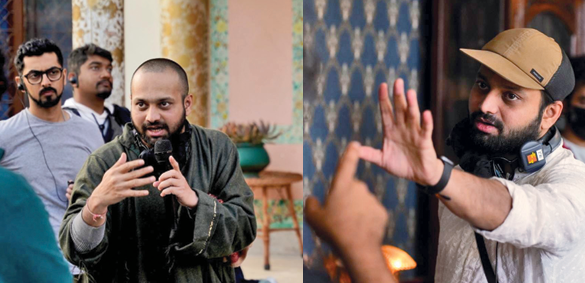
It was a distant dream, yet never beyond reach. Growing up as a young boy competing in the Kala Academy Marathi Drama competitions, Aditya Suhas Jambhale used to feel that as Goans one doesn’t dream enough. He broke the mould and became a trailblazer as he has now won his third National Award as the director of ‘Article 370’, the film that won the Best Feature Film Award at the 72nd National Film Awards. “I remember in my theatre days, people used to laugh when I used to say, I want to become a Bollywood director. People used to say you can go to Bombay, but you can’t become a director. It’s not an easy thing but with Goa, dreams are very critical. You have to dream, otherwise you will not reach anywhere and for that you have to leave home. I always believe home is the place where you return to, not where you stay. But Goa has been great for me,” says Aditya, who was in Goa when the awards were declared. ‘Article 370’ won three honours at the 72nd National Film Awards, including Best Actress for Yami Gautam and Best Background Score for Shashwat Sachdev.

Reflecting on the recognition, Aditya says the award belongs as much to his young team as it does to him, “I’m a little superstitious in always thinking that sometimes you don’t just get award because you are the best. I genuinely feel there might be so much of talent hidden yet, which is probably yet to be arrived at. Hard work sometimes matters more.” Calling ‘Article 370’ an unlikely project, he believes being underestimated worked in his favour, “With ‘Article 370’, it was a gamble for a lot of people, no director in the industry was ever going to attempt it, because it has politics in it. India doesn’t do a political thriller because it’s almost a recipe for a disaster for a director. People always had a preconceived notion that it’s going to be a disaster anyways. That was a very good moment for me, because I felt like an underdog. The award also belongs to the team because ‘Article 370’ was a political thriller and nobody knew what the format of doing a political thriller is. It has not been done before.” The film was completed under a demanding schedule as it came together after months of research and an unusually short production window. “The film had a research of about four months when Monal Thakkar, Aditya Dhar, the producer, and I were part of the research team.
When B62 and Jio Studios approached me with this film, that time there was no script. Their condition was, if you say yes, you have to release the film in February, which is a very cut-to-cut deadline. That credit obviously goes to the team and everybody who worked hard for it. I’ve always mentioned my partner in crime, Monal Thakkar, who is my co-writer. Overall, it was a very youngsters approach to doing a cool political film, which would inspire youngsters to say that, let’s stop commenting on politics. Let’s actually become part of it.” Even before clinching his third National Award, Aditya was already feeling like a winner when people started calling him after the release of the film. He informs, “I just realised that this might be my only chance as somebody who’s coming from a small state like Goa, which doesn’t have a Bollywood director till date, to have a first film that can go theatrical. Somehow with that greed and aspiration to have a theatrical release, I just took that date, and I told Jyoti Deshpande that, we’ll make it work.” Explaining why Yami Gautam was his first choice, Aditya says preparation was the defining factor. “I knew Yami since my association with Aditya Dhar. Yami is a very studious person as an actor. With Yami, you can’t really change things at the last minute. The homework is so rock solid. When I started working on ‘Article 370’, I felt that many spy films don’t quite convince you that their protagonists are actually intelligence officers because the filmmakers themselves don’t fully understand that world.
At some point, I felt Yami is going to do justice with the character who has to be sharp and completely focused on what she wants. She’s one of those actresses who goes into the flow and then you can’t cut in between. She’s one of those actresses whose best take is going to be in the first three takes.” Aditya wanted the locations to feel authentic and organic. Most of the film was shot in Delhi and Mumbai. All the indoor sets were built in Mumbai, while almost all the Kashmir exteriors were shot on location in Srinagar. He took a bold decision to shoot one of Yami’s scenes in downtown Srinagar, an area that had long been considered sensitive. “Many people were against the idea due to safety concerns. But the CRPF, the Army, the Jammu and Kashmir Police, and even the local residents were incredibly supportive and helped us tremendously. I didn’t want to keep recreating Kashmir on sets when we could capture the real place on camera.
We shot the Pulwama scene in Delhi. That was a massive scene, no CGI, no VFX at all. It’s an actual blast, which carried the debris till two kilometers away. I requested Aditya to trust me for that one day and invest as much as he can. There is a lot of effects that was done by a company, Identical Brains, that genuinely helped us in creating certain things which were not possible otherwise,” he explains. Looking ahead, Aditya says the National Award brings pressure as much as validation. He shares, “I’m always aware of the fact that I am somebody who’s capable to do good things, but at the same time, I’m not denying the fact that you can go wrong sometimes and you can completely mess it up. So that concern and that expectations is actually something that helps me to get that pressure that, whatever I do next is going to be judged massively as comparison with Article 370. There is always so much room for improvement. International cinema needs to needs to be completely revolutionized with perspective of what Indian cinema means.” Despite the recognition, he says his roots in Goa continue to shape his choices. “The day I feel I don’t have a good script, I’m coming back to Goa and do cashew farming. That increases my leverage because I don’t have anything to lose.
So I can always stay on my track and not compromise. I’ve got so many offers in the last one year, I’ve just rejected each and every one of them. Unless it’s something credible and you genuinely believe in it, there’s no point in just cashing in money for it,” he explains. Aditya credits his daughter, Katha, for keeping him grounded through two demanding productions. He says, “It was a very tough time for me shooting ‘Baramulla’ then ‘Article 370’ because I was away from her. She was just one year old. The strength comes from the fact that my daughter is away from me. So, let me make it valuable that tomorrow she grows up and watches my film, she shouldn’t be saying that, ‘you were away from me for this particular film which is so bad’. The whole aspect was that she should be proud about the film that I made.” To conclude, Aditya hopes to change how Goa is represented on screen. “My first responsibility is towards Goa which has been wrongly portrayed in cinema till now. The state is not about beaches and alcohol consumption. We have a rich cultural heritage and a remarkable tradition of cultural exchange between Christians and Hindus. It’s my responsibility to revamp the image of the state in a way where, it can be a pan world film and puts Goa on a mark where, suddenly it becomes the coolest state. I want to change that image completely, which might take some time, but that’s the idea.