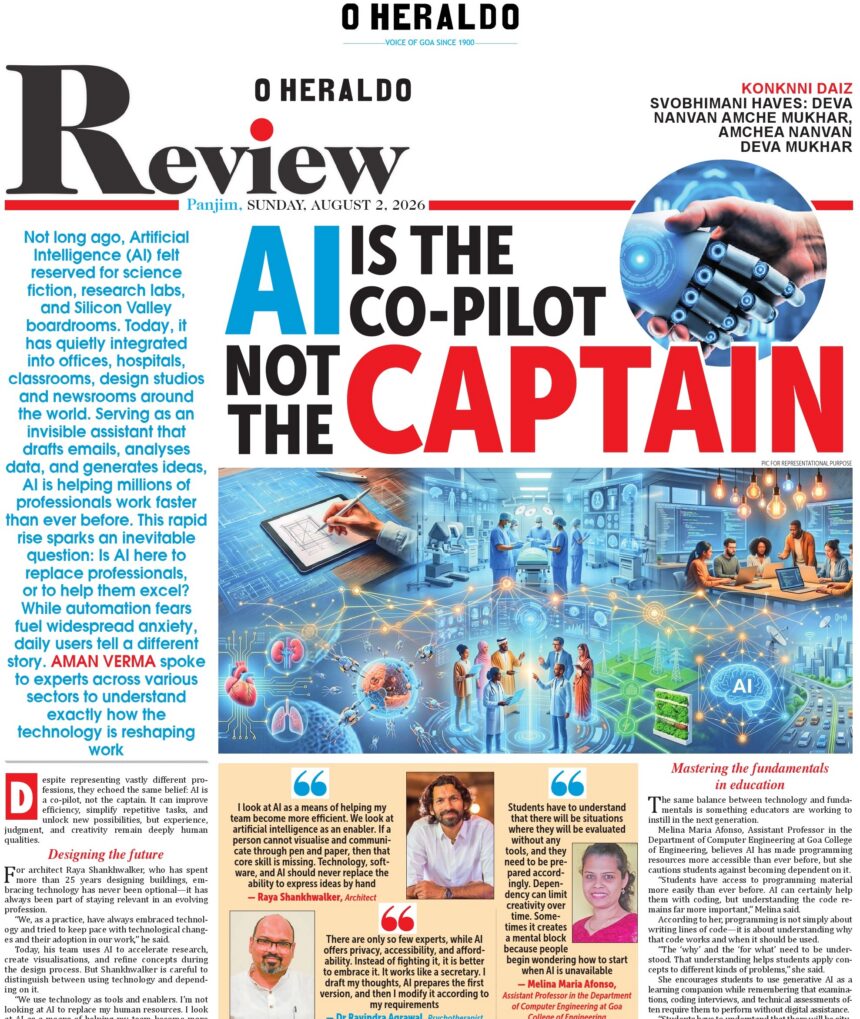
Not long ago, Artificial Intelligence (AI) felt reserved for science fiction, research labs, and Silicon Valley boardrooms. Today, it has quietly integrated into offices, hospitals, classrooms, design studios and newsrooms around the world. Serving as an invisible assistant that drafts emails, analyses data, and generates ideas, AI is helping millions of professionals work faster than ever before. This rapid rise sparks an inevitable question: Is AI here to replace professionals, or to help them excel? While automation fears fuel widespread anxiety, daily users tell a different story. AMAN VERMA spoke to experts across various sectors to understand exactly how the technology is reshaping work.
Featured Quotes
“I look at AI as a means of helping my team become more efficient. We look at artificial intelligence as an enabler. If a person cannot visualise and communicate through pen and paper, then that core skill is missing. Technology, software, and AI should never replace the ability to express ideas by hand.” — Raya Shankhwalker, Architect
“There are only so few experts, while AI offers privacy, accessibility, and affordability. Instead of fighting it, it is better to embrace it. It works like a secretary. I draft my thoughts, AI prepares the first version, and then I modify it according to my requirements.” — Dr Ravindra Agrawal, Psychotherapist
“Students have to understand that there will be situations where they will be evaluated without any tools, and they need to be prepared accordingly. Dependency can limit creativity over time. Sometimes it creates a mental block because people begin wondering how to start when AI is unavailable.” — Melina Maria Afonso, Assistant Professor in the Department of Computer Engineering at Goa College of Engineering
Designing the future
Despite representing vastly different professions, they echoed the same belief: AI is a co-pilot, not the captain. It can improve efficiency, simplify repetitive tasks, and unlock new possibilities, but experience, judgment, and creativity remain deeply human qualities.

For architect Raya Shankhwalker, who has spent more than 25 years designing buildings, embracing technology has never been optional—it has always been part of staying relevant in an evolving profession.
“We, as a practice, have always embraced technology and tried to keep pace with technological changes and their adoption in our work,” he said.
Today, his team uses AI to accelerate research, create visualisations, and refine concepts during the design process. But Shankhwalker is careful to distinguish between using technology and depending on it.
“We use technology as tools and enablers. I’m not looking at AI to replace my human resources. I look at AI as a means of helping my team become more efficient. We are still teaching ourselves how we can use this technology to better visualise projects and improve research. We look at artificial intelligence as an enabler,” Shankhwalker said.
For him, AI is simply the latest addition to an architect’s toolkit—not a substitute for imagination or expertise. He believes aspiring architects must first master the fundamentals before turning to digital tools.
He said, “If a person cannot visualise and communicate through pen and paper, then that core skill is missing. Technology, software, and AI should never replace the ability to express ideas by hand.”
Learning, he says, should begin with hand drawing before evolving into software and AI-assisted workflows.
“Your learning must begin with hand expression. Later, digital tools and hand drawing should complement each other so that you have mastery over both,” Shankhwalker said.
Practical experience, he adds, remains impossible to automate.
“The profession of architecture needs many years of practical building experience; an architect needs at least 10 years to gain a certain degree of proficiency,” he stated.
Although AI can process enormous volumes of information and generate possible solutions in seconds, deciding whether those suggestions are practical still requires human expertise.
“AI may analyse huge amounts of information and suggest solutions, but eventually someone with real-world experience has to decide whether AI is telling you the right thing,” he added.
His advice to young professionals is straightforward: “AI is not going to take away jobs. AI will take away your job if you’re not skilled enough. It is people with mediocre skills that get replaced by technology, not people with core creative skills or expertise.”
Prescription for efficiency
Healthcare presents a similar picture. Here too, AI is increasingly becoming an assistant rather than a replacement.
Psychotherapist Dr Ravindra Agrawal says artificial intelligence has dramatically reduced the time doctors spend searching for medical information.
“It is definitely a very helpful tool and is helping us in the medical profession become far more efficient than before,” Dr Agrawal said.
Instead of navigating multiple journals and websites, doctors can now obtain quick summaries and relevant medical information within seconds. Dr Agrawal also sees AI as a valuable source of mental health information for people who may hesitate to seek professional help.
“There are only so few experts, while AI offers privacy, accessibility, and affordability. Instead of fighting it, it is better to embrace it,” he said.
But information alone, he says, cannot replace clinical judgment. A psychiatrist may recognise emotional distress that a chatbot cannot detect, decide to involve family members, carefully adjust medication, or intervene during a crisis based on subtle behavioural cues developed over years of clinical practice. Those decisions require empathy, experience, and responsibility—qualities no algorithm possesses.
For his own practice, AI functions much like a digital assistant.
“It works like a secretary. I draft my thoughts, AI prepares the first version, and then I modify it according to my requirements,” Dr Agrawal said.
He also uses it to check drug interactions, explore possible side effects, review differential diagnoses, and assist with documentation before personally verifying every output.
Scepticism in the newsroom
If architecture depends on creativity and healthcare relies on judgment, journalism requires both speed and scepticism. Unsurprisingly, newsrooms have also embraced AI, though within carefully defined limits.
Across modern media organisations, AI helps reporters summarise lengthy reports, transcribe interviews, organise research material, and analyse large volumes of information within minutes. Digital teams use it to generate SEO-friendly headlines, translations, metadata, and social media copy, while television newsrooms increasingly rely on AI for scripting, subtitles, and production planning.
Yet the core of journalism remains fundamentally human. AI cannot verify a confidential source, build trust with a whistleblower, understand political or cultural nuance, ask difficult follow-up questions, or exercise editorial judgment during a breaking news event. Those responsibilities continue to belong to journalists.
Rather than replacing reporters, AI is becoming a newsroom enabler—freeing journalists from repetitive tasks so they can spend more time reporting, verifying facts, and telling stories that matter.
Mastering the fundamentals in education
The same balance between technology and fundamentals is something educators are working to instill in the next generation.
Melina Maria Afonso, Assistant Professor in the Department of Computer Engineering at Goa College of Engineering, believes AI has made programming resources more accessible than ever before, but she cautions students against becoming dependent on it.
“Students have access to programming material more easily than ever before. AI can certainly help them with coding, but understanding the code remains far more important,” Melina said.
According to her, programming is not simply about writing lines of code—it is about understanding why that code works and when it should be used.
“The ‘why’ and the ‘for what’ need to be understood. That understanding helps students apply concepts to different kinds of problems,” she said.
She encourages students to use generative AI as a learning companion while remembering that examinations, coding interviews, and technical assessments often require them to perform without digital assistance.
“Students have to understand that there will be situations where they will be evaluated without any tools, and they need to be prepared accordingly,” Melina said. Although AI undoubtedly helps students solve problems more quickly, she believes excessive dependence can gradually erode independent thinking.
“It helps students become quicker problem solvers. But dependency can limit creativity over time. Sometimes it creates a mental block because people begin wondering how to start when AI is unavailable,” she said. Strong programming fundamentals, she insists, remain indispensable.
“C, C++, and Java remain the core. Once your fundamentals are strong, you can quickly adapt to newer technologies,” Melina said.
While students already use AI for presentations, assignments, and reports, she notes that they must still master design principles, documentation, and problem-solving deeply enough to ask the right questions and use AI effectively.
Collective conclusion
In many ways, all the experts arrived at the same conclusion: AI is not a replacement for professionals; it is a powerful enabler that amplifies the abilities of those who already possess strong fundamentals. Whether designing buildings, treating patients, reporting the news, or teaching future engineers, the technology delivers its greatest value when guided by human judgment.
This shift also places a greater responsibility on professionals and students alike. The real challenge is no longer whether to use AI, but how to use it wisely—without allowing it to replace curiosity, independent thinking, or the discipline of mastering the fundamentals.