JOVITO LOPES
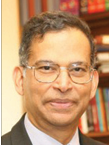
FIFA president Gianni Infantino was forced to abandon his divi sive plan to sell World Cup profits to private equity after receiving strong op position from all corners of the football world and especially from his senior advisor on global strategy and governance, Carlos Cordeiro. Cordeiro, the son of a Goan father with roots in Saligao, resigned over the matter, stating that the proposal was a bad deal for football and that it would mortgage its future. Besides, three major con federations—UEFA, North America’s CONCACAF, and the AFC—also spoke against the plan. According to “Galeria dos Goeses Ilustres”, the 61-year-old Cordeiro was the Senior Adviser to the FIFA President until he re signed on Friday.

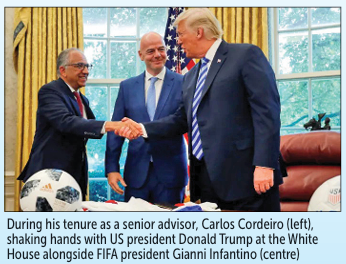
A former President of the US Soccer Federation, he is the son of Pedrito de Sousa Cordeiro from Saligao and a Co lombian mother. Cordeiro moved to Miami at 15 and later graduated from Harvard University. He joined the US Soccer Federation in 2007, became its vice president in 2016, and served as its president from 2018 until his resignation in March 2020, taking over from Sunil Gulati. In 2021, he was appointed Senior Advisor to FIFA for Global Strategy and Governance before becoming Senior Advisor to the FIFA President. He achieved global familiar ity when President Donald Trump appointed him as Senior Advisor to the White House Task Force on the FIFA World Cup 2026. A lifelong football fan, he represents his federa tion on the CONCACAF Council and worked alongside In fantino for five years. Meanwhile, UEFA’s 55 member nations had agreed to boycott the World Cup and all other FIFA competitions over Infantino’s proposed plan. The plan offered FIFA’s 211 member associations $40 million (£30 million) if they backed private investment in its tournaments, including the men’s and women’s World Cups. Infantino and FIFA wanted to create a commercial sub sidiary to run its main events, allowing external investors to buy stakes. It aimed to invite third parties to make mi nority, non-controlling investments in a new subsidiary named FIFA Forward Enterprise (FFE).
Infantino had set a September 19 deadline for federa tions to accept his plans if they wanted to access an initial $20 million (£15 million). A 25-page document created by investment bank JP Morgan laid out how FIFA’s tourna ments would expand to hit an estimated increased payout of 24 million euros per member association in the 2035–39 cycle. It mentioned new business initiatives and attracting top talent with incentive-driven compensation. Infantino was dealt a severe blow by Cordeiro, a for mer Goldman Sachs banker, who resigned on Friday and urged other senior FIFA staff to speak out. “I cannot stand by while FIFA considers selling a stake in the World Cup,” Cordeiro said, just hours after FIFA insisted, “Nobody is selling football.” Cordeiro disclosed he was excluded from talks about the plan, which was backed by a New York investment fund created by Joshua Kushner. “I unequivocally opposed the plans and did not accept the proposition that FIFA needed outside investors to unlock greater value,” Cordeiro de clared. “Football has been central to my life and after more than 35 years in banking, I understand both the value of this asset and the consequences of giving part of it away.
That is why this proposal should be rejected. Decisions of huge magnitude should be made in the interests of football, not by those who stand to profit from it,” he added. He pointed out that FIFA already sits on billions of dol lars in reserves, has no debt, and generated $15 billion in revenue between 2022 and 2026. It is also learnt that In fantino left some of FIFA’s eight vice presidents in the dark about his plan. In a statement, UEFA stated: “Some things are simply too important to sell. The FIFA World Cup belongs to football. So long as Europe has a voice, it will never be for sale.” FIFA Chief Operating Officer Kevin Lamour also issued a statement blasting the proposal: “FIFA staff were deceived by Infantino’s lack of openness. It is the project of one per son. A president must bring people together, but this was just the opposite.” Finally, Infantino conceded that the project had created divisions that no longer served its original objective. “Hav ing listened carefully to all views, it has become clear that the project has created divisions.
As a result, this proposal will not proceed,” Infantino replied. Infantino had proposed creating a $20 billion subsidi ary company, with 20% owned by private investors, to run the World Cups and Club World Cups. The private backers included the Kushner family, drawing a backlash that grew daily. The anchor investor was a New York-based invest ment firm created by Joshua Kushner, the younger brother of Jared Kushner. UEFA welcomed the withdrawal, calling it a “victory for the whole game,” but warned that they would work with other federations to ensure such secret schemes on fast track timescales never occur again.