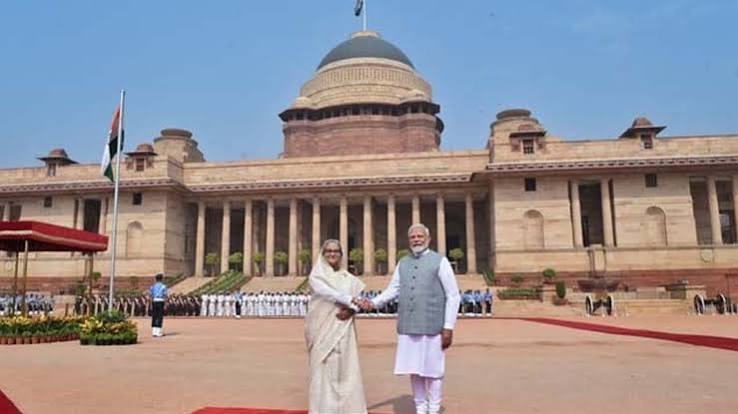
The extradition of former Bangladesh Prime Minister Sheikh Hasina from India is emerging as a sensitive legal and diplomatic issue between the two neighbouring countries. While Bangladesh has pressed India to return Hasina, New Delhi has maintained that any extradition request will have to go through the established legal process and that the Indian judiciary will have a role in deciding the matter.
The issue has become more complicated because of the verdict delivered by Bangladesh’s International Crimes Tribunal (ICT). Any attempt to enforce that verdict in India could face legal challenges, including arguments concerning the circumstances in which the proceedings were conducted and the fact that the tribunal proceedings took place under an interim political administration.

What Does The India-Bangladesh Extradition Treaty Say?
India and Bangladesh signed an extradition treaty in 2013. The agreement creates an obligation for the two countries to consider requests involving people who have been charged with, convicted of, or are wanted for the enforcement of a judicially pronounced sentence.
However, the treaty also contains exceptions. One of the key provisions concerns offences of a political character. Extradition can be refused when the offence for which surrender is sought is considered political.
At the same time, the treaty specifically excludes several serious offences from being treated as political offences. These include murder, manslaughter or culpable homicide, assault causing serious injury, certain firearms offences, kidnapping, incitement to murder and specified terrorism-related offences.
This distinction could become important in any legal proceedings involving Hasina. If Bangladesh’s request is based on allegations that fall within the treaty’s specified criminal offences, the political-offence exception may not automatically prevent extradition.
What Role Will Indian Courts Play?
The extradition request would not simply result in an automatic handover. India’s Extradition Act, 1962 lays down a procedure for dealing with requests from foreign countries.
Under the law, the Central Government can order a magistrate to conduct an inquiry into an extradition request. The magistrate can examine evidence submitted by the requesting country as well as material presented by the person whose extradition is being sought.
The inquiry can also consider whether the alleged offence is political in nature or qualifies as an extradition offence.
If the magistrate concludes that there is no prima facie case supporting the foreign government’s request, the fugitive can be discharged. If the magistrate finds that a prima facie case has been established, the person may be committed to prison while the matter is referred to the Central Government for further consideration.
This means the judicial process can become a significant stage in determining whether Bangladesh’s request meets the requirements of Indian law and the bilateral treaty.
Could The ICT Verdict Be Challenged?
A major legal question could be whether the Bangladesh tribunal’s verdict should be treated as sufficient for extradition under the treaty and Indian law.
Any challenge in India could potentially focus on issues surrounding the tribunal proceedings, the nature of the charges, procedural safeguards and whether the requirements for extradition have been satisfied.
The fact that the verdict was delivered while an interim government was in power could also form part of the wider arguments raised by Hasina’s legal team. However, the existence of an interim government by itself would not automatically invalidate a judicial verdict or prevent an extradition request. The Indian authorities and courts would have to examine the specific legal and procedural circumstances.
Diplomacy Could Be Just As Important
Even if the matter reaches the Indian judiciary, extradition is likely to remain a diplomatic issue as well. India has an interest in maintaining stable relations with Bangladesh, and the two countries have been discussing ways to manage the issue without allowing it to derail broader bilateral ties.
The diplomatic dimension could become particularly important if Bangladesh takes a maximalist position and demands Hasina’s immediate return.
If Hasina herself decides to return to Bangladesh, the extradition question could take a different course. But if she remains in India and Dhaka continues to formally seek her surrender, the matter is likely to move through the treaty and domestic legal framework.
What Happens Next?
The immediate focus is likely to remain on the formal extradition request, the documents supplied by Bangladesh and the legal grounds on which India assesses the case.
The 2013 treaty provides the international framework, while the Extradition Act establishes the domestic procedure. Ultimately, the Indian authorities and judiciary will have to assess whether the request satisfies the applicable legal requirements.
For India, the challenge will be to balance its treaty obligations, domestic law and judicial process with the broader diplomatic relationship with Bangladesh. For Dhaka, securing Hasina’s return will depend not only on the tribunal’s verdict but also on whether the Indian legal system finds sufficient grounds for extradition.
The case therefore represents more than a straightforward extradition request. It sits at the intersection of international law, domestic judicial procedure and India-Bangladesh diplomacy.