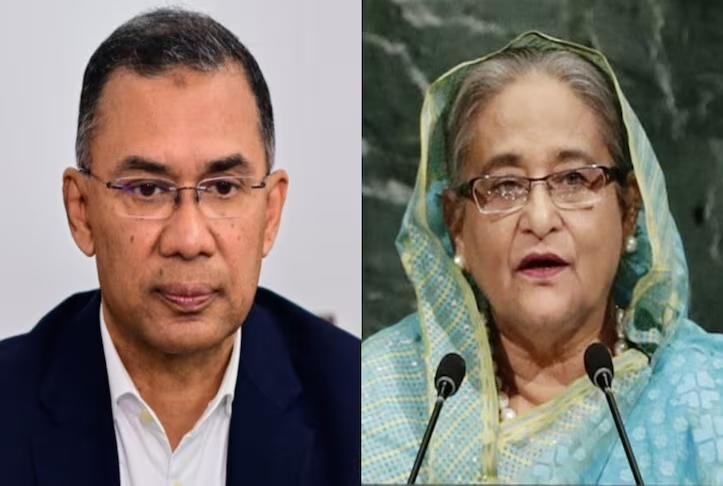
Bangladesh has indicated that Prime Minister Tarique Rahman’s proposed visit to India may not go ahead unless New Delhi takes action on Dhaka’s extradition requests involving former prime minister Sheikh Hasina and other fugitives.
According to a statement issued by Bangladesh’s foreign ministry on Sunday, officials from Dhaka and New Delhi have been in discussions for several weeks regarding the possibility of Rahman’s bilateral visit to the Indian capital.

However, Bangladesh said the environment for the proposed visit had been affected by a public interaction involving Sheikh Hasina in New Delhi on August 5.
Bangladesh foreign ministry spokesperson AKM Shahidul Karim said that Dhaka believes a “propitious environment” must be created before the visit can take place.
“To this end, we have requested the Indian authorities to expeditiously act on our request to extradite Sheikh Hasina and other fugitive criminals,” Karim said.
He also called on India to hand over individuals accused of killing political activist Sharif Osman Hadi, citing the bilateral extradition treaty between the two countries. Bangladesh said it was awaiting India’s response to the requests.
The demand comes as tensions over Sheikh Hasina’s presence in India continue to influence relations between the two neighbours. Hasina was removed from power in August 2024 following a student-led uprising that developed into a wider anti-government movement. She subsequently fled Bangladesh and took refuge in India.
Dhaka has repeatedly sought Hasina’s extradition. Bangladesh’s International Crimes Tribunal has convicted her of crimes against humanity, while Indian authorities have maintained that the extradition request remains under examination.
Bangladesh also objected to Hasina’s recent public interaction in New Delhi. Dhaka described the development as having “vitiated” the process surrounding Rahman’s potential visit.
India, however, has made it clear that the event involving Hasina and Bangladeshi officials was not connected with the Indian government.
The dispute also involves the killing of Sharif Osman Hadi. Two people accused of his murder were arrested by the Special Task Force of the West Bengal Police in March from Bongaon in North 24 Parganas district, near the India-Bangladesh border.
Bangladesh’s foreign ministry reiterated that Dhaka’s foreign policy would continue to follow its “Bangladesh First” approach. The country said it wanted to maintain friendly relations with neighbours and other countries while emphasising sovereign equality, national dignity, non-interference in internal affairs and mutual benefit.
The latest statement suggests that Hasina’s extradition has become an important condition for creating what Bangladesh considers a suitable atmosphere for Tarique Rahman’s proposed India visit.
For New Delhi, the issue presents a sensitive diplomatic challenge, with Hasina remaining in India while Bangladesh presses for her return.
Rahman’s proposed visit has therefore become closely linked to the wider diplomatic dispute surrounding Hasina and Dhaka’s other extradition demands. Whether the visit proceeds could depend on how the two governments handle these outstanding issues in the coming days.