The government may have pressed the pause button on electricity penalties, but the power-bill shock facing Goan households shows no sign of abating. Consumers across the State continue to receive bills several times higher than what they had been paying earlier, including cases where the bills car ry zero penalty charges for both demand and energy. The continuing surge has effectively blown a hole in the government’s earlier narrative that inflated elec tricity bills were substan tially linked to penalties for exceeding sanctioned load. A Fatorda resident, for in stance, received a bill of Rs 17,894 against Rs 7,500 in the previous billing cycle.
In Salcete, another consumer was confronted with a bill of Rs 22,695 despite zero penalty charges on both de mand and energy. A Panjim resident, who normally paid around Rs 600, received a bill of Rs 4,000. In Margao, a consumer has received two successive bills of around Rs 10,000 Rs 12,000, a dramatic de parture from earlier bills. Across households, con sumers say bills that once ranged between Rs 2,000 and Rs 4,000 are now rou tinely touching Rs 7,000 8,000 and even crossing Rs 10,000.

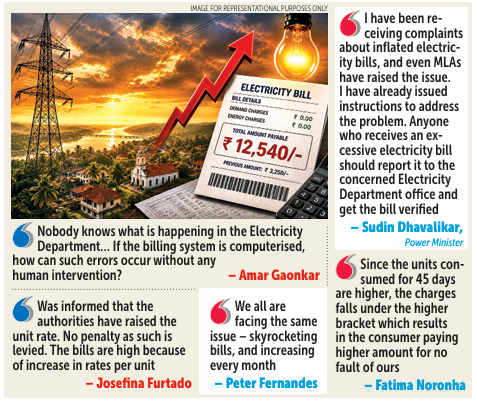
The question now con fronting the Electricity De partment is: if penalties have been put on hold, what exactly is driving these ex traordinary increases? The government it self had halted penalties linked to sanctioned-load violations amid mounting public anger over inflated bills and the smart-meter rollout. Consumers who had already paid such penalties were assured that the amounts would be adjusted against future bills. But the latest com plaints suggest that re moving the penalty com ponent has not removed the underlying problem. “We all are facing the same issue – skyrock eting bills, and increase every month,” said Pe ter Fernandes, capturing the growing frustration among consumers who say their bills bear little resemblance to their es tablished consumption patterns. Josefina Furtado said her bill had doubled and that she approached the Electricity Department of fice in Mapusa seeking an explanation.
She said she was told that the increase was due to the high er unit rate rather than a penalty. “Was informed that the authorities have raised the unit rate. No penalty as such is levied. The bills are high because of in crease in rates per unit,” she said. That explanation, however, raises another uncomfortable question for the government: how much of the increase is actually attributable to revised tariffs, and how much is the result of consumption slabs, billing periods or other compo nents of the bill? The JERC-approved tariff structure for Goa’s current mul ti-year control period does provide for different slab rates, with rates for LTDS-II domestic consumers rising from Rs 1.95 per unit for the first 100 units in FY 2025-26 to Rs 2.10 in FY 2026-27, and from Rs 6.20 to Rs 6.60 for consumption above 400 units. But tariff revisions alone do not explain the scale of every bill being reported by consumers, particularly where established household consumption has supposedly remained unchanged. Victoria Travis said her bill jumped from Rs 2,500 to Rs 7,500 without any corresponding change in household use. Subsequent bills remained above Rs 5,000 and then crossed Rs 7,000.
The problem becomes even harder to explain in cases in volving barely occupied or closed homes. Siddhant Naik said he received a Rs 480 bill for a closed house where only a new refrigerator was operating. The previous maximum bill for the premises had been around Rs 200. Another consumer said an apartment that had re mained unoccupied for two months nevertheless generat ed a bill of around Rs 3,000. Such cases are precisely why consumers are demanding something more than a generic assurance that the bills are “correct”. They want the depart ment to physically verify meters and readings where there is a dramatic departure from a property’s established bill ing history. The billing cycle itself has also come under scrutiny. Fatima Noronha said meter readers sometimes arrive after 45 days instead of 30, resulting in more units being recorded in a single billing period. With domestic tariffs increasing pro gressively across consumption slabs, she argued that a longer billing period could push consumers into higher brackets. She pointed to rates of Rs 2.10 for 0-100 units, Rs 3.10 for 101-200, Rs 4.15 for 201-300, Rs 5.45 for 301-400 and Rs 6.60 above 400 units. “Since the units consumed for 45 days are higher, the charg es falls under the higher bracket which results in the con sumer paying higher amount for no fault of theirs,” she said, demanding that the department ensure meter readings are taken every month. The department, however, maintains that bills covering longer periods are calculated on a pro-rata basis to a 30 day period and therefore do not constitute overcharging merely because the reading is taken late. That explanation does little to settle the dispute for con sumers who want to know exactly how their individual bills have been calculated and why their monthly liability has changed so dramatically.
The official position also leaves a wider accountability question unanswered. If the billing system is functioning cor rectly, why are consumers reporting such substantial devia tions from their established bills — and why must individual consumers fight their way through departmental offices to have unusually high bills checked? Amar Gaonkar said the situation had become so opaque that consumers no longer knew whether the problem lay with the department’s billing system or its internal functioning. “Nobody knows what is happening in the Electricity De partment,” he said, citing the case of a friend who allegedly received a Rs 68 lakh bill for just 148 units. “If the billing system is computerised, how can such errors occur without any human intervention?” he asked, arguing that the scale of the complaints pointed to a lack of proper or ganisation and coordination. Gaonkar said the issue warranted a thorough investigation, while also pointing to the difficulty ordinary consumers face in understanding the tariff slabs and the extent of electrici ty-charge increases. The political fallout is beginning to reflect that frustration. MGP leader Mahesh Panshikar has also raised questions over high bills, including a case involving a closed pump where he questioned how 250 units of consumption and a bill of Rs 1,600 could have been generated. A memorandum has meanwhile been submitted to the Power Department seeking intervention and an explanation for the steep bills. Power Minister Sudin Dhavalikar acknowledged that the government was receiving complaints, including from legisla tors, but placed the immediate responsibility on consumers to have disputed bills checked. “I have been receiving complaints about inflated electrici ty bills, and even MLAs have raised the issue. I have already issued instructions to address the problem. Anyone who re ceives an excessive electricity bill should report it to the con cerned Electricity Department office and get the bill verified,” Dhavalikar said. He also stopped short of promising any immediate reduc tion in electricity rates. “As for whether electricity rates can be reduced, that will have to be discussed with the Centre and may require a budg etary provision. I will also have to discuss the matter with Chief Minister Pramod Sawant, who holds the Finance port folio,” he said. Dhavalikar maintained that increased consumption could also result in higher bills and advised consumers to compare their current bills with previous consumption patterns. He said consumers could approach the Junior Engineer or As sistant Engineer and, if necessary, escalate the matter to the Chief Engineer. But that places the burden of detecting and challenging pos sible billing anomalies squarely on the consumer. For households already struggling with bills that have sud denly doubled or tripled, the government’s message amounts to little more than: check your bill and come back if you think something is wrong. What consumers are demanding is the reverse — that a billing system capable of comparing years of consumption data should itself flag an extraordinary deviation before the bill reaches the doorstep. The government’s decision to suspend sanctioned-load penalties was an acknowledgement that the earlier approach had generated widespread public anger. But if bills continue to soar even in the absence of those penalties, the controversy can no longer be reduced to smart meters or sanctioned load.