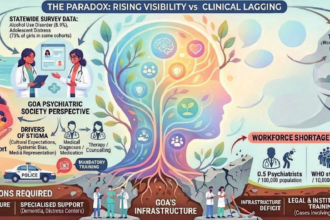
Behind the 298 lives lost to suicide in Goa in 2024 lies a complex, often silent crisis. According to the latest National Crime Records Bureau (NCRB) data, illness is now cited as a major contributing factor in 24.5 per cent of these tragedies. Experts warn that these figures are more than just statistics-they are a call for an evidence-based, Goa-specific roadmap that goes beyond crisis response to address the root vulnerabilities of both the young and the elderly. ANIL KUMAR MISHRA reports
- Illness accounts for 24.5 per cent
- Ageing population, stress among youth
- Family problems remain a major national factor
- Student suicides add another layer of concern
- Seniors and migrant workers vulnerable
- Prevention needs a Goa-specific approach
- Centre expands mental-health support
- Tele-MANAS expands reach
- A decline, but no room for complacency
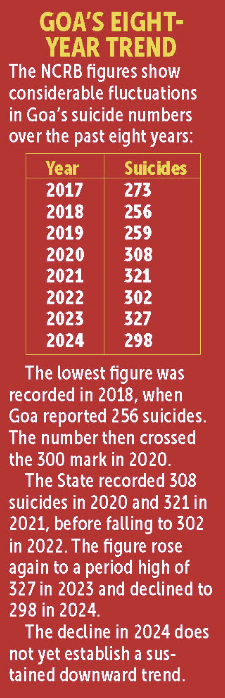
Goa recorded 273 suicides in 2017, 256 in 2018, 259 in 2019, 308 in 2020, 321 in 2021, 302 in 2022, 327 in 2023 and 298 in 2024.Over the eight-year period, Goa recorded 2,344 suicides, an average of about 293 deaths a year.
Although suicides declined by 29 cases, or 8.9%, from 327 in 2023 to 298 in 2024, the latest figure remains higher than the pre-pandemic levels recorded between 2017 and 2019, which is 9% higher than suicides recorded in 2017.
The NCRB data is based on suicide cases reported and recorded by police authorities. The Centre has clarified that the NCRB compiles the figures reported by States and Union Territories through its annual Accidental Deaths & Suicides in India reports.

Illness accounts for 24.5 per cent
Seventy-three illness-linked suicides in 2024 con-stituted 24.5% of the State’s total. The proportion was higher than the national share of 18%. An analysis of the NCRB’s 2024 data found that 30,617 suicides across India were linked to illness, including 14,305 attributed to mental illness and 14,705 to chronic or prolonged illness.
Goa’s illness-linked suicides increased in 2024 compared to the previous year.
Experts caution against interpreting the NCRB catego-risation as proof that illness alone caused an individual’s death.
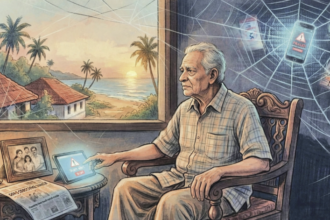
Dr Abhijit Nadkarni, Co-director of the Addictions & Re-lated Research Group at Sangath, said, “Goa’s high propor-tion of illness-linked suicides could be associated with its ageing population and the burden of chronic diseases.”
“Long-term illness can increase distress through pain, disability, treatment costs, dependence on others and de-pression,” he said.
Nadkarni cautioned against drawing a causal link be-tween ageing, chronic illness and suicide solely from NCRB figures. The category recorded as “illness” may cover con-ditions, including mental-health problems. A person who dies by suicide may be facing family difficulties, financial stress, substance use, relationship problems or social iso-lation – even though only one primary reason is recorded in police data. This is important when interpreting Goa’s numbers, where the small number of cases means that year-to-year variations can alter percentages.
Ageing population, stress among youth
Psychiatrist Dr Akshada Amonkar said, “The proportion of illness-related suicides in Goa is likely to reflect multiple factors. Goa has got an ageing pop-ulation and there is prevalence of stress among youth also, along with prevalence of chronic disorders in the young and old. Exam stress, job stress and unem-ployment are leading causes.”
Dr Amit Dias, Assistant Professor in the Department of Preventive and Social Medicine at Goa Medical College and Hospital, said, “The latest figures should prompt a deeper examination of suicide prevention. The figures from Goa should make us pause-not because of the numbers, but because of the lives behind them.”
Dias noted that Goa’s suicide rate has remained higher than the national average. India recorded 1,70,746 suicides in 2024, with a suicide rate of 12.2 per 100,000 population. Dias said Goa’s rate remained around 1.5 to 1.8 times the national average in the past five years.
“Goa may not have the highest suicide rate, but we should not take comfort in being ‘better than others. Every life lost is one too many, and every preventable death is a call to action,” he said.
Dias said, “The 73 suicides attributed to illness were significant because they pointed to the intersection of physical illness, chronic disease, ageing, pain, disability, mental-health distress, social isolation and loss of independence. We must be cautious about assigning a single ‘reason’ to suicide. Behind suicides lies a convergence of vulnerabilities, stressors and circumstances, often devel-oping over time.”
He called for shifting the focus from responding to su-icide after it occurs to identifying warning signs and opportunities for intervention much earlier.
“Behind every suicide are warning signs and missed opportunities for intervention waiting to be recognised,” Dias said.
He said, “Suicide prevention must be viewed within the broader framework of mental health and resilience, with people needing support to cope with setbacks, grief, failure, difficult relationships, fi-nancial pressures, chronic illness and life-changing diagnoses.”
“Counselling should be an accessible and normal part of healthcare and community support,” he said.
Dias said, “Primary healthcare must be strengthened to identify distress early, while schools and colleges should have counselling and life-skills programmes. Workplaces and communities should have mechanisms to recognise vulnerability and connect people with appropriate support.”
People with chronic illness, disability, pain or terminal conditions, he added, require good palliative care alongside appropriate medical treatment. He cautioned against sensational or insensitive reporting of suicide, noting that dramatic coverage can increase the risk of imitation among vulnerable people. “The media has a responsibility to use the story to promote hope, resilience, heln-seeking and prevention” he said.
Dias said, “Goa needed a deeper research into who is dying by suicide, including their age groups, occupations, health conditions and social circumstances, as well as where clusters and missed opportunities for intervention occur.”
“The NCRB figures should be the starting point for a Goa-specific, evidence-based roadmap for suicide prevention,” he said.
Family problems remain a major national factor
The The NCRB data underlines the role of family prob-lems in suicides across India.
Family problems accounted for 33.5% of suicides in 2024. Goa was not among the States and Union Territories with the highest proportion of suicides attributed to family problems. Tripura recorded the highest share at 72.5%, followed by Chandigarh at 68.8%, Odisha at 56.8%, Kerala at 53%, Bihar at 48.4% and Rajasthan at 44.9%.
The figures reinforce the point that suicide is rarely the result of one circumstance. Family conflict, illness, economic hardship, relationship problems, substance use, academic pressure and mental-health difficulties can overlap and reinforce one another. The NCRB lists a range of circumstances associated with suicides, including professional and career problems, a sense of isolation, abuse and violence, family problems, mental disorders, addiction to alcohol, financial loss and chronic pain.
Student suicides add another layer of concern
The issue assumes significance amid concerns over suicides among students and youth. The Centre said NCRB data on student suicides is based on police-recorded cases and provides year-wise, State-wise, gender-wise and age-group-wise details. Reported factors include family problems, love affairs, illness and exam failure.
Dr Amonkar pointed to examination stress, job stress and unemployment among factors affecting young people.
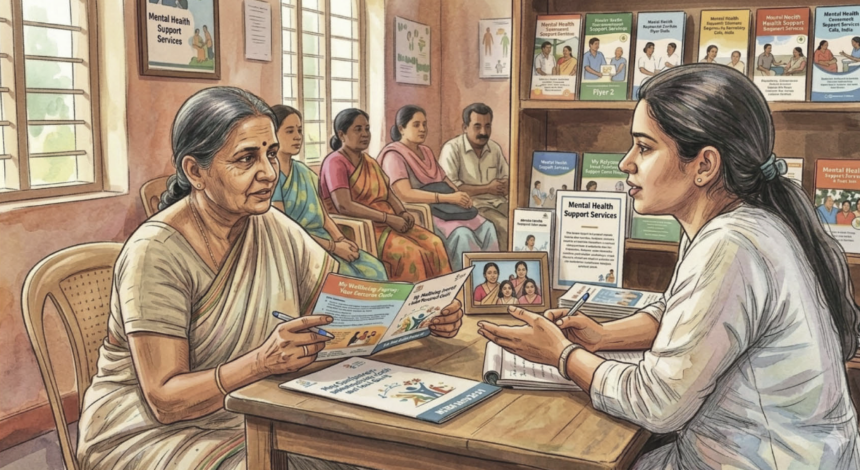
Mental-health experts stressed that prevention must begin well before a person reaches a crisis point. Early identification of distress, access to counselling, supportive family and peer networks, and the ability to seek professional help without stigma are components of such an approach.
Seniors and migrant workers vulnerable
Roland Martins, Co-ordinator of GOACAN, said, “Goa’s ageing population warranted greater attention in any suicide-prevention strategy. The number of seniors, who have died by suicide, if checked, will show that many of them lived alone. Prolonged physical illness, heavy medication and loneliness have taken their toll.”
Martins said, “Goa is yet to put in place a system to address the needs of senior citizens living alone. Geriatrics, palliative care and programmes on care and wellness are yet to reach the talukas.” He flagged the reported suicides among migrant labourers, saying the issue could not be ignored.
“GOACAN has raised with the Directorate of Health Services the need for a Task Force on Suicide Prevention in Goa,” Martins said.
He said, “Such a task force, should go beyond students and educational institutions and examine the problems faced by widows, senior citizens and migrant workers. These sections also need to have access to counselling facilities at all levels.” Martins said, “World Suicide Prevention Day on September 10 should be used by the Directorate of Health Services and its Non-Communicable Disease Cell to formulate a roadmap for suicide prevention. Any delay will only see the rise in annual figures.”
Prevention needs a Goa-specific approach
Suicides among youth point towards a different set of interventions ons accessible counselling in schools and colleges, early identification of students under stress, support systems for young job-seekers and awareness among parents and teachers about warning signs. Experts stress on reducing the stigma surrounding mental illness. A person experiencing depression, anxiety or distress may not communicate openly. Families, teachers, colleagues and friends have an important role in recognising behavioural changes and encouraging professional help. Goa should ensure that mental-health support becomes a part of routine healthcare, education and community support.
Centre expands mental-health support
The Centre has expanded mental-health interventions covering students, educational institutions and the wider population.
The Ministry of Education’s MANODARPAN initiative provides psychological support to students, teachers and families through a toll-free helpline, trained counsellors, interactive sessions and webinars.
‘Sahyog’ sessions and ‘Paricharcha’ webinars are used to create mental health awareness and are telecast through PM e-Vidya channels and made available through the NCERT official YouTube channel.
The Central Board of Secondary Education has mandated the appointment of a counsellor and wellness teacher in every secondary and senior secondary school affiliated with it. The Navodaya Vidyalaya Samiti provides for two counsellors – one male and one female in Jawahar Navodaya Vidyalaya. As of February 2026, 830 counsellors were engaged on a contractual basis in JNVs, while directions were issued to Kendriya Vidyalayas to appoint counsellors on contract basis.
At the higher education level, the University Grants Commission issued an advisory in 2023 circulating the National Suicide Prevention Strategy and issued guidelines dealing with academic and peer pressure, behavioural issues, stress, career concerns, depression and other challenges.
The UGC framework on the emotional and mental well-being of students calls for counselling services, identification of distress, suicide-prevention SOPs, student support networks, grievance-redressal mechanisms and insti-tutional reviews.
Tele-MANAS expands reach
The National Tele Mental Health Programme is component of the country’s mental-health and suicide-prevention response. As of August 6, 2026, 36 States and UTs established 53 TeleMANAS cells, while the helpline handled over 43.25 lakh calls, according to the Centre.
A Tele-MANAS mobile app offers support ranging from general mental well-being to mental disorders. The service has been expanded to include video consultations in addition to audio-based counselling.
For Goa, such services can provide an avenue for those who may hesitate to approach a hospital or psychiatrist.
Mental-health services are being integrated into primary healthcare under the National Mental Health Programme. The government has said over 1.81 lakh Sub Health Centres and Primary Health Centres have been upgraded to Ayushman Arogya Mandirs, where mental-health services are included as primary healthcare.
A decline, but no room for complacency
Goa’s 298 suicides in 2024 represent a decline from the 327 recorded in 2023, but the figure remains above the levels seen before 2020. The data shows that Goa has been recording close to 300 suicides annually, underscoring the need for sustained intervention.
The 73 suicides attributed to illness underline that prevention must extend beyond conventional mental-health services to include chronic disease management, pain relief, palliative care, social support and protection against isolation and loss of independence. Students, youth, senior citizens, migrant workers and vulnerable groups may require different forms of support.