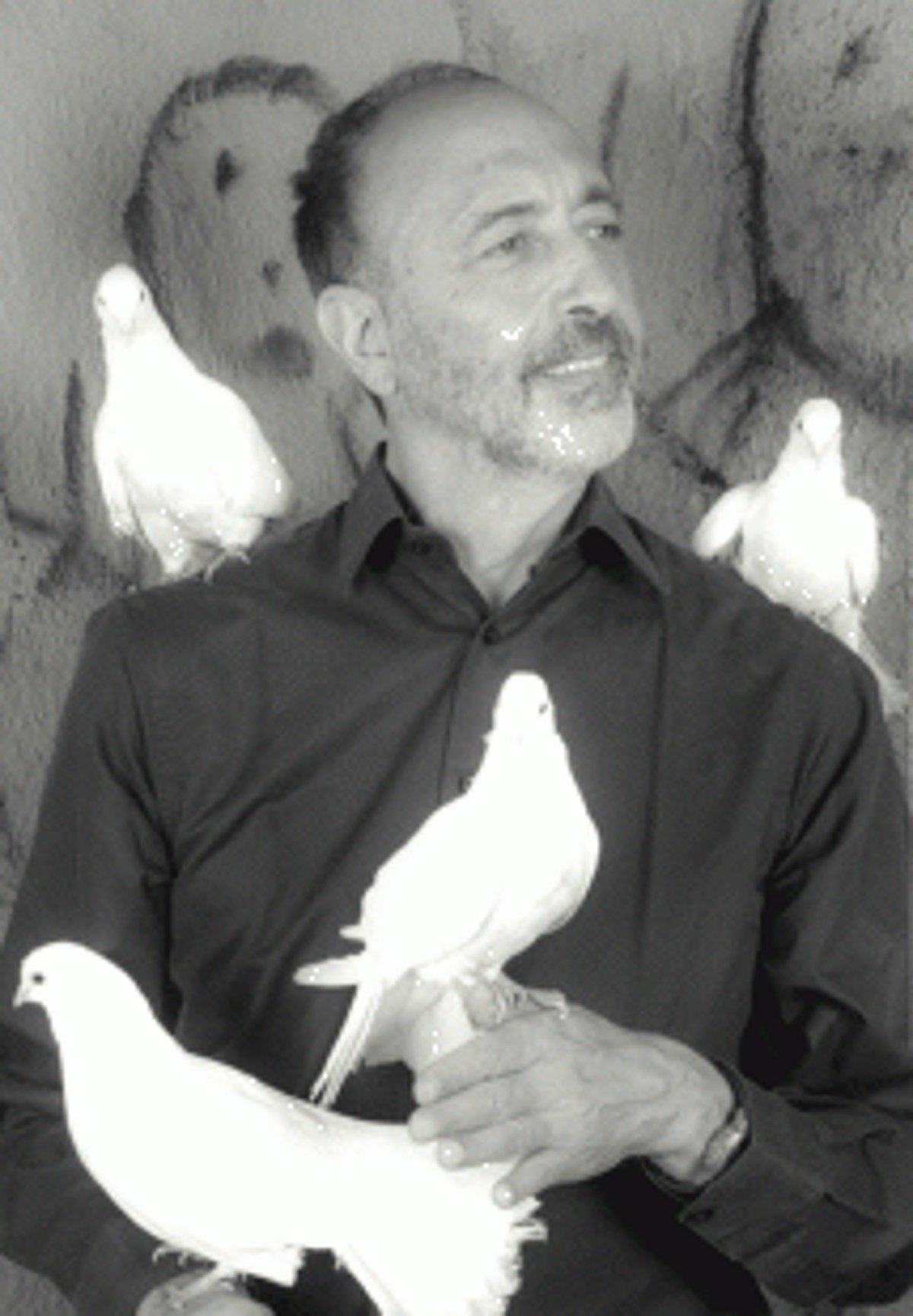
Herald Café: You’ve been shooting in black and white film for almost five decades. Tell us why you prefer seeing the world in B&W over colour?
Roger Ballen: I am the last generation to have grown up in a world where black and white film dominated photography. One cannot separate the meaning of my work from the fact that they were shot in Black and White. I am devoted to this media as it does not pretend to mimic reality like colour photography, and transforms the subject matter in a pure and minimalistic manner.

HC: How did Johannesburg, Africa become the focus of your photography?
RB: In 1974, I arrived in Johannesburg after hitchhiking from Cairo to Cape Town. On this same trip, I later visited India, taking some very interesting and influential images. I received a doctorate degree in Mineral Economics from the Colorado School of Mines in 1981 and moved to South Africa in 1982 as my wife lived there and it was an important centre in the mining industry.
HC: You lived through the Apartheid regime and witnessed its end. Did it in anyway shape the way you photograph? Unlike most photographers in South Africa, why did your photographs focus on white South Africans living on the margins of society?
RB: I have always considered myself a photographer focused on the existential and psychological. Beckett the writer might be seen as an inspiration to my work. I was ostracised by most of South Africa’s white society following the publication of my book ‘Platteland’ in 1994. The book revealed a subject matter, the poor whites, that the European population had tried to hide for decades.
HC: You are considered one of the most original image-makers of our time. Can you elaborate on why you chose to move away from your original documentary style to what you now call ‘documentary fiction’.
RB: My change of style occurred over a long period of time and continues to evolve and transform itself. In other words, it was not a conscious decision, rather, a spontaneous one. My best work has an aspect of the enigmatic. The viewer is not clear whether the photographs are solely a reflection of my imagination or a depiction of factual reality that presents itself to me.
To me, the purpose of photography has always been to create a diary reflecting my essence on the planet. It is my hope that my images will assist others to more effectively come to terms with themselves.
HC: In your latest series, ‘Asylum of Birds’, shot within the confines of a makeshift house on the outskirts of Johannesburg, both humans and animals perform for your camera. What is the central message in this very theatrical series?
RB: My photographs are ultimately multi-layered visual representations of the so-called reality. Hence they cannot be reduced to one central message.
(Roger Ballen will be in conversation with Siddharth D Shanghvi at Edition Three of the Shanghvi Salons today at Sunaparanta Goa Centre for the Arts, Altinho-Panjim)