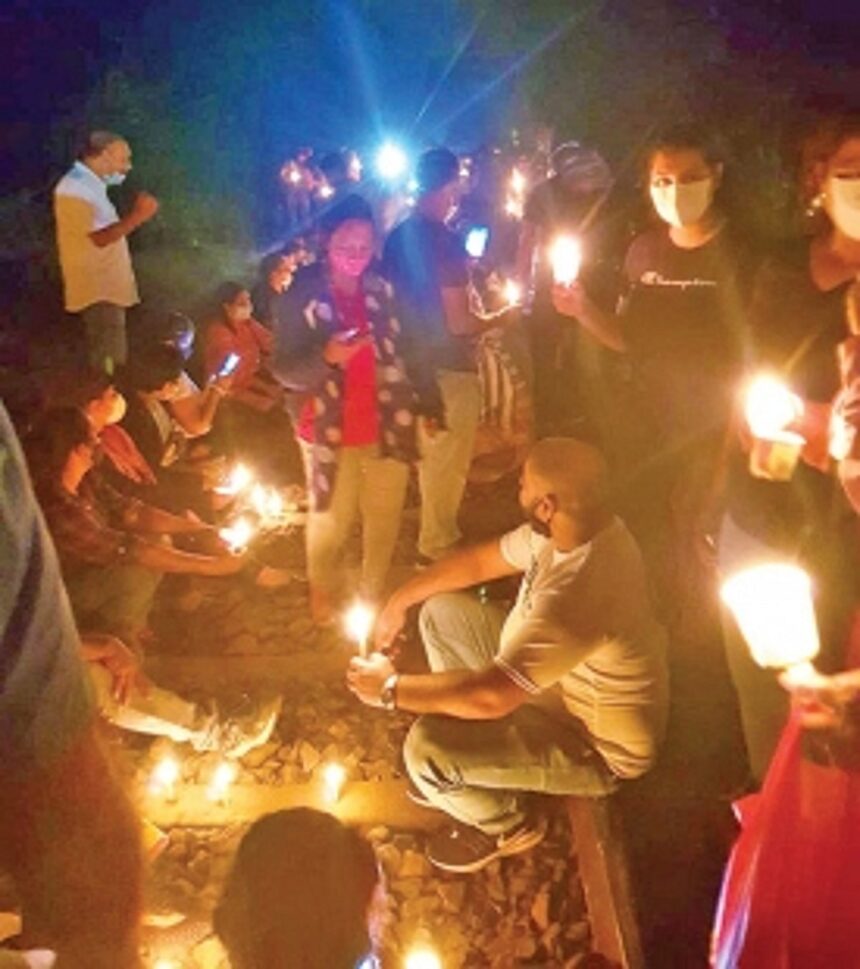
The Goa Chambers of Commerce and Industry (GCCI) had published a detailed report on Goa’s infrastructural needs in August 2006 in which they had talked about all these projects. This report was presented to the then Chief Minister Pratapsingh Rane in the presence of then Power Minister Digambar Kamat and ever since, “We have been following up on these projects with successive governments in the State. In the Union Railway Budget for 2010-11 presented to the Parliament on February 24, 2010, the then Railway Minister, Mamata Banerjee had included the doubling of Hospet-Hubli-Londa-Vasco-da-Gama tracks as part of her expansion plans for Railways that year,” said the President of GCCI, Manoj Caculo.
Goa with its central location on the west coast of the country and its excellent all weather natural harbour has the potential to emerge as India’s premier logistics hub (not coal hub) which could facilitate the region’s, which would also include large parts of South Maharashtra and North Karnataka participation in global trade. This, besides being a fairly green activity, can give Goa’s economy a boost and also help in creating large number of jobs which could find favour among Goan youth.

“For this we had proposed development of internationally competitive cargo handling capacity and support services at the port and efficient transport linkages to the hinterland and the rest of the country. We had even had a few meetings with Chambers of Commerce in Hubli, Dharwad and Belgaum to mobilize their support for augmenting cargo for MPT. Unfortunately, at that time the major cargo being handled by MPT was iron ore (approx 80 per cent) and Coal (approx 11-12 per cent) and they did not show much interest in developing other cargo opportunities. It was only after the ban on export of iron ore, that the port is forced to increase handling of coal,” added Caculo.
When asked about the opposition to these projects, Caculo said, “The people are concerned, and rightly so, about the cumulative adverse impact that these three projects may together have on a small but highly eco-sensitive area like the Mahavir Wildlife Sanctuary, particularly since they are all being executed more or less simultaneously. They are also concerned about the pollution that occurs due to inappropriate handling, transportation of coal. I do not think that people’s intent is to prevent development, but to ensure that the development happens without causing large scale irreversible damage to nature or without compromising the health and wellbeing of the citizens. I think we have to find a middle path that will adequately address the concerns of the people.”
Caculo further said, “I think there should be a definite roadmap for reducing coal handling at MPT and there should be strict monitoring to ensure that all laid down norms are strictly observed while transporting the coal. I would also like to suggest that the government forms a joint coordination committee consisting of project officials and some responsible citizens and environmentalists which can monitor that the mitigating measures suggested in the EIAs of all the three projects are fully and sincerely implemented so that the damage to environment is limited and later reversed.”
The President of the Goa State Industries Association (GSIA), Damodar Kochkar on this subject said, “First of all I must clarify here that industry was not taken into confidence while taking decisions on these projects. We had asked for information from the government but till now it has not happened. As I have said earlier, we need to protect our environment. At the same time, we have to work on solutions as how to achieve our objective.”
He suggested that a team of experts from the Government as well as representatives of all parties concerned and discuss across the board the following points (a) Whether we really need this road expansion, (b) If yes, then what is the best way to execute this project- with additional tunnels wherever required, construction of elevated freeways, creating cross-over bridges for movement of animals etc.
Presently, there is no proper road connecting Goa to National Quadrangle and in no way we can build this road by avoiding Western Ghats. Public opinion is that this road will be used for coal transportation. “We have to transport other goods also like vegetables, cement, raw materials and industrial finished goods. This road will be also used by those who want to travel to Bangalore, Chennai, Mumbai via cars and buses and has to cross Western Ghats. So in my opinion one proper 4-lane road is required for the State,” said Kochkar.
On 440 KVA issue, the GSIA President said that the total present load of Goa is again about 550 MVA. “Therefore, there is no justification to lay a separate line of 440 KVA. As per government’s argument there is no separate 440 KVA line for south Goa and also there is no alternate reliable source of power from other grids. I suggest that there are two options. (a) The line coming from Ambevadi can be upgraded to 440 KVA to tap Goa’s power allocation from Jharkhand power grid and (b) Laying a line from Kaiga power plant in Karwar to Goa Cuncolim substation which could be cheaper option and will avoid unnecessary environment damage,” said Kochkar.
On double tracking, Damodar Kochkar feels that this is not necessary for Goa. “No other industry other than MPT will benefit from this. We can push for Konkan railway line double tracking instead. I will also take this opportunity to highlight lots of hill cutting and conversation of land that is rampantly happening across Goa which is slowly converting landscapes of greenery to at present patches of concrete jungles. Hope it does not get converted itself into another Singapore,” warned Kochkar.
President of Vibrant Goa Foundation, Rajkumar Kamat believes that on any matter there can be multiple opinions, but at the end of it Government needs to take holistic decisions on the basis of some principles or direction which has been identified after a deep study. Goa government has accepted the ‘Vision 2035’ document prepared after a lot of research and interactions by panel of experts in 2011 which is politically agnostic and directionally sound.
“We do not believe that the aspirations of the youth today can be fulfilled by Goa remaining in a cocoon insulated from the outside world. We have to create opportunities for our youth in our own State. We would also like to suggest a panel of planners, experts and genuine environmentalist who could advise government on major projects. We believe that government has rightly prioritised infrastructure projects, knowledge institutions and these needs to be pursued while strictly ensuring minimum environment impact,” said Kamat.
Making it clear that these are his personal views, Pradip Antonio Peregrino da Costa who is the president of Verna Industries Association believed that at the moment, the administration needs to immediately come out with a clear white paper on these supposedly perceived controversial projects, so that the fears in the minds of common citizens are allayed and the trust deficit removed. As for progress there should be sound synergy between the people of the State and the State’s administration.
“A peoples government needs to be for the people. In the absence of that clear white paper, the current three pronged push of NH-4B expansion, SCR double tracking along with its electrification of the rail-line and then the power-line project, coupled with the Sagarmala project of nationalisation of Goa’s famed river network, unfortunately only subtly point in the direction, that they are only in the sinister interest of supporting the coal syndicate and thus in the interests of primarily business houses of only Jindal and Adani,” said Pradip Antonio Peregrino da Costa.