It is a transfer of technology for the people of Goa, especially for the farmers who are engaged in paddy cultivation. It was found that Goa was giving up on its tradition of working on paddy fields and the overall rice yield was not for the market but for farmers and his family consumption only. The paddy fields started drying up and ultimately became barren. This phenomenon of barren paddy fields was seen four years ago until Father George Quadros entered Goa from Delhi.
“I was working in Delhi during 2012-15 and around that time at an exhibition, a Japanese company called Kubota, exhibited their machines which could be used for paddy farming. I was fascinated and wrote a project for government of Goa to implement this. But due to some subsidy issues, I opted out of government help during that time. However, in 2015 the then agriculture director requested me to pursue that project and was willing to give a subsidy of 75 per cent. This call encouraged me. Prior to 2015, the subsidy was at 25 per cent and hence was not feasible for me. We are now sowing seeds of love,” said Father George Quadros.
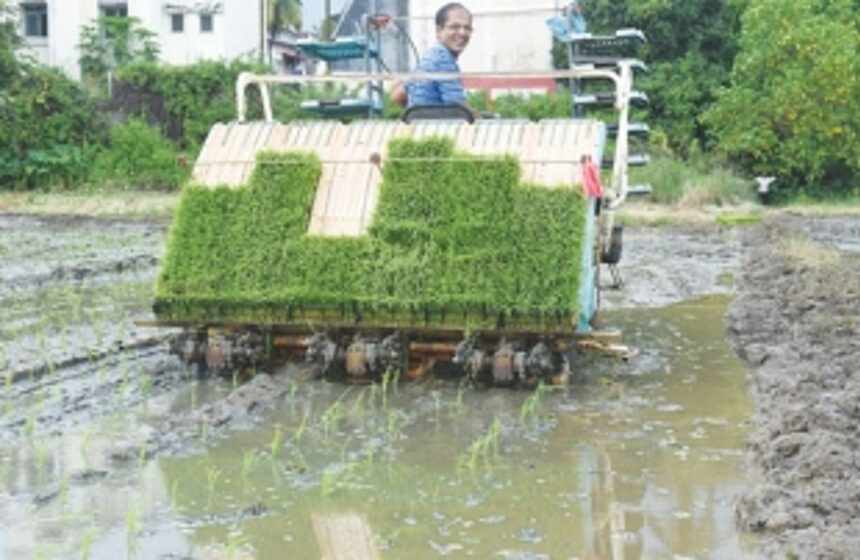
Soon after the Agriculture Department intervention, Father Quadros Project Director of the Don Bosco Society from Loutolim bought those machines at a cost of Rs 45 lakh, which was helpful in mechanised nursery for seeding of seedlings on special trays and then planting it actually on the field by use of specialised machine.
“Now the farmers had no tension of growing seedlings, planting for paddy saplings and arranging labour at a high cost. All the extra work and cost are eliminated by the use of the machine. The machine does it all and it also maintains perfect distance between the two neighbouring saplings which is not possible if done manually. Also, with mechanised farming a farmer can have three crops in a year,” added Father Quadros.
Also, not only has the yield has gone up multifold but due to mechanised farming, the farmers are able to reap at least three crops in a year as against two. It normally takes 110-130 days for the rice to ripen and be ready for harvest. In fact, this mechanised farming is happening only in three states in India which are Tamil Nadu, Kerala and Goa.
“During the season we have covered about 12 lakh square meters and there was a rise on 5 lakh square meters last year. During the Rabi season we have covered 8 lakh square meters. In fact, my machine is fully booked for next year,” added Father Quadros. Majority of these areas are in South Goa. In Goa three varieties for paddy plant are being sowed which are Jaya, Jyoti and Karjat III. All these three varieties are high yielding and predominant in Goa. The yield may vary between 6 tonnes per hectare (2.47 acres is equivalent to on hectare) to 12 tonnes per hectare.
Gauri Prabhudesai who works as Assistant Agriculture Officer at Zonal Agriculture Office in Margo says that this mechanisation of paddy sowing is a game changer and it has really helped the farmers a great deal.
“This has not only made paddy farming cheaper as there is no cost involved for seeding, labour for sowing seeds etc. In fact, farmers are coming together like in community farming which is making farming further economical. In fact, it became their need to come together. In Goa we had fragmented land and now with mechanisation, those boundaries have been given away so that the machine can be utilised to a maximum for sowing paddy,” added Prabhudesai.
She added that many farmers who had virtually abandoned farming and kept their land barren for last eight years are now coming and demanding the help of the Agriculture Department and Father Qudros. “Earlier paddy was sowed only for family consumption but with entry of Father George Quadros and introduction of mechanised farming the scenario has completely changed and farmers are now taking it up in commercial scale,” said Prabhudesai.
Cynthia Aguiar is a farmer in Cavelossim for last 16 years has been using the services of Father Quadros for last four years. “The rate of hiring labour is too high and his machine is very useful for us and we in fact work less for more produce. In fact, nowadays we do not have any tension. We just book our time with Father and keep our field ready and rest is done by machines. We do not even put manure and we only use cow dung as manure and the yield is very good,” said Aguiar.
Savio Peres who is a farmer in Curtorim village for last eight years said, “It is excellent and we are getting great yield and I am into this mechanised farming for last four years. It is cost efficient and less laborious. In fact investment is much less and the productivity is much higher. My field produces 600-700 kilos more rice than what it used to produce earlier.”