November 25, 1510 is the date of the recapture of Goa by Afonso de Albuquerque
from the Sultan of Bijapur and to commemorate it, Albuquerque dedicated the
victory to Saint Catarine, and she was chosen as the Patroness of the Cidade
de Goa. A small chapel was ordered to be built and it was made of straw and
palm leaves, with a painting of the Saint placed inside. This shine was rebuilt
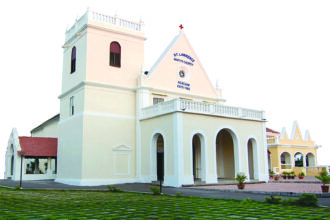
to what is today the Chapel of St Catherine at Old Goa, which was constructed
in 1550 by then Governor Geroge Cabral on the same place where the mud chapel
earlier stood, close to one of the gates on the Northwest side of the bank of
river Mandovi. Prior to the Exposition of 1952, restoration work of the
interior of this chapel was executed.
This is a historical monument as it is the location of a gate of
the fortified castle of Adil Shah on the Northwest side along the River Mandovi
from the present arch (Riveira gate) through which Albuquerque entered. The
Chapel of St Catherine was built on the site of one of the citadel gates of
Adil Shah for reasons of sentiment and strategy.

The chapel is a UNESCO listed world heritage monument, and among
the oldest structures in the Cidade de Goa. At the request of
Albuquerque, the Portuguese King Dom Joao III ordered that November 25 the
entire senate with the Cathedral Chapter and other religious groups should join
in the procession to this chapel for a thanksgiving mass and be present at the
feast at the Sé Cathedral.
Roman Catholic traditions were followed, and the chapel was once
the centre of attraction, famous for the procession of the confraria attired
in the red gowns, besides other Church dignitaries, the viceroy, senators and
others attending. It was customary that during the solemn Mass, the Portuguese
forces fired a 20-gun salute. This was continued till the last Portuguese
Governor General left India.
The life size bronze statue of St Catherine once stood on the
top of the Viceroys Arch in the niche above the statue of Vasco da Gama. In
1948, torrential rain caused severe damage to this Arch, and it was
reconstructed in 1949, removing the statue of St Catherine, which can now be
seen in the courtyard of the convent of St Francis of Assisi Church.
The main structure of the chapel is made of hard red laterite
stone in simple renaissance style, the façade is of three stories high, where
an image of Our Lady and monstrance on a black basalt stone carved on it, above
the main door, two towers flank two square towers on the side. And a niche at
the centre once housed the statue of Saint Catarina and a cross above it.
Inside, on the main altar, there was a statue of Saint Catarina
in the niche, which was recently removed by the Archaeological Survey of India.
There is an excellent depiction of the Saint’s martyrdom in Sé Cathedral.
Soon
after, the Arch of the Viceroys collapsed, but a journalist, the late Antonio
de Menezes, had taken a photograph that is so unique that the detached head of
Vasco da Gama is perceptible giving the milieu of the busted Arch. The rebuilt
Arch lost the brilliance when the vaulted room was replaced by a plain
pediment.