Animal sanctuaries are remarkable institutions that deserve
immense praise for their invaluable role in providing a safe haven to animals
in desperate need. These serve as beacons of compassion and make a significant
impact by rescuing, rehabilitating, and protecting animals from a wide array of
abuses, neglect, and exploitative practices.
Sonia Smart, one such individual, has dedicated her life to
the well-being of animals and runs the Cat Sanctuary Goa, located in the small
quiet village, Olaulim. Originally hailing from Uttar Pradesh, Sonia’s journey
has taken her across different regions, shaping her diverse background and
unique perspective. Having spent 25 years living in Nepal, while her formative
years were spent in the state of West Bengal, Sonia has had the opportunity to
immerse herself in the rich culture and traditions of these states. In May
2015, Sonia embarked on a new chapter in her life by relocating to Goa. Her
decision to establish a sanctuary for cats in Goa reflects her unwavering dedication
to providing a safe nurturing environment for these beloved animals.
When living in Nachinola, she would take her daughter to
school, stopping at the Aldona market where she’d often see numerous cats. Soon
she developed a habit of feeding them every day. Taking it upon herself, she
would take the cats, one by one, and have them neutered before returning them
to the market. She provided them with food and water, knowing that the market’s
vicinity offered abandoned spaces where they could find refuge. “However, the
market environment posed numerous dangers for the vulnerable kittens. Dogs,
traffic, cruel individuals, and garbage made them prone to illnesses. Contrary
to common belief, leaving a kitten in the market doesn’t guarantee survival, as
they would resort to eating waste and inevitably fall sick. I then, made the
decision to take the kittens home. This way, I could provide them with a safer
and more nurturing environment,”
she says.
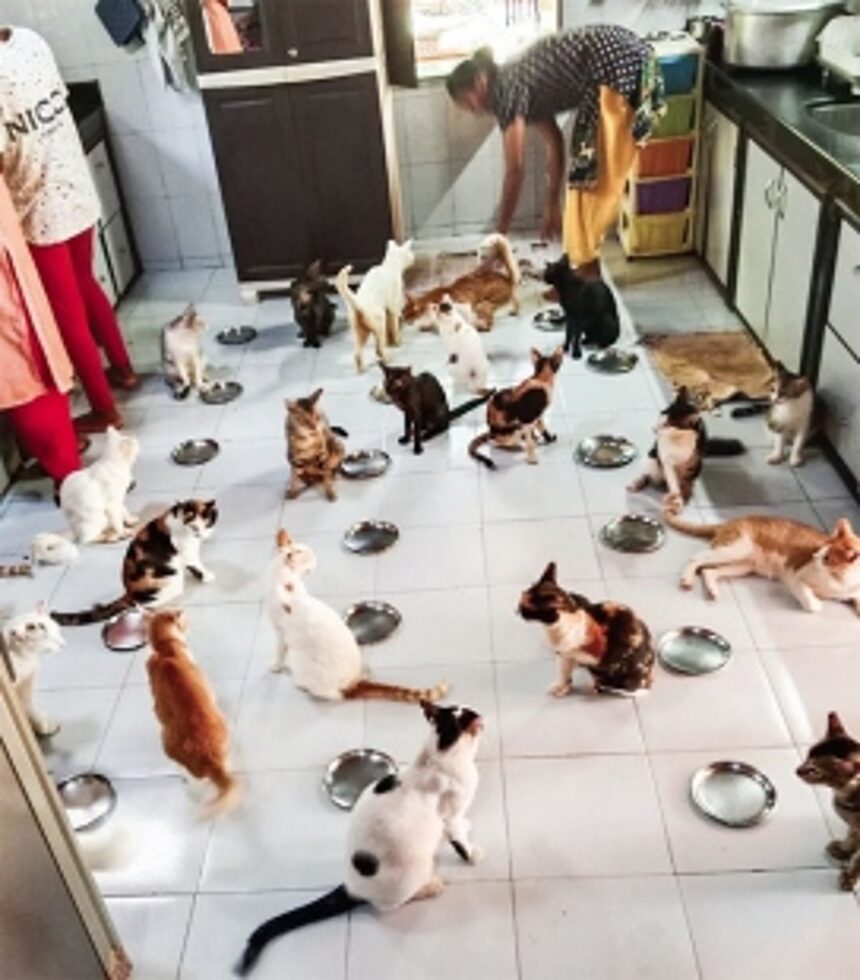
She expresses, “When I first arrived in Olaulim, in 2016, I
brought along 22 cats with me. Fast forward to the present day, and our feline
family has grown to 142. These cats are cherished members of our family. We all
reside in this house together, which serves as our permanent home. It’s not a
shelter where we come and go, leaving the cats under someone else’s care.”
Instead, the cats are provided a cage-free environment to roam freely.
Surrounded by gardens, the rented Goan house is fenced on both sides, to ensure
the cats’ safety from dogs and other predators.
Cats are brought from various locations such as Margao,
Vasco, Panjim, and even Mumbai, where they may not have had a safe space or the
necessary resources. “Among the cats I have taken in, there are five blind
cats, ten cats with three legs, two deaf cats, one cat recovering from
paralysis, two cats with cerebellar hypoplasia, and cats with impaired vision
or just one eye. Our group of cat rescuers, fosters, caretakers, and
transporters in Goa work together to address this challenge. While there is a
significant number of dog rescuers and cattle caregivers, the number of cat
rescuers remains quite limited,” she says.
The cat exclusive sanctuary is also currently housing four
rescued dogs. She states, “Although we are not an NGO, we would like to
register it as such. We are currently a cause taken up by family effort.”
Residing with her daughter, and a team of five individuals, they work together
to maintain the house. These individuals are highly committed and conveniently
live nearby. She says, “We are incredibly fortunate and blessed to have such an
excellent and dedicated team. Furthermore, since the house belongs to a
veterinarian, we receive valuable support from them.”
She continues, “Once a cat under my care reaches the age of
4 months, I consider them a resident cat and choose not to put them up for
adoption,” she says. This is because they have already established this place
as their home and are familiar with their surroundings. Cats typically have
difficulty adjusting to new environments and may attempt to run away.
Convincing potential adopters to create a secure space for the cat, confining
them for a few days, can be challenging as they often believe they know better.
As a veterinary assistant, she has the ability to provide
basic treatment for the cats. However, there are limitations, and complex
medical issues are taken care of by a qualified veterinarian. She would rather
not take in owned cats, but take in cats that have been abandoned or dumped.
She goes on to say, “When people approach me with complaints about having too
many cats, urging me to take them in, I respectfully decline. I firmly believe
that these cats are their owners’ responsibility but, I offer assistance in
getting the cats neutered and help facilitate the adoption process.”
Yet situations arise where compassionate foreigners rescue
cats and then have to return to their countries. These cats are taken into the
sanctuary. Some people threaten to abandon or mistreat their cats. She says,
“While it’s uncertain whether their claims are true or not, my priority is the
cat’s well-being, and I feel compelled to remove them from dangerous
situations.”
Her day starts at 7 in the morning, by preparing their
morning meal, which includes cooked fish with pumpkin and turmeric. The staff
comes to pick up the litter boxes, clean and sanitize them, and lay them out in
the sun while places messed up by the cats are cleaned up. At 8:30 am, the cats
have their breakfast, after which some of the cats receive medication and
grooming, while others require multivitamins. Taking care of long-haired cats
and those needing grooming is time-consuming. Some cats receive packaged food
for lunch, especially kittens, juveniles, and sick cats, not all of them.
During the afternoon, the cats sprawl out all over, sound asleep
and the staff leaves. During this time, Sonia manages social media and engages
in crochet work. The evening meal, prepared in the afternoon, consists of
chicken, minced meat, liver, heart and pumpkin cooked with turmeric. By 7 pm,
the cats are fed and the house is tidied up. Litter trays are cleared, and the
cats are brought inside by 11 pm for a good night’s sleep. According to Sonia,
sleep is peaceful as the cats don’t fight or play at night.
The sanctuary has a presence on various social media platforms
like Facebook, Instagram, Twitter, and YouTube, under the name “Cat Sanctuary
Goa” and have supporters who have trusted and helped them for 7 to 8 years
continuously who contribute whatever donations they can. She says, “We also
continue to feed the cats in the market, a responsibility taken up by my sister
and her twin daughters.” They feed these cats every single day, provide water,
and administer medication when needed. They also report any new cats and take
home any abandoned kittens. This effort hasn’t stopped, even during the
Covid-19 pandemic,” she explains.
However, expenses pose a challenge as nothing comes cheap.
Providing the cats with dry food put her in debt, and therefore have switched
to home-cooked food, which is also costly.” Various methods to meet expenses
have been employed, including a sponsorship scheme where people can sponsor a
cat for two thousand rupees per month. This support helps cover the costs of
food, medical bills, transportation, rent, and staff salaries. Donations are received
from people who know and support them, as well as occasional large donations.
“Nevertheless, we do face struggles and hope for an improvement in our
financial situation,” she explains.
She adds, “I invite everyone to visit the Cat Sanctuary in
Goa to witness the positive impact of their contributions. The sanctuary is
open for visitors daily from 1.30 pm to 5.30 pm. Bring your family and
children, to enjoy the company of friendly cats in a peaceful green village,
often described as a little piece of heaven.”