With an emphasis on art that is original and striking, the exhibition ‘Form, Metaphor, Memory’ showcased works by the four awardees of the Goan Artists’ Grant, instituted by the Serendipity Arts Foundation in 2019 and selected by an eminent jury comprising Dayanita Singh, Sudarshan Shetty and Mario D’Souza.
Each artist was given a room to display their work at the Serendipity Arts Festival 2019. And while the support given to the artists was lacking in terms of proper cleaning, lighting and display equipment and the absence of a curatorial note or strong curatorial direction, the grant recipients nevertheless made their presence felt with artworks that made an impact on viewers and were both cool and conceptual.
Akshay Chari is an alumnus of the Goa College of Art and the SN School of Arts & Communication, Hyderabad and comes from a family where carpentry has been the main profession through many generations. His artistic practice draws deep into his lineage of carpentry to articulate his main concern – the rampant ecological destruction of his tiny land visually defined by beaches and boulders.
Akshay has received several awards – the 43rd State Art exhibition Student category, 2018; 44th State Art exhibition Student category 2019 and been invited to participate in the fourth edition of the Student Biennale 2018 which runs parallel to the Kochi-Muzuris Biennale.
Of his work, he says, “Belonging to the small village of Canacona and a family of carpenters, I have grown up in an area and environment filled with the art of furniture making and crafting.
“Somehow through the generations the tradition is on the verge of extinction and these tools are abandoned, the tools that I perceive as a window to the past. These tools are like cannons and can tell us about the time when they were created and give us an idea of the world, serving as the tangible link connecting “people today” and past societies. Seeing these tools lying lifelessly in drawers and the shelves, I was urged to explore them.”
Looking at the important element of precision in carpentry, Akshay associates the hypnotic act of patience with the aftermath of mining on the land, using nails. He says, “The act of hammering nails (tools) precisely is a metaphor of authorities covering their tracks and creating a hoax vision of things being in order. The ‘Mountain of Nails’ also represents the huge stockpile of iron ore that has become a common sight lately in contrast to the traditional clean and green land of Goa. I basically take up elements of carpentry combining and comparing it with the other socioeconomic concerns and effects giving it a material form.”
With degrees from Central Saint Martin’s College of Art and Design (London) and the School of Film/Video at California Institute of the Arts (Los Angeles), Nishant Saldanha worked in the animation industry before moving back to his ancestral land, Goa to pursue an independent practice.
Nishant operates at the intersection of art forms to create new ways in which to experience images, including photography and book making, writing and comics. Recently, his work has become part of an intense direct commitment to the city of Panjim, which he engages with as a source of material, a backdrop for artwork and a space for artistic exploration.
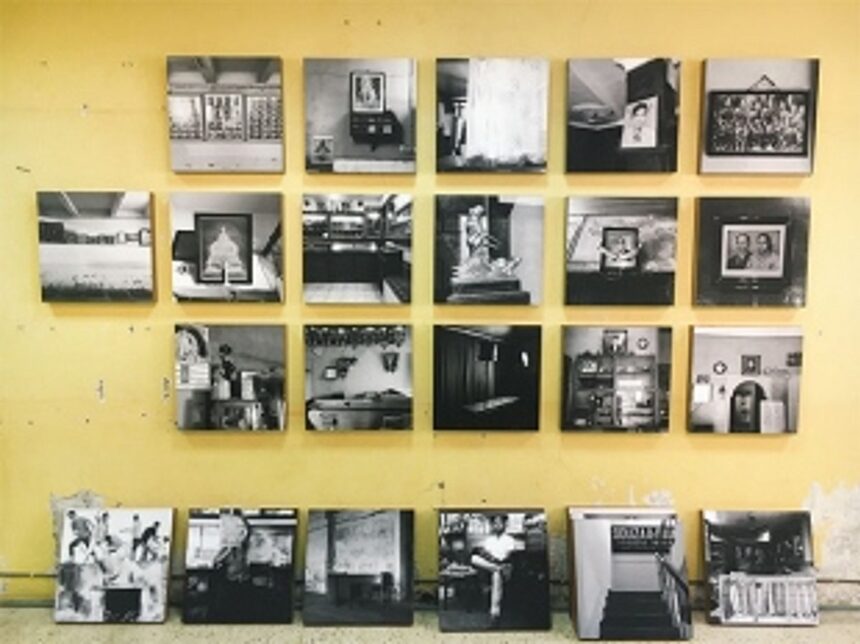
He presents ‘Ponnjechim Dukanam/ Shops Of Panjim’, an early stage archival project of Panjim City’s old shops and commercial establishments.
By working closely with the owners of each establishment to understand its history and place in Panjim’s economic narrative, the artist makes portraits and images of objects and spaces that collectively come together in an ever-evolving web of interconnecting narratives, adding layers to the city’s biography.
The artist is interested in how viewers make meaning from such an archive, and in the potential for the creation of new meanings and discussions which will arise from multiple readings of an arrangement of this nature.
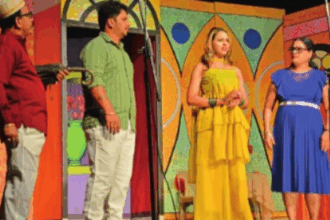
Rajaram Naik holds a BFA from the Goa College of Fine Arts and has previously exhibited in the Students’ Biennale as part of Kochi-Muziris Biennale 2016 and has received two awards in the 41st State Art Exhibition in 2015-16. For SAF 2019, the young Goa based artist explored his fascination for ‘Dashavtara Natak’, a traditional practice prevalent in the Konkan belt he is deeply rooted in. Referring to the 10 avatars or reincarnations of the deity Vishnu, the colourful dramatic portrayal is enacted in village temple premises, replete with music and dance and usually performed by male actors playing female characters. Rajaram says, “I have grown up experiencing this tradition closely. The practice always makes me wonder about the dedication and the process of characterisation that the actor goes through for such a transformation physically as well as psychologically.
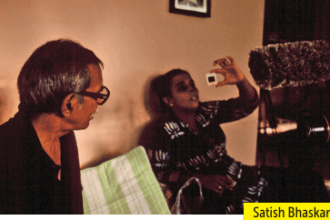
“My work is basically a portrayal of the dashavatara artist’s life through the sound and visual mediums, with research and insights into his life and lifestyle, through his history and story, through understanding his persona and binding together the different characters he plays throughout his day. My working process involves vigorous research with site visits, interviews, photo documentation and audio-visual recording. This work will exclusively explore the life of a Dashavatara artist named Bunty Kambli, whom I have been watching perform for a long time in my village. I have been observing his life closely, to know more about his struggles and passion for the art. These artists dedicate their life to the art, especially when they need to play the female character. For instance, they do not use a wig but they grow their hair to fit into the skin of the female character they enact. It’s a process of total transformation and dedication to commit to a role like this.” Rajaram hopes to use this study as the starting point of a series that will further explore these “living traditions… and spread awareness about the forgotten traditions through documentation, a mere attempt at freezing them in material, textual and visual mediums forever.”
Rujuta Rao received her BFA in sculpture from Maharaja Sayajirao University of Baroda in the year 2011. Subsequently, she moved to New York City to pursue her MFA in Fine Arts at Parsons the New School for Design. She presently lives in Goa and primarily works on making images (moving and otherwise), objects, garments and working with sound and writing.
Rujuta combines these diverse interests in unusual ways in her untitled work – a room where the figurations and arrangements of things keep changing every time she presents it. While she has shown iterations of this particular project before, this was the first time the young artist presented an array of deconstructed garments she had made along with sculptural objects and images that she regularly encourages viewers to interact with. The space is open to interpretation – is it a studio, a workshop, an installation? Deliberately set up to look like a shop, the space encourages interaction and engagement. Says Rujuta, “I had grown disappointed with the distance between artwork and viewers in a gallery and this work is to see if a different kind of engagement is possible.”
The tactility of fabrics, the purpose of garments – whether to cover the body or embellish it, the use of materials such as old upholstery, damaged discarded fabric from shops, cut pieces, repurposed old garments, ideas of durability, functionality, materiality and beauty come to the fore in this remarkable space that holds all of these diverse objects together to create multiple layers of meaning.