Many festivals across the globe are deeply rooted in nature and are celebrated in commemoration of mythological and historical events, and arrival of new seasons. The festivals are also celebrated to observe the birth of a deity or some important legendary events. Every religion or tribal communities have their own unique festivals which are community celebrations or specific to a particular region deeply connected to culture and tradition. One such festival which has legendary status in Hindu religion is Vata Pournima or Vada Punav, as Goan calls it.
This year, it will be celebrated today, June 21, which incidentally is also the Longest Day of the Year in the northern hemisphere. It is a festival amidst nature when women begin their day by fasting for the long life of their husband and a blissful family life. The festival is celebrated during monsoon on full moon day in the Hindu month of Jyestha, mostly in the western and northern India.

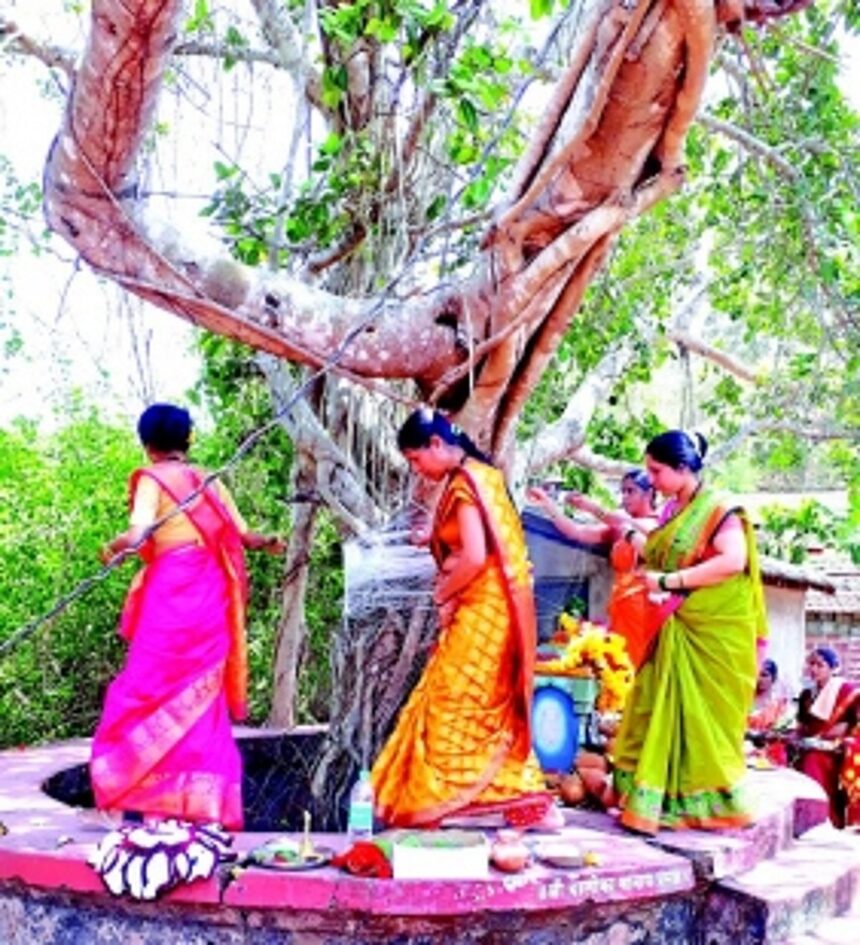
On the day of the festival, women dressed in colourful festive attires, mostly wearing Nav Vari (nine yard) saree throng to the nearby sacred Vata Vraksha, the Banyan tree (Ficus benghalensis), considered the abode of gods, and the tree that sustains hundreds of plants and animal species. It’s a colorful sight as women offer prayers for long life of their husband and marital life by tying a sacred thread around the banyan tree. The thread signifies a strong bond between husband and wife. The celebration is in honor and dedication of the mythological princess Savitri, and every woman is inspired by her.
The story dates back to Mahabharata period and revolves around a highly dedicated, intelligent and charming princess Savitri, daughter of king Ashwapati and queen Kaushalya from Madra kingdom. Enlightening on this fascinating tale, Vimal Nigale from Porvorim, well versed in Hindu culture and traditions says, “When Savitri attained marriageable age, her father asked her to choose her husband and to her misfortune, she selected prince Satyavan, son of king Dyumatsena, who was destined to live only for a year after marriage, which only Sage Narad knew. Despite knowing the impending bleak future in marital life, Savitri was steadfast in marrying only Satyavan.”
One day when Satyavan went to collect firewood in the forest, Savitri also accompanied him remembering it being the last day of his life as prophesied by Sage Narad. After a tiresome day, he rested on the lap of Savitri, under the canopy of a giant banyan tree. When the god of death, Lord Yama, arrived to take his soul, Savitri
prayed to spare his life. Due to her resolute dedication and love, Lord Yama granted her four wishes, by which her father-in-law regained his eyesight along with restoration of his kingdom. Next, she wished for a son to her parents and finally she managed to trick the lord to bestow life on Satyavan.
Most celebrate the festival by performing Pooja at a community Banyan site, whereas many do it at home. At home, a small twig from a Banyan plant is placed in the Supli in a mound of mud and sand adorned with flowers. Basket (Supli) made of bamboo comprising the seasonal fruits, bangles, Mangal Sutra, haldi (turmeric), kumkum (vermilion) and kajal (eyeliner) as offerings to Savitri is worshipped. When the first Pooja is carried by a newly married woman, a priest performs the religious rituals, confirms Rekha Karbotkar from Mayem.
In the past, newly married women fasted for three days and would break her fast on Vata Pournima day. On the fourth day, she would celebrate by inviting a couple for a delicious lunch. “The practice is now only in the pages of history. Fasting is basically followed by a married woman that signifies her sacrifice, love and long life for her husband and a strong marital bond,” Vimal adds. Women exchange pleasantries and good wishes and offer a basket often made out of Banyan leaves comprising mango, jackfruit, jamun, pineapple, guava and other seasonal fruits.
Environmentally, the Banyan tree is very vital for nature, besides its medicinal value, the large canopy that grows keeps the surrounding very cool. With people becoming more environmentally conscious the practice of cutting branches must be discontinued, feels Vimal. Instead women can grow a plant at home in a vase and then the sapling can be transplanted somewhere in the open so that festivals can be celebrated with sensitivity.
Vimal exhorts women to get a sapling from forest department and plant it somewhere and nurture it. In Pune, there are few places like Vetal Tekdi (hill) and near Fergusson College where people plant Banyan sapling. Off season, they visit the site and water the plant and also put some manure for its growth. Such a measure will enhance biodiversity conservation as festivals like Vata Pournima can foster such an initiative.
The story shows strong resolve of a lady who has self-belief no matter what may come next, and Savitri is epitome of womanhood completely immersed in the wellbeing of her husband and family, which is more relevant even today as in the past.
While the festival in recent times has gained greater significance with cultural traditions being reinvented and professed more aggressively, care for nature could be a positive message from the festival.