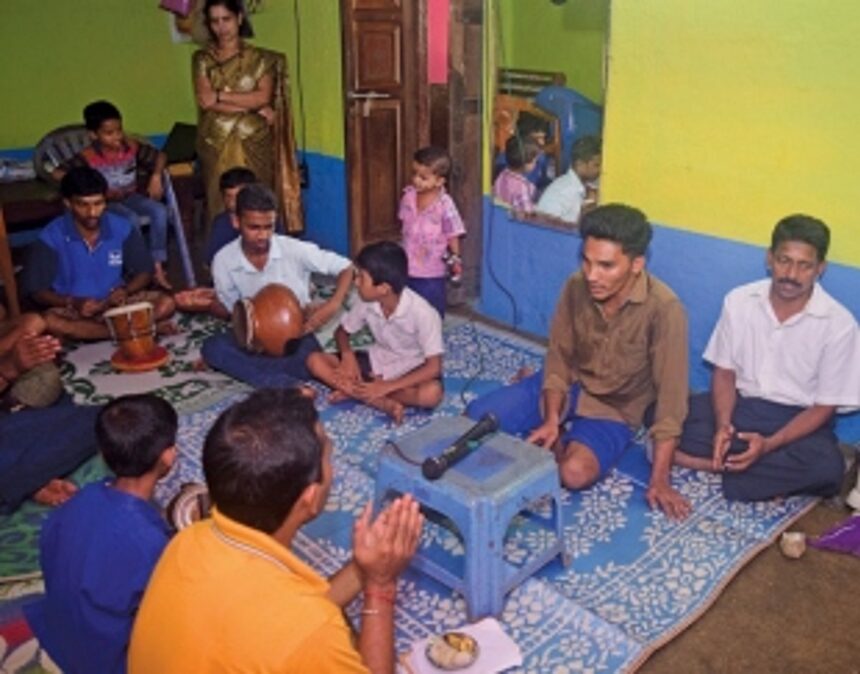
Amidst the bustle
of the festival, you are bound to hear the beats of the ghumat as
it is being tuned or drummed
upon in one of the houses in the vicinity. This is the first sign that the
villagers are getting ready for ghumat aarti around
the neighbourhood. An integral
part of basic rituals of Ganesh Chaturthi, ghumat aarti has also become a beautiful way for
youngsters to strengthen their devotion. Mostly comprising youths in the age group of
10-25 years, these groups travel in their wards to perform in each home.
Rupesh Pednekar from Pirna and the boys of the ward get
ready for Ganesh Chaturthi a few days before the festival. Earlier, they had a
group that would participate in competitions but as the boys have grown up and
are now working, they find it hard to practise. However, they devotedly sing
and play the musical instruments before Lord Ganesha during the five days of festivity. The
boys in the age group
of 10 to 25 years are trained by the elders in the group itself.
“We are around 10-15 boys from the same ward who perform ghumat aarti. Siddesh and
Sanket Naik are the main singers, while the instruments are played by Darshan
Naik and Pankaj Naik on ghumat, Kiran Naik on shamel and I play
the kasale. We meet at the Shantadurga Rashtroli Prasann in our ward and
then we go to the houses to perform the ghumat aarti. We do this on the second and
fifth day. On the fifth day, all the idols of the ward are first brought to
Shantadurga Rashtroli Prasann where we perform ghumat aarti for over an
hour from 9am,” says Rupesh.
Shubham Naik from Margao has been singing ghumat aarti
since the age of 10 and is currently a final year student of Goa College of
Music, Altinho, Panjim,
studying the harmonium.
Trained over the years with regular practises, he is part of the Sai Damodar
Ghumat Aarti Mandal that recently
won the first place at the Aquem Sarvajanik Ganesh Utsav on August 7, 2017. He
also won the best singer award.
“Our group consists of 10-12 members and we perform ghumat aarti with ghumat,
kasale, shamel and tanpura. The competition season for ghumat
aarti begins from the
month of Sharavan in
July and goes on till December. We practise almost every day at the mutt
and during Ganesh Chaturthi, we sing in the ward and also have special performances. We begin with ‘Sukhakarta’, which is the main
aarti for Lord Ganesha
and has to be sung first, followed by ‘Lavthavthi Vikrala’, ‘Jay He Damodara’,
‘Mahakali tu tu Mahashakti’ and ‘Ghalin Lotangan’. ‘Jay he Damodara’ is
composed by our group itself and is featured on the music album that we
recently released, titled,
‘Jay he Damodara’,” explains Shubham. Their duration of ghumat aarti in
each house is almost 25 minutes.
Dattaraj Shetye from Sankhelim is currently working as a
music teacher with the
Art and Culture Department and is deputed at Shri Bhumika High School, Valpoi.
Even as a student and now a teacher, he practises daily from 5am to 7am.
“Playing musical instruments and singing are natural gifts but those who want
to get better at it have to practise continuously. Ghumat aarti can be
performed throughout the year and almost every village has a music teacher who trains young
boys to sing bhajan and aarti correctly. Everything has to be perfect when they
perform together. It should be on the same beat and the timing of all the instruments has to be right. I teach the tabla
but if I know my students are also playing the ghumat, I correct
them in case they are going wrong,” says Dattaraj.