Goans are known for being extremely talented in fields like music and football among others. Goans probably have a 24th pair of chromosomes coding for both these talents. “Music gives us wings to fly and turns our dreams into reality,” says music enthusiast
Fr Mansueto Marcelino Fernandes, a Diocesan priest, serving the Capela do Menino Jesus in Murida, Cuncolim.
Being Goan, one needs to be aware of, and hence take pride in the rich heritage one has inherited and carry it gracefully into the generations to come. Intangible heritage of the state like that of its music, song, dance and stories cannot be preserved as an object in a museum. These are living and breathing antiquities and if need to be preserved, have to be practiced and lived. Music schools that taught to read western music were present in Goa right from 1545. In 1551, a Jesuit missionary Fr Gaspar (associate of Saint Francis Xavier), introduced choir masters, organ accompanied chants and sung mass. Organs were common in churches in the 1540s. Alongside these European instruments, native ones continued to be used. One of them undoubtedly being the ghumott, which was banned in churches in the 18th Century by the decree of Inquisition, dated April 14, 1736. With the ghumott, other Indian instruments like flutes were banned at weddings. Konkan song is part of the tradition of song in Konkani, which is the language of the land that came to be recognized as Goa in 1510. The theme for Goan song is life, expressed in three of its sides. Firstly, the ultimate meaning of life which includes religious pieces, secondly, the crucial moments of life (birth, death and middle age) and thirdly, the festive occasions of life. The various types are popular art songs (songs without a set theme), religious songs (Fugrhi/Fugdi), theatrical songs (Tiatr songs, zagor songs), childhood songs (Palnnam), caste-based songs (Dhalo), occupational songs (work songs sung by toddy tappers), random folk songs (miscellaneous folk songs celebrating random moments), death songs (Dirges), marriage songs (Ovi, Shobhane), and dance songs like ‘Deknni’, including the Mando. The Mando is a form of 19th century Goan song which fits into a class of songs called Dance songs.
“World music day is a reminder for each one of us that music is one universal language which allows our unique Goan music to harmonize with the diverse genres of music from around the world showcasing its power in uniting us all in perfect harmony, transcending all boundaries”, explains Luis Francisco Coutinho, a choir leader from Orlim.
Until the middle of the 19th Century, the ‘Ovi’ (Vovi), a wedding song (also banned in 1736 by the Portuguese Inquisition, but in use up to the mid-20th Century), was Goa’s most well-known form of musical expression. It is from this ‘Ovi’, that the Mando could have had its origin. Like these ‘Ovio’, the earlier Mando consisted of stanzas containing four lines while the Mando of the later years was probably influenced by the Portuguese Fado where the chorus was added to the traditional four lined stanza. The Fado was surely relished by Mando composers being quite similar to each other in many ways. As presumed, the Fado is sad but the Mando is sad and intense. The Mando, as mentioned earlier is a dance song which allows one to assume that it was created after the introduction of ballroom dancing in Goa somewhere in the 1830s.
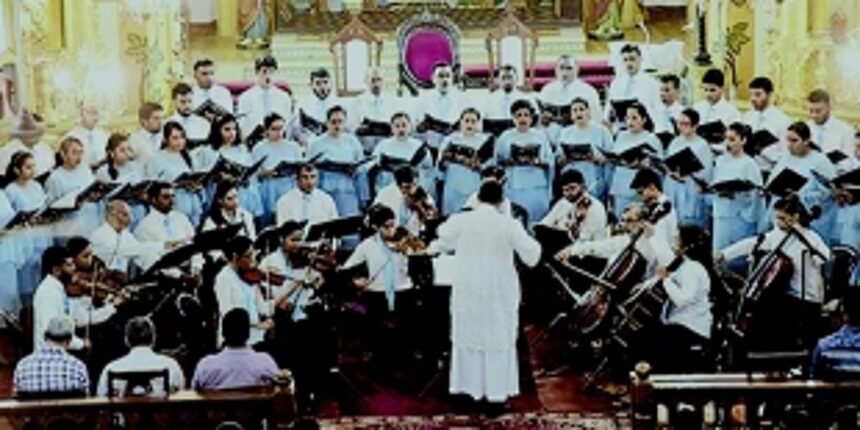
Before the Vatican Council II (1962-65), liturgical hymns during Mass, solemn vespers, office of the dead, funerals and weddings were sung in Latin using polyphonic or Gregorian music. There was very little space for Konkani with the exception of a hymn during communion or at the end of mass. Post Vatican council II, all of this changed. The parts of the Mass such as Kyrie, Gloria, Credo, Sanctus as well as the entrance hymn, offertory hymn, communion hymn, meditation hymn and recessional hymn were to be sung in the vernacular language of Goa – Konkani.
There was now an immediate requirement for vernacular hymns to be composed. It was Fr Vasco do Rego at the Patriarchal Seminary of Rachol, who single handedly penned down word after word to create suitable hymns for essential parts of the Mass and other liturgical services held during various parts of the liturgical year. He motivated local musicians to set music to these lyrics while he himself composed the music for many of the pieces.
In Goa, the practice of singing or chanting the litany is unique. It would be sung sometimes within the family, often with invited neighbors and friends. It would be sung in thanksgiving for special favors from God. This unique devotion carries special authorization from the church so the faithful could have services as and when they wanted to. At the community level, litanies were and are still held at road-side crosses and chapels. Of late, most of the traditional Latin versions of these litanies have been translated into their Konkani form, thus killing the originality of this beautiful tradition in a considerable way.
‘Exultemos com Alegria’, a song of celebration was sung at the end of the litany on the feast day, to express the joy of successfully completing the annual public devotion. Many times, one would not be able to draw any meaning from what was sung because, most of those who locally sang the litany or the song mentioned, did not know the language of Latin or Portuguese and often ended up creating their very own vocabulary. Ivo Gonçalves, a music admirer from Moira feels that most of the younger generation somehow lacks the skill of putting in emotion and instilling life and meaning into the lyrics they are introduced to.
Until the 19th Century, most Goan songs were handed down generation after generation, only via oral means. Traditional classical Indian music is monophonic just like that of nearly all of the subcontinent’s folk song traditions, including the Konkan song, which was exclusively monophonic from its inception until it became a Goan song in the 16th Century. It was in the 19th Century that some of the Goan songs belonging to the monophonic period, got modified into their harmonic version. “Music for me is ‘someone’ I can count on at all times. My one and only stress buster is relaxing instrumental music with sounds of nature. Music will never let you down as it blends with all your emotions and soothes your soul,” says Vallenie Dias e Almeida, a singer from Carmona.