If you are wondering whether the python that’s lurking in your backyard is due to deforestation and ecological imbalance, then probably you are not looking at the obvious problem. It could be because of mixed garbage which is thrown in nook and corners of Goa.
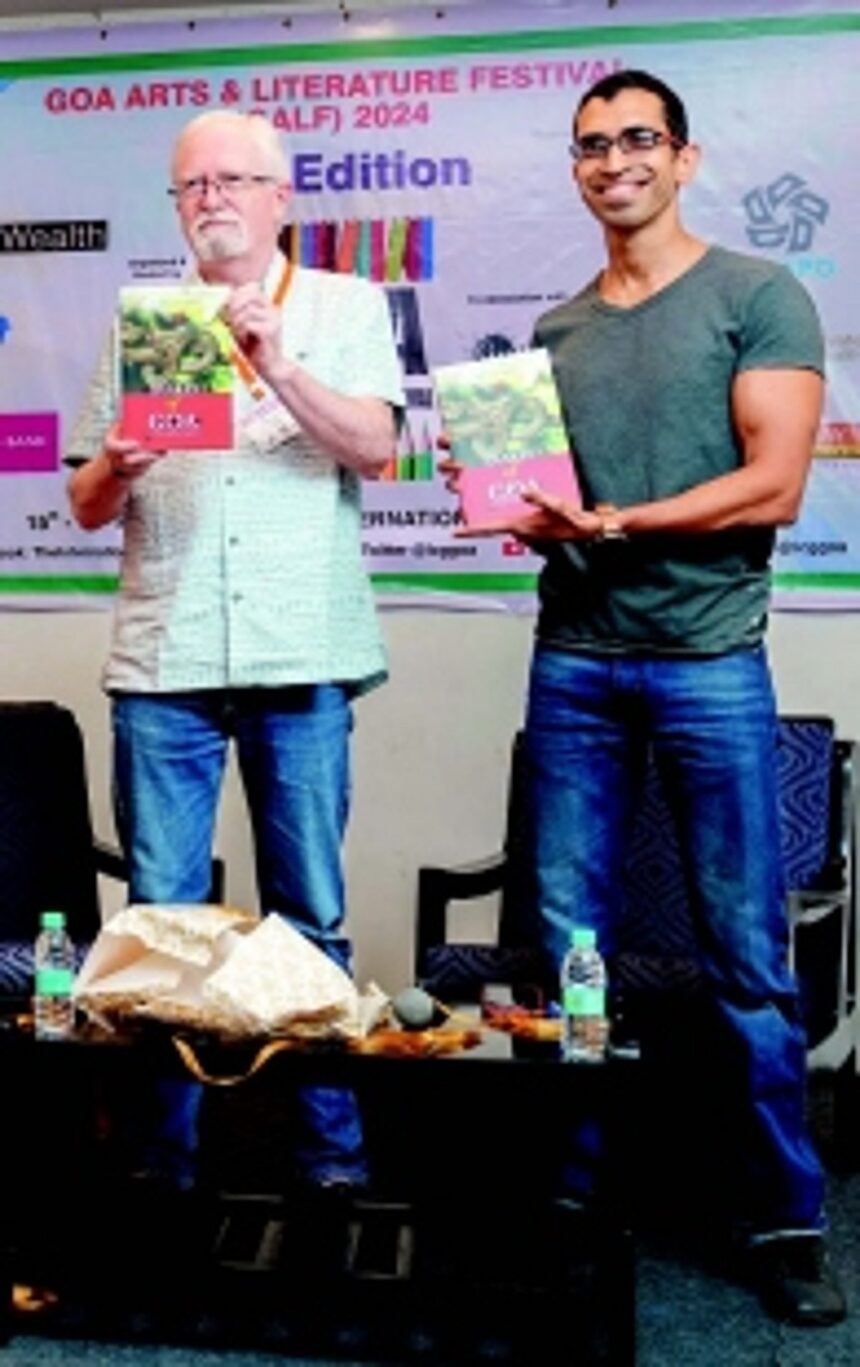
Snake rescuer, wildlife photographer, and writer, Rahul Alvares, stated, “The increasing python number is the reflection of the garbage that’s thrown out. As this garbage attracts massive rats and thus the pythons.” He was speaking during the release of his book, ‘Snakes of Goa’ at the 12th edition of Goa Arts and Literature Festival, at ICG, Dona Paula. The book was formally launched by wildlife writer, Stephen Alter and Conservation scientist, Aaron Lobo. He added that we should be thankful to pythons as they control the rat population and thus save us from the risk of plagues, etc.

Rahul at the age of 16 left school to train under two of India’s best snake experts (Neelimkumar Khaire and Rom Whitaker). He is also a self-trained wildlife photographer, which is reflected through this book. While speaking about photographing snakes in the wild, he said that it is not a good option as it will end up looking like a line. Thus, he photographs them in specific locations and because he knows how to handle snakes it is easier for him. But, then he cautioned that one need to understand when to let it go. “When you are photographing a bird, it has a choice to fly away. But as you are handling snakes, how much do you put it through? It’s great if you get a shot but if not you just let it go, and then wait for the next specimen.”
When asked about the pressing question of loss of biodiversity and threat to snakes, he added that it could be true for some endemic species which are found only in particular habitat. So, if you replace that habitat with another habitat it will attract some species like cobras or rat snakes as they are more generic species compared to forest species like pit vipers, shield-tail snake, etc.
Conservation scientist Aaron Lobo, who was present at the event stated, “Shield-tails, pit vipers are habitat specific. So if you change the habitat from moist deciduous forest to cashew plantation, then it is open to generic species like Russell vipers, pythons, etc.”
The book ‘Snakes of Goa’ lists down around 30 species of snakes found in Goa. It also speaks about other reptiles and amphibians. It is not just a field guide but it is peppered with some funny and interesting stories of snake-catching that Rahul has encountered. The book promises of helping the reader in identifying snakes, and stimulate you to look at them in friendlier terms than before.
As Rahul, during his interaction, maintained that there’s nothing about snakes that is dangerous. He stressed on the point that snakes bite or attack only when one steps on them. He said that it is like putting around 50 or 60 kgs of weight on them. He argued that because of this reason, sea snakes do not bite as in water one is almost weightless.
Speaking of snake bites, he shared anecdotes of getting bitten by checkered keelback, a non-venomous snake, during his training at the snake park. He said, “When you are bitten by non-venomous snake, something changes you. You lose that irrational fear of snakes as until that time you don’t know what it is like.”
When asked what attracted him towards snakes, he informed that he doesn’t exactly know why. He shared that as a child he was scared of chickens and dogs and not of snakes as he spent his childhood on a farm in Valpoi.