Dolcy D’Cruz
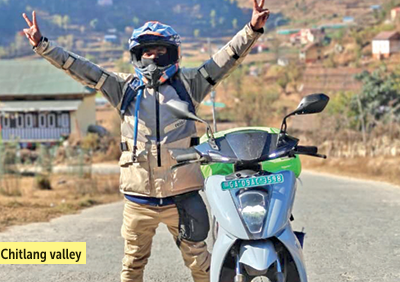
After getting a mention in the India Book of Records for being the first Goans to complete an expedition on an electric scooter from Goa through Karnataka, Tamil Nadu, and Kerala, Franky Fernandes of Assolda and Jeston Fernandes of Chandor have now set their sights even higher. The duo recently became the first Indians to complete an electric bike journey from Goa to Nepal, covering an impressive 3,300 kilometres. Their journey took them across Maharashtra, Madhya Pradesh, Uttar Pradesh, and finally into Nepal. Franky and Jeston had already made a mark in the EV biking community by completing the route from Goa to Vailankanni, the first Goans to undertake the journey on an electric vehicle. Reflecting on their planning for this trip to Nepal, Franky says, “After the Vailankanni trip, we started planning our next journey immediately, in October. We had to carefully map out the route and identify all the charging stations from Goa to Gorakhpur, which is the border with Nepal. From there, we would continue into Nepal and explore the country.” Their route took them through key cities and towns, including Solapur and Nagpur in Maharashtra, Jagalpur in Madhya Pradesh, Prayagraj, Varanasi, and Gorakhpur in Uttar Pradesh, before crossing into Nepal at the Butwal border. In Nepal, they visited Chitwan National Park, Pashupatinath Temple, Kathmandu, and Chitlang, finally returning to India through the Birganj border in Bihar and concluding their journey at the Ram Mandir in Ayodhya. Ayodhya was the final stop of their journey. Since Franky had a family emergency, the bikes were shipped back by courier, and they had to return early. Otherwise, the full return trip from Ayodhya to Goa would have taken another seven days. The journey officially began on the night of January 9, after months of meticulous planning. “We stayed in Kathmandu for three days, exploring temples like Pashupatinath Temple and attending a meet-and greet event organised by the local EV community. We then visited Chitlang, an isolated valley with some snowfall, before returning via the Birganj border and making our way back to Gorakhpur and Ayodhya,” Franky recalls. Crossing into Nepal was straightforward for the riders. “In Nepal, we didn’t need a visa; an Aadhar card or election card was sufficient to enter. We did have to pay the RTO tax for the vehicles, but the process was smooth and welcoming,” Franky explains. Unlike other long-distance EV journeys, which often rely on backup vehicles and multiple bikes, Franky and Jeston completed this expedition on their own bikes, without any support team, relying entirely on public goodwill and careful planning. “Previous journeys from Bangalore to Kathmandu were done with backup vehicles and multiple bikes. We did ours on a single bike the entire way. That made the trip more demanding, but also more rewarding,” Franky says. Jeston adds, “It was amazing, better than I imagined. As a rider, a journey is never complete without challenges. We faced some minor emergencies with the throttle sensor and belt, but we pushed on. We aimed to cover around 250 kilometers a day and took breaks when needed. Sometimes, there were no hotels or petrol pumps nearby, and we had to cover 80–90 kilometers without support. But local people were incredibly helpful, offering charging and shelter along the way.” The riders faced a wide range of weather conditions on their journey. Starting from the tropical climate of Goa, they encountered the heat and humidity of Maharashtra before moving into colder regions in northern India. “Starting from Nagpur, it was very cold. We were wearing five layers of clothing, and near the Sonali border, the fog was so dense that we could barely see the vehicle in front of us,” Franky reminisces. In Nepal, the climate varied further, with snowy patches in the high-altitude valley of Chitlang adding both beauty and challenge to their ride. Despite these conditions, the duo managed to keep a steady pace. The duo found Nepal’s EV infrastructure impressively developed. “For EV users, Nepal is a heaven. There are charging stations every 5–10 kilometers, and most taxis and tempo travelers are electric. Charging was never an issue there. It was completely different from India, where we had to request petrol pumps, toll gates, and hotels for assistance,” says Franky. Despite the challenges, the journey was conducted on a tight budget. “From Goa to the border, we spent around Rs 4,000 total, Rs 2,000 each for food and minor expenses. The generosity of people along the way made it possible,” Franky says. The Nepalese EV community also welcomed the riders warmly. “We had informed the EV company in Nepal that we would be entering, and they organized a meet-and-greet for us with local EV owners and customers. The welcome at the Butwal border and Chitwan showroom was heartwarming,” Franky shares. This expedition has already earned recognition in the Asia Book of Records and Limca Book of Records. “Till now, no one from India has completed this journey on an electric bike. We are proud to be the first,” Franky says. The trip was not just about setting records; it was also a lesson in endurance, planning, and the value of community support. “We had to plan every detail, from charging points to daily distances. The ride was smooth overall, but we learned the importance of teamwork and being prepared for emergencies,” Jeston says. The expedition concluded with a meaningful visit to Ayodhya, a culturally and religiously significant site in India. “Visiting the Ram Mandir was the goal, and ending our journey there made it special,” Franky adds. Reflecting on their journey, both riders emphasized the support they received along the way. “People were happy that we were traveling by electric vehicle. From hotels to toll gates, everyone was willing to help. That made the trip possible,” Jeston says. Franky and Jeston’s journey demonstrates not only the potential of electric vehicles for long-distance travel but also the power of planning, perseverance, and human goodwill. Their achievement marks a milestone in Indian EV history and sets an inspiring precedent for future riders looking to explore the country—and beyond—on electric bikes.