Launched as
recently as December 23, 2016, Aamir Khan’s latest blockbuster seems to be
making the news for all the right reasons. Granted, it was always going to be
in the news because at the end of the day, it is an Aamir Khan production.
However, this time around, the theme of the movie in itself is already
beginning to challenge the system that it addresses.
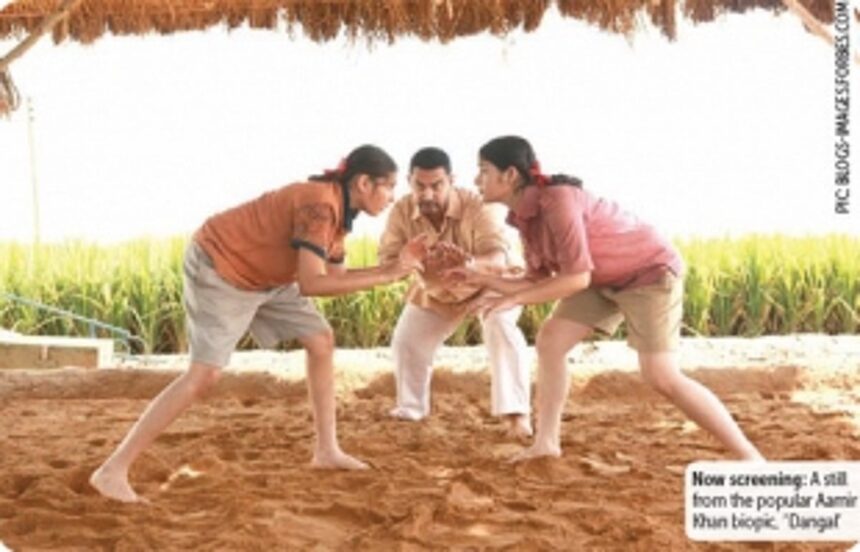
The first point addressed: Aamir portrays former wrestler Mahavir
Singh Phogat, who trains his two daughters, Geeta and Babita, to be wrestlers
even at a time when such a thought was frowned upon, which the movie has
depicted with crystal clarity. The girls take on local chauvinists of all ages,
shapes and sizes, because their father has decided to transform them into
world-class wrestlers.

The second point addressed: The corruption and lack of support offered to
sports is clearly depicted by way of Aamir’s argument as Mahavir, that says “Medal laane ke liye support koi na deta …
par medal na mile toh gaali sab dete hai.” Translated, it simply states
that no one supports you in your quest to get a medal, but when you don’t win
one, everyone curses you. His other arguments are highlighted in his fight to
get his daughters financial aid, his fight to get his daughter leave of absence
from school, to train and so on.
In a
country that turns to its celebrities to lead the way, which at the same time
has often proven itself to be one that forgets issues with the passage of time,
one needs to ask whether this is a cue for sports to be analysed, afresh; both
from the point of view of parents who have children looking at a sporting
career; as well as the officials that govern bodies that are in place to
facilitate these same aspirational candidates, without prejudice.
Café speaks to a couple of sports professionals from
specialised areas, asking them just how much these kind of productions can
alter the fate of sports that do not get much recognition in the country:
These
movies serve as inspiration. I have personally seen a lot of associations try
to approach Bollywood superstars, to try and get them on board as brand
ambassadors. This is primarily down to the fact that they motivate people to
get into things that have only been a dream until now. I feel that a film like ‘Dangal’
could see a rise in people wanting to get into such sports, as they can see the
downside and hardships of such a sport, as well as the advantages. It’s not
easy and requires a lot of personal and physical commitment, but at the end of
the day, it is worth it.
Clyde Lobo,
Boxing
These films
highlight a system that is in need of a revamp. To be honest, very often there
are deserving candidates that get overlooked in favour of those who have a bit
of clout. This is far from fair and is what requires to be shaken up. I can see
this film inspiring a lot of people to get into such sports, and fortunately,
Goa is a much smaller state where justice towards potentially great athletes
may see the light of day, as opposed to say a state like Maharashtra, where one
deserving child could be lost in a massive number of applicants. As far as
karate is concerned though, we seem to be having a massive amount of
transparency, thus far.
Joseph Rodrigues,
Karate